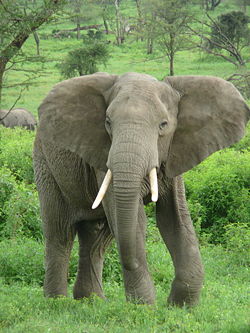
The elephants (Elephantidae) are a family in the order Proboscidea in the class Mammalia. They were once classified along with other thick skinned animals in a now invalid order, Pachydermata. There are three living species: the African Bush Elephant, the African Forest Elephant (until recently known collectively as the African Elephant), and the Asian Elephant (also known as the Indian Elephant). Other species have become extinct since the last ice age, which ended about 10,000 years ago, the Mammoth being the most well-known of these. The word "elephant" has its origins in the Greek, meaning "ivory" or "elephant".
Elephants are mammals, and the largest land animals alive today. The elephant's gestation period is 22 months, the longest of any land animal. At birth it is common for an elephant calf to weigh 120 kilograms (265 lb). An elephant may live as long as 70 years, sometimes longer. The largest elephant ever recorded was shot in Angola in 1956. This male weighed about 12,000 kg (26,400 lb), with a shoulder height of 4.2 m (13.8 ft), a metre (3 ft 4 in) taller than the average male African elephant.
The smallest elephants, about the size of a calf or a large pig, were a prehistoric species that lived on the island of Crete during the Pleistocene epoch. Elephants are symbols of wisdom in Asian cultures, and are famed for their exceptional memory and very high intelligence, on par with cetaceans and hominids.. Aristotle once said the elephant was "the beast which passeth all others in wit and mind."
Elephants are increasingly threatened by human intrusion and poaching. Once numbering in the millions, the African elephant population has dwindled to between 470,000 and 690,000 individuals. The elephant is now a protected species worldwide, with restrictions in place on capture, domestic use, and trade in products such as ivory. Elephants generally have no natural predators, although lions may take calves and occasionally adults. In some areas, lions may regularly take to preying on elephants. Read more ...
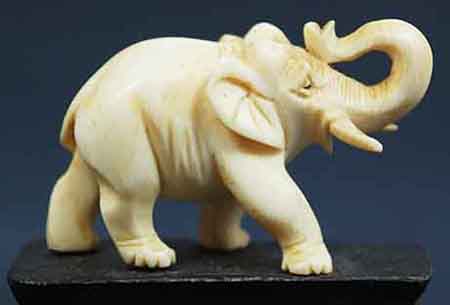
Elephants symbolize noble things such as wisdom, courage, stature and strength. Elephant tusks in particular are known to symbolize great strength. The origin of the elephant as a symbol of good luck comes from Hinduism, in which the elephant-headed god Ganesha is the elephant-headed luck-god Ganesh. Elephants are also symbols of longevity, because of their long lifespans.
Elephants have been the subject of various cultural depictions in popular culture, mythology and symbolism. They are both revered in religion and are known for their prowess in war. They also have negative connotations such as being a symbol for an unnecessary burden. Ever since the stone age, when elephants were represented by ancient petroglyphs and cave art, they have been depicted in the arts in various forms, including pictures, sculptures, music, film, and even architecture.
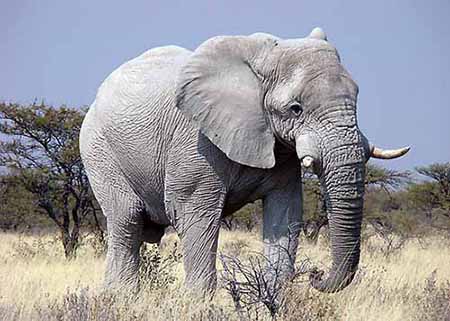
The legend of the white elephant began in Southeast Asia, the home of the White Elephant. In metaphysics we learn that any animal represented by the color white, supposedly is linked to mystical legends, giving it greater power. White represents purity, the Light. Elephants represent power and peace. When the trunk is lifted it means overcoming obstacles.
In the story of the Buddha, the white elephant is connected to fertility and knowledge. On the eve of giving birth to the Lord Buddha, his mother dreams that a white elephant comes to present her with a lotus, symbol of purity and knowledge.
At the heart of the first great Southeast Asian Empire, at the Angkor Wat in Cambodia, the might of the war elephants is depicted on murals of the region's armies. Over the next few hundred years, two states dominated the region - the forerunners of modern Burma and Thailand (Siam). In both, the elephant was a very important animal. It was key to military success - both in mass battles, and in the elephant duels. It was also key to royal pageantry - kings chose the biggest, most magnificent elephants for royal ceremonies and processions. Kings and courtiers spent a lot of time and energy hunting elephants from the forests. And the most powerful kings kept thousands in their stables.
In legend the Royal White Elephant brought sacred power. It brought fertility. For the kings of Burma and Siam, the possession of these sacred beasts became very important. A king who had many fine white elephants would be successful - his kingdom would prosper and his reign be long. If his white elephants died, it foretold disaster for the king and his kingdom.
The magnificent king needed seven things: a perfect wife, and able treasurer, a wise chief minister, a swift horse, a wheel of the law and a precious gem to guide his actions: and the most noble of white elephants. The kings hunted eagerly for these fine and special beasts. Occasionally royals presented white elephants to one another as marks of diplomacy. Wars were fought over them for the represented their rule as chosen by the gods. The Royal White Elephants were not taken to war, and not ridden in procession, Rather they were kept within the confines of the palace, entrusted to the care of senior officials, fed well, washed regularly, and worried over constantly.
When the British envoy came to Amarapura in 1855, Mr. C. Grant, the artist, drew beautiful pictures of the royal white elephant, Nibbana. Grant also made an eyewitness account of the noble beast - The color of the animal was a cream very slight dun, his magnificent tusks nearly touch the ground. He was in bands of crimson cloth or velvet and gold, studded with large bosses of gold, margined with innumerable rubies.
By the nineteenth century, the white elephant was firmly established as one of the special wonders of Siam. American Frank Vincent titled his book on Southeast Asia, The Land of the White Elephant.
From Burma came reports of the kings' extravagant care for white elephants. Though his favorite white elephant was clearly dying, the last Burmese king, Thibaw, loaded him with treasures, making him the wealthiest person in the country. His forehead was decked with a spray of diamonds to ward off evil spirits. Diamonds were set into each tusk. A golden plaque, inscribed with his titles, hung from his head - golden pendants hung from his ears. Four golden umbrellas protected him from the heat of the sun. Above his gold feeding trough, a mirror specially ordered from France was installed to reflect his splendor. Yet the white elephant died. The pundits predicted plagues, floods, earthquakes. But the real disaster was more prosaic. The British took over Burma and deposed the king.
In neighboring Siam, the kings revered the white elephant and put its likeness on their new flag. But with elephants no longer so vital for warfare, elephant hunts had become less common, and fewer of the rare white elephants were found. The Siamese king passed a law demanding that any white elephant found in the kingdom had to be presented to the king. He sent out scouting parties and offered rewards. The discovery of a white elephant became a special event, a time for national celebration.
In the 1820's After Sir John Bowring arrived in Bangkok. He negotiated the main trade treaty between Britain and Siam, the Siamese king sent to Queen Victoria a tuft of the white elephant's hairs; and to Sir John himself, a few hairs from the tail.
In the 1860's King Mongkut heard that America had no white elephants. He offered to send several pairs of young male and female elephants turned loose in the forest where there was an abundance of water and a suitable climate. President Lincoln replied that the American climate was probably unsuitable, and that they preferred to use steam power. But he thanked the Siamese king for the gift of two magnificent elephant tusks.
King Mongkut's son, King Chulalongkorn traveled to Europe in 1907. One of his German hosts had heard about the Siamese love for the white elephant. He hired a local artists to make a flag with a white elephant and hang it all around the house where the king was lodged. The King thanked him very much for the thought. It had made him feel very much at home. But it was a pity the artist had probably never seen an elephant. The animal on the flag looked more like a cow. He would send them a proper elephant. What he meant by this was the Order of the White Elephant - a decoration granted by the king for service to the state.
Today White Elephants are very rare. They are still revered in Southeast Asia- Laos, Cambodia, Vietnam. The last white elephant in Burma was found in 1961. They are different than the descriptions of the Royal White Elephants in legend. White elephants' sculptures, paintings, wood craves, murals and archives can be found in temples, palaces in Southeast Asia, especially in Thailand.
Incredibly Rare Pink Elephant Calf Seen Playing In South African National Park
Live Science - February 28, 2024
In August 2004, a rare Albino elephant was spotted spotted in Sri Lanka.

The Elephant's Trunk Nebula is a concentration of interstellar gas and dust within the much larger ionized gas region IC 1396 located in the constellation Cepheus about 2,400 light years away from Earth. It is commonly called the Elephant's Trunk nebula because of its appearance at visible light wavelengths, where there is a dark patch with a bright, sinuous rim.
As you know - seniors are forever drawn to live in Florida due to the weather, taxes, the 'pull of the coast' on the soul, etc. Years ago - when I realized this 'migratory pattern" - what came to mind - and still does - is the Elephants' Graveyard a place where - according to legend - older elephants were intuitively guided to die.
Though thought to be a myth ... Ancient 5.5-Million-Year-OId 'Elephant Graveyard' Has Been Discovered In Northern Florida IFL Science - June 3, 2023
5.2 Earthquake near Julian brings widespread shaking across Southern California. Dozens of aftershocks were reported CNN - April 14, 2025

The quake was preceded by a 3.3 magnitude foreshock just before 4 p.m. Sunday, Dr. Lucile Jones, a seismologist working with Caltech, said on a call following the quake. Jones said the quake seems to be associated with the Elsinore fault line.
Video shared by the San Diego Zoo shows the moment a group of elephants huddle to protect their young during the 5.2 Julian earthquake in San Diego county BBC - April 15, 2025
The behavior is known as an 'alert circle', a formation meant to protect calves from threats.
In the aftermath of the 2004 Indian Ocean earthquake and tsunami, reports indicated that elephants in Indonesia and other affected areas showed unusual behavior, including fleeing the coast for higher ground before the tsunami waves reached land. Some elephants even managed to escape or even break free from restraints. While the specific details of elephant behavior during the 2003 earthquake in Indonesia are not widely documented in the search results, the 2004 tsunami event highlights elephants' potential ability to sense and react to seismic disturbances and subsequent natural disasters like tsunamis. I remember elephants carrying people to safety.
Rare twin elephants - male and female - born in Thailand miracle BBC - June 14, 2024
An Asian elephant in central Thailand has given birth to a rare set of twins, in what caretakers have described as a miracle. The mother, 36-year-old Chamchuri, was not expected to deliver twins and when she gave birth to a male calf last Friday, staff at the Ayutthaya Elephant Palace and Royal Kraal, had thought the delivery was done. But while cleaning up the first calf and helping it stand on its feet, they heard a loud thud and realised that Chamchuri had given birth to a second calf, a female. The second birth sent the mother into a panic and caretakers had to restrain her to prevent her from stepping on the female calf. One caretaker was hurt in the melee. Dramatic footage on social media showed a crowd of caretakers - known locally as mahouts - frantically separating the female calf from the mother, with blood from the birth still visible on her hind legs. Twins occur in only one percent of elephant births and male-female are even more rare,
African Elephants Call Each Other By "Names", Just Like Humans Do IFL Science - June 12, 2024
Nw research has suggested that wild African elephants could address each other with individual specific calls - the equivalent of a name - with fascinating implications for the evolution of language.
Video: Listen to Elephants Call Each Other By Name
Woolly mammoth de-extinction inches closer after elephant stem cell breakthrough Live Science - March 7, 2024
Scientists at the company Colossal Biosciences have derived induced pluripotent stem cells from elephants, which they say could boost efforts to resurrect woolly mammoths. iPSCs also open a path to creating elephant sperm and egg cells, which are essential for mammoth de-extinction, in the lab. With fewer than 52,000 Asian elephants left in the wild.
Asian elephants loudly mourn and bury their dead calves, according to a study by Indian scientists that details animal behavior reminiscent of human funeral rites. Science Alert - March 4, 2024
They found in each case that a herd carried the deceased calf by the trunk and legs before burying it in the earth with its legs facing upward.
On the Kenya-Uganda boundary lies Mount Elgon. Inside this extinct volcano, there is a fascinating animal population: Cave Elephants IFL Science - July 12, 2023
The entrance is idyllic and is found behind a beautiful waterfall and bountiful foliage. The fascination for these elephants is what lies on the surface of the volcanic rock - salt. Elephants need minerals for a healthy lifestyle and pregnancy. Often, they get this from the soil or surrounding vegetation, however, in this location rainfall is three times the amount in London, which makes the vegetation on the mountain mineral-depleted. This is why they go through all of this effort to traverse the rocky caves. These caves are abundant in calcium, magnesium, and sodium, and a single elephant can excavate up to 20 kilograms (44 pounds) of rock in one night.
Ancient Elephants And Mastodons Were Totally Down With Inter-Species Boning Gizmodo - February 26, 2018
New research published this week in Proceedings of the National Academy of Sciences shows that ancient elephants were very much the product of interbreeding between species. Elephants - both those from the ancient past and those living today - were shaped by this mating practice, but it isn't something the two remaining species of elephants are into any more. Interbreeding among closely related mammalian species is fairly common. Good examples today are brown bears and polar bears, Sumatran and Bornean orangutans, and Eurasian gold jackals and grey wolves. Evolution does a pretty good job of creating advantageous new traits using the powers of random mutation, but there's nothing quite like interbreeding, where the traits from two different species get intermixed. And in fact, our ancient ancestors were into the whole interbreeding thing, too, with anatomically modern humans getting it on with Neanderthals and Denisovans. So in a way, we're also a kind of hybrid species.
Complete genomes of extinct and living elephants sequenced Science Daily - February 26, 2018
Researchers have produced one of the most comprehensive evolutionary pictures to date by looking at one of the world's most iconic animal families - namely elephants, and their relatives mammoths and mastodons-spanning millions of years.
Asian elephants have different personality traits just like humans Science Daily - February 21, 2018
Researchers of the University of Turku, Finland, have studied a timber elephant population in Myanmar and discovered that Asian elephant personality manifests through three different factors. The personality factors identified by the researchers are Attentiveness, Sociability and Aggressiveness. As is commonly known, people have different personalities, and the structure of human personality can be divided into five factors. Other species' behavior also differs between individuals: some are braver, more social, or aggressive than others. These kinds of consistent differences in behavior are called personality. Personality studies on other species than humans have so far focused on primates, pets and zoo populations, or on species that have a relatively short lifespan. Besides humans, personality studies on other long-lived species living in their natural habitat are rare.
Mysteries of elephant sleep revealed BBC - March 2, 2017
Wild African elephants sleep for the shortest time of any mammal, according to a study. Scientists tracked two elephants in Botswana to find out more about the animals' natural sleep patterns. Elephants in zoos sleep for four to six hours a day, but in their natural surroundings the elephants rested for only two hours, mainly at night. The elephants, both matriarchs of the herd, sometimes stayed awake for several days. During this time, they travelled long distances, perhaps to escape lions or poachers. They only went into rapid eye movement (REM, or dreaming sleep, at least in humans) every three or four days, when they slept lying down rather than on their feet.
Desert elephants pass on knowledge -- not mutations -- to survive Science Daily - August 4, 2016
Despite reported differences in appearance and behavior, DNA evidence finds that Namibian desert elephants share the same DNA as African savanna elephants. However, Namibian desert-dwelling elephants should be protected so they can continue to pass on their unique knowledge and survival skills to future generations.
Elephants possess 'superior' sense of smell, study finds PhysOrg - July 22, 2014
The African elephant's genome contains the largest number of olfactory receptor (OR) genes - nearly 2,000 - said the study in the journal Genome Research.
Videos Elephants recognize human voices BBC - March 11, 2014
Elephants are able to differentiate between ethnicities and genders, and can tell an adult from a child - all from the sound of a human voice. This is according to a study in which researchers played voice recordings to wild African elephants. The animals showed more fear when they heard the voices of adult Masai men.
Asian Elephants Console Each Other When in Distress Live Science - February 18, 2014
Asian elephants reassure other distressed elephants by touching them and "talking" to them, which suggests they are capable of empathy and reassurance, according to new research. There is 50 years of behavioral observational research out of Africa that elephants are highly social, they have empathy and they can think about their social relationships and make specific social decisions that impact themselves and others. They were able, for the first time, to really confirm this through our work in Thailand. The study was conducted in Thailand, and the researchers observed the behavior of 26 elephants in captivity over the course of a year.
Videos: Elephant mimics Korean with help of his trunk BBC - November 1, 2012
An Asian elephant called Koshik has astounded scientists with his Korean language skills. Researchers report that the mammal has learnt to imitate human speech and can say five words in Korean: hello, no, sit down, lie down and good. The zoo animal places the tip of his trunk into his mouth to transform his natural low rumble into a convincing impression of a human voice.
'Let's-Go Rumble': For Elephants, Deciding to Leave the Watering Hole Demands Conversation Science Daily - October 3, 2012
In the wilds of Africa, when it's time for a family of elephants gathered at a watering hole to leave, the matriarch of the group gives the "let's-go rumble" -- as it's referred to in scientific literature -- kicking off a coordinated and well-timed conversation, of sorts, between the leaders of the clan. First, the head honcho moves away from the group, turns her back and gives a long, slightly modulated and -- to human ears -- soft rumble while steadily flapping her ears. This spurs a series of back and forth vocalizations, or rumbles, within the group before the entire family finally departs.
The mystery of the elephant's long pregnancy has been unravelled by scientists. BBC - June 20, 2012
The mystery of the elephant's long pregnancy has been unravelled by scientists. A quirk of biology allows the unborn calf to develop in the womb for almost two years, giving it the brain power it needs to survive from birth. The research, detailed in Proceedings of the Royal Society B, will help elephant breeding programs in zoos. It may also lead to the development of a contraceptive to control wild populations of elephants in Africa.
Little Elephant Shows Big Brains Live Science - August 19, 2011
A 7-year-old Asian elephant named Kandula at the Smithsonian National Zoo wowed his keepers when he devised a strategy to use a large plastic cube to obtain out-of-reach food. And when the cube wasn't around, Kandula found other means, including using a tire and stacking multiple, smaller objects, to reach toward the food
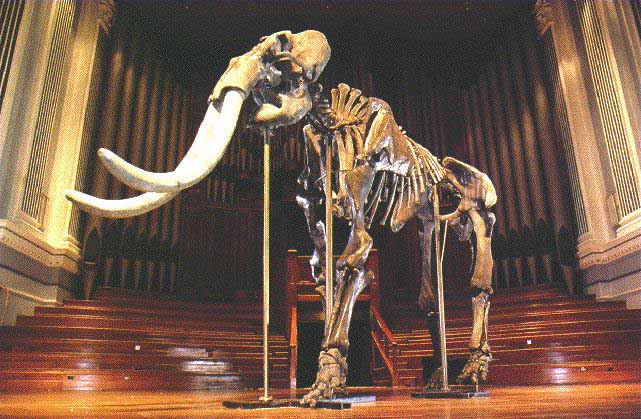
Elephant Fossils
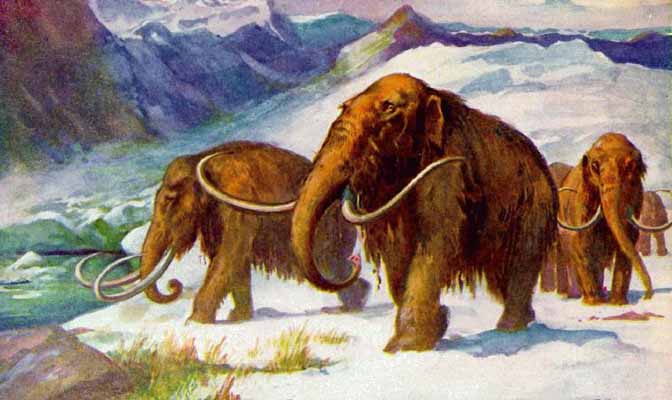
Woolly Mammoths and Mastodons