
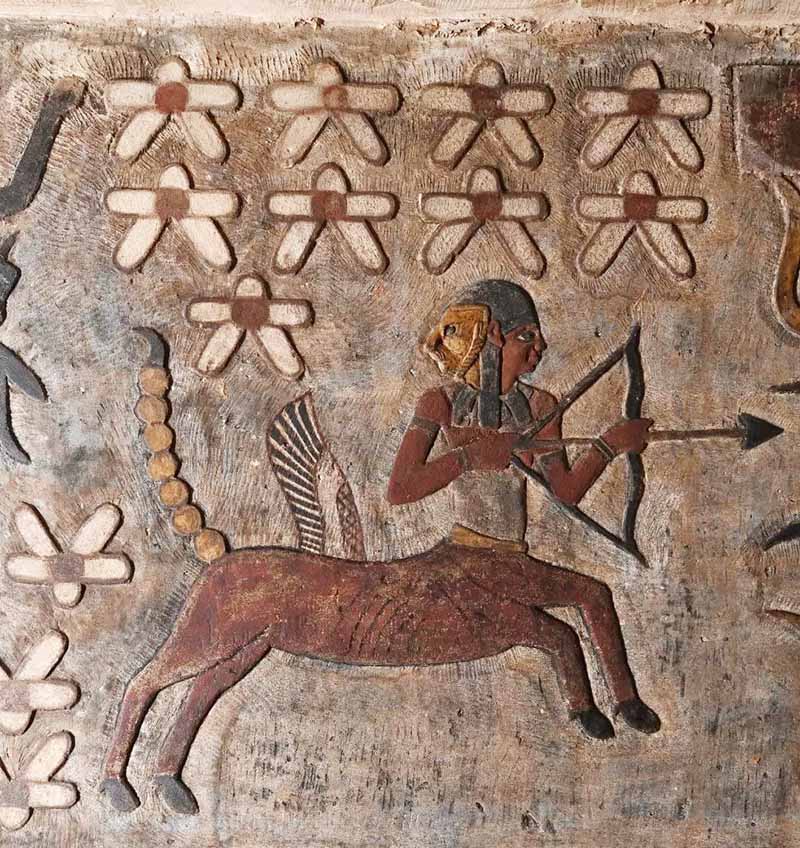
Complete Depiction of The Zodiac Found in Ancient Egyptian Temple Science Alert - March 24, 2023
A spectacular series of relief paintings on the ceiling of an ancient Egyptian temple depict 12 signs of the zodiac, and you might be surprised to recognize some of them.
Ancient zodiac paintings on Egyptian temple see the light of day after 2,200 years - restoration project has revealed ancient Egyptian zodiac paintings and inscriptions at the Temple of Esna. Live Science - March 23, 2023
Gorgeous zodiac paintings decorating the roof and walls of the 2,200-year-old Temple of Esna in southern Egypt have been revealed during a restoration project that's clearing away two millennia's worth of grime, soot and bird poop, researchers announced March 20. Restorers painstakingly cleaned the zodiac artworks, many of which were painted onto the temple's ceiling. Other restored images include depictions of the planets Jupiter, Saturn and Mars, as well as images of stars and constellations used by the ancient Egyptians to help measure time, researchers said in a statement. The team also conserved ancient images of snakes, crocodiles and hybrid creatures, such as a snake with a ram's head. While the existence of the zodiac and some of the other images at the temple were already known to researchers, the cleaning and conservation have allowed the artwork to be seen in more detail. The restoration work also revealed previously unknown inscriptions.
Hellenistic astrology is a tradition of horoscopic astrology that was developed and practiced in Hellenistic Egypt and the Mediterranean, whose texts were written in Greek (or sometimes Latin), mainly around the late 2nd or early 1st century B.C.E. Although the Hellenistic period properly ended in the early part of the Common Era, the type of astrology that developed during the early Hellenistic period was practiced in essentially its original form until the 6th or 7th century C.E. and so is commonly referred to as 'Hellenistic astrology'.
In 525 BCE Egypt was conquered by the Persians so there is likely to have been some Mesopotamian influence on Egyptian astrology. Arguing in favor of this, Barton gives an example of what appears to be Mesopotamian influence on the zodiac, which included two signs Ð the Balance and the Scorpion, as evidenced in the Dendera Zodiac (in the Greek version the Balance was known as the ScorpionÕs Claws).
After the occupation by Alexander the Great in 332BC, Egypt came under Greek rule and influence. The city of Alexandria was founded by Alexander after the conquest and during the third and second centuries BCE, the scholars of Alexandria were prolific writers. It was in 'Alexandrian Egypt' that Babylonian astrology was mixed with the Egyptian tradition of Decanic astrology to create Horoscopic astrology. This contained the Babylonian zodiac with its system of planetary exaltations, the triplicities of the signs and the importance of eclipses. Along with this it incorporated the Egyptian concept of dividing the zodiac into thirty-six decans of ten degrees each, with an emphasis on the rising decan, the Greek system of planetary Gods, sign rulership and four elements.
The decans were a system of time measurement according to the constellations. They were led by the constellation Sothis or Sirius. The risings of the decans in the night were used to divide the night into ÔhoursÕ. The rising of a constellation just before sunrise (its heliacal rising) was considered the last hour of the night. Over the course of the year, each constellation rose just before sunrise for ten days. When they became part of the astrology of the Hellenistic Age, each decan was associated with ten degrees of the zodiac.Texts from the second century BCE list predictions relating to the positions of planets in zodiac signs at the time of the rising of certain decans, particularly Sothis.
Particularly important in the development of horoscopic astrology was the astrologer and astronomer Ptolemy, who lived in Alexandria in Egypt. Ptolemy's work the Tetrabiblos laid the basis of the Western astrological tradition. The earliest Zodiac found in Egypt dates to the first century BC, the Dendera Zodiac.
According to Firmicus Maternus (4th century), the system of horoscopic astrology was given early on to an Egyptian pharaoh named Nechepso and his priest Petosiris. The Hermetic texts were also put together during this period and Clement of Alexandria, writing in the Roman era, demonstrates the degree to which astrologers were expected to have knowledge of the texts in his description of Egyptian sacred rites:
This is principally shown by their sacred ceremonial. For first advances the Singer, bearing some one of the symbols of music. For they say that he must learn two of the books of Hermes, the one of which contains the hymns of the gods, the second the regulations for the king's life. And after the Singer advances the Astrologer, with a horologe in his hand, and a palm, the symbols of astrology. He must have the astrological books of Hermes, which are four in number, always in his mouth.
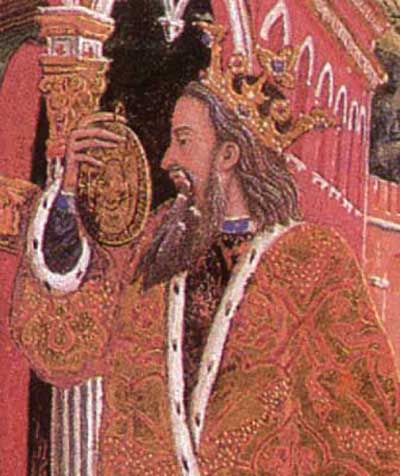
Ptolemy worked from the data of past astrologers to map over one thousand stars. He compiled a list of 48 constellations, and, for the most part, described the longitude and latitude lines of the earth. He was a believer that the earth was the center of the universe and worked to advance this theory. His effort in this area was in his thirteen volume work called the Almagest.
The Ptolemaic system is explained why some planets seemed to move backwards for periods of time in their orbit around Earth. He theorized that each planet also revolved in a smaller circle as well as a larger one. This was called the "epicycle." This theory would survive for 1400 years, until it was finally accepted that the earth was itself another planet in orbit around the sun.
The first book defined Ptolemy's reasoning for practicing Astrology as well as astronomy, for by this time, there were many who opposed astrology. He said that it should not be abandoned merely because there are a few people who abuse it. This book also deals with the various alignments of planets, the moon, and the sun. Ptolemy describes in detail which positions are favorable and which are not. He also explained the signs, when they begin, and why they begin there.
The second book of the Tetrabiblos describes astrology as it relates to countries. Ptolemy makes the point that astrological events of countries and race supersede those of the individual. He details which planets rule over which country, and makes the distinction between human signs and animal signs. He notes that human signs cause things to happen to humans and animal signs affect animals. Finally, Ptolemy explains how the planets affect earth. For example, Saturn was thought to cause cold, floods, poverty, and death. Mars caused war and drought. Comets and shooting stars were thought to also affect the weather.
The third book dealt with the individual. The Tetrabiblos examined conception and birth, saying that it was better to work with the conception date and that this date should be known by observation. Several key factors were involved with this aspect of astrology. The sign that was rising at the time of conception, the moon's phase, and the movements of the planets were all taken into consideration. The father's influence was shown through the sun and Saturn, while the mother's was shown through the moon and Venus.
Finally, the forth book of the Tetrabiblos handled matters of occupation, marriage, children, travel, and 'houses' of the zodiac. The particular angles of various planets were used to calculate these things.
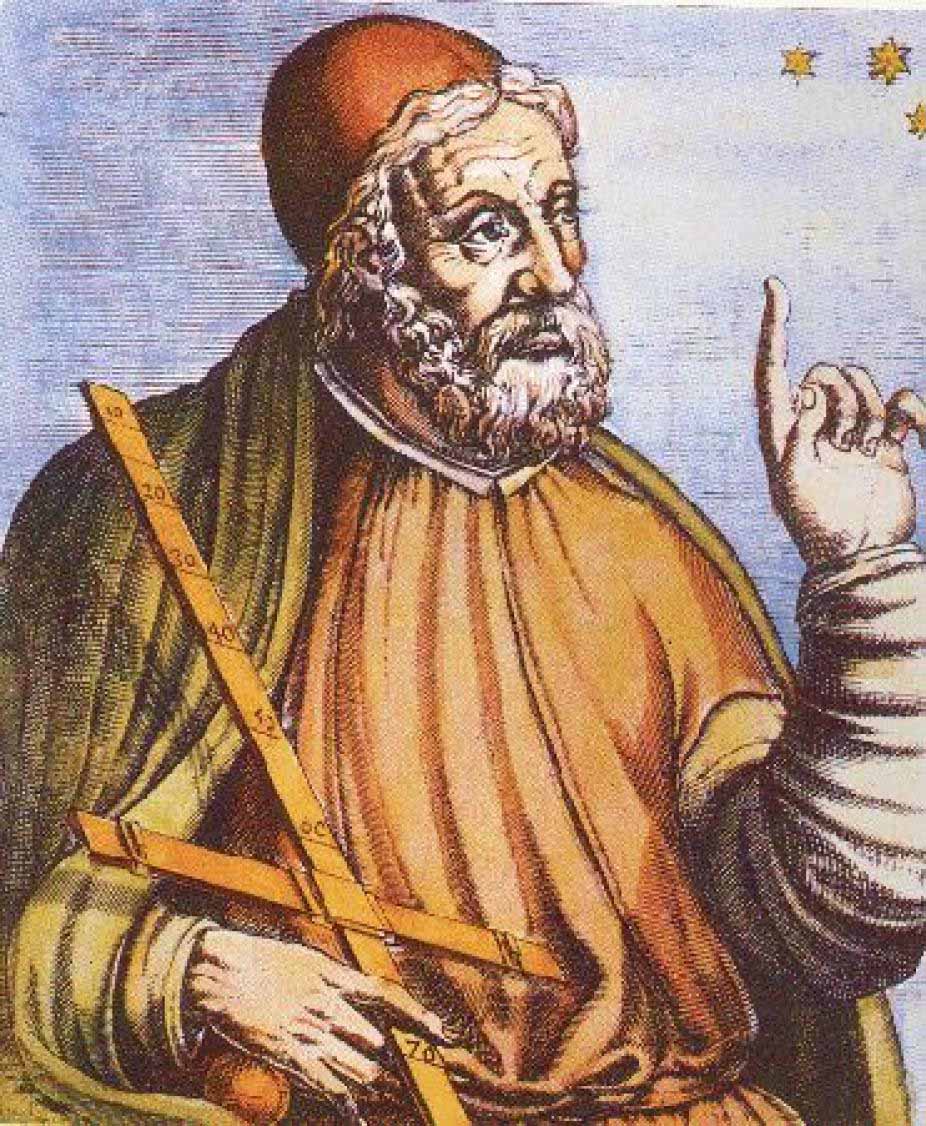
The Tetrabiblos compiled almost all of the astrological works up to that point. Only very few modifications have been made since then, and most of what we know as astrology comes from this work. Critics claim that it is "tedious and dry" to read, and that there are some contradictions in Ptolemy's ideas.
Furthermore, he did not take into account the precession of the equinoxes. He undoubtedly knew about this phenomenon, an overlapping between signs and constellations that gets larger over time (about 5 degrees per three hundred years), but why he did not examine or explain this is a mystery and one of the biggest flaws of his work.
There were also problems with his correlation between astrology and the seasons. His belief that the conception time was preferable to birth time is a misguided one, as conception time for an individual is actually rather difficult to calculate. There were other errors in his work, mostly dealing with beliefs of the time and misinformation about astronomy; however, for the most part, the Tetrabiblos has proved invaluable to this day.
Ptolemy may never have actually practiced astrology, as there has not been a single horoscope found that was created by him. Some say that his writing almost reflects an embarrassment about astrology, and suggest that perhaps he might not havebeen a scholar of the art, but more a reporter of it.
Probably the most disturbing accusation against Ptolemy is that his figures were intentionally skewed and doctored to fit his hypotheses. A study of Ptolemy's figures was done in 1977, and the findings were that most of his data was fraudulent. For more on this subject, one should refer to the book by R. Newton, The Crime of Claudius Ptolemy. It is hard to hold this against Ptolemy; he was, of course, working in ancient times. However, had he used correct numbers in his work, it might not have taken future scholars 1400 more years to correct wrong ideas concerning the universe.
In his defense, he was living during a time when 'politically incorrect' beliefs could be grounds for punishment. It actually may not have been safe for him to expose the truth; instead he may have been forced to make his numbers fit into incorrect theories. He knew enough about the truth...the precession of the equinoxes and the theories that postulated that the earth, in fact, revolved around the sun. Apparently, fear for his own life is the reason why he did not act on his knowledge.
After Ptolemy, many astrologers followed. Some notable Egyptians in the field were Paul of Alexandria, Hephaestion of Thebes, and Palchus, though little other than their names are known about these people. Ptolemy's work was continued and commented on by the Alexandrian mathematician Pappus, the mathematician/astronomer Theon of Alexandria, and the Greek mathematician Proclus, who wrote a paraphrase of Ptolemy's Tetrabiblos.
Most of our understanding of Egyptian astrology is contained within the Cairo Calendar, which consists of a listing of all the days of an Egyptian year. The listings within the calendar all take the same form and can be broken up into three parts:
the type of day (favorable, unfavorable etc)
a mythological event which may make a particular day more favorable or unfavorable
a prescribed behavior associated with that day.
Unlike modern astrology as found within newspapers, where one can choose whether to follow the advice there in or not, the Egyptians strictly adhered to what an astrologer would advise. As is evidenced by the papyrus of the Cairo Calendar, on days where there were adverse or favorable conditions, if the astrologers told a person not to go outside, not to bathe, or to eat fish on a particular day, such advice was taken very literally and seriously.
Some of the most interesting and misunderstood information about the Ancient Egyptians concerns their calendrical and astrological system. Of the greatest fallacy about Ancient Egypt and it's belief in astrology concerns the supposed worship of animals.
The Egyptians did not worship animals, rather the Egyptians according to an animals astrological significance, behaved in certain ritualistic ways toward certain animals on certain days. For example, as is evidenced by the papyrus Cairo Calendar, during the season of Emergence, it was the advisement of the Seers (within the priestly caste), and the omens of certain animals they saw, which devised whether a specific date would be favorable or unfavorable.
The basis for deciding whether a date was favorable or unfavorable was based upon a belief in possession of good or evil spirits, and upon a mythological ascription to the gods. Simply, an animal was not ritually revered because it was an animal, but rather because it had the ability to become possessed, and therefore could cause harm or help to any individual near them. It was also conceived of that certain gods could on specific days take the form of specific animals. Hence on certain days, it was more likely for a specific type of animal to become possessed by a spirit or god than on other days.
The rituals that the Egyptians partook of to keep away evil spirits from possessing an animal consisted of sacrifice to magic, however, it was the seers and the astrologers who guided many of the Egyptians and their daily routines. Hence, the origin of Egyptians worshipping animals, has more to do with the rituals to displace evil spirits, and their astrological system, more so than it does to actually worshipping animals.
Flooding of the Nile