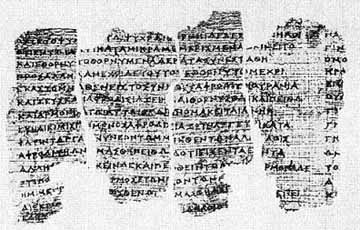
The Derveni papyrus is an ancient Greek papyrus scroll which was found in 1962. It is a philosophical treatise that is an allegorical commentary on an Orphic poem, a theogony concerning the birth of the gods, produced in the circle of the philosopher Anaxagoras, in the second half of the fifth century B.C., making it "the most important new piece of evidence about Greek philosophy and religion to come to light since the Renaissance" (Janko 2005). It dates to around 340 B.C., during the reign of Philip II of Macedon, making it Europe's oldest surviving manuscript.
The scroll was found at a site in Derveni, Macedonia northern Greece, in a nobleman's grave in a necropolis that was part of a rich cemetery belonging to the ancient city of Lete. It is the oldest surviving book in the Western tradition and one of very few surviving papyri found in Greece. The scroll is carbonized from the pyre of the nobleman's grave.The papyrus is kept in the Thessaloniki Archaeological Museum.
Europe's Oldest "Book" Read With High-Tech Imaging National Geographic - June 6, 2006
Ancient Scroll May Yield Religious Secrets Live Science - June 2, 2006
More than four decades after the Derveni papyrus was found in a 2,400-year-old nobleman's grave in northern Greece, researchers said Thursday they are close to uncovering new text -- through high-tech digital analysis -- from the blackened fragments left after the manuscript was burnt on its owner's funeral pyre.
Large sections of the mid-4th century B.C. book -- a philosophical treatise on ancient religion -- were read years ago, but never officially published.
Now, archaeologist Polyxeni Veleni believes U.S. imaging and scanning techniques used to decipher the Judas Gospel -- which portrays Judas not as a sinister betrayer but as Jesus' confidant -- will considerably expand and clarify that text.
"I believe some 10-20 percent of new text will be added, which however will be of crucial importance,'' said Veleni, director of the Thessaloniki Archaeological Museum, where the manuscript is kept.
The scroll, originally several yards of papyrus rolled around two wooden runners, was found half burnt in 1962. It dates to around 340 B.C., during the reign of Philip II of Macedon, father of Alexander the Great. "It is the oldest surviving book, if you can use that word for a scroll, in western tradition,'' Veleni said. "This was a unique find, of exceptional importance.''
Greek philosophy expert Apostolos Pierris said the text may be a century older. "It was probably written by somebody from the circle of the philosopher Anaxagoras, in the second half of the 5th century B.C.,'' he said.
Anaxagoras, who lived in ancient Athens, is thought to have been the teacher of Socrates and was accused by his contemporaries of atheism.
Last month, experts from Brigham Young University in Utah used multi-spectral digital analysis to create enhanced pictures of the text, which will be studied by Oxford University papyrologist Dirk Obbink and Pierris, and published by the end of 2007.
"We were now able to read even the most carbonized sections, as there were pieces that were completely blackened and nobody could make out whether there were letters on them,'' Veleni said.
The scroll contains a philosophical treatise on a lost poem describing the birth of the gods and other beliefs focusing on Orpheus, the mythical musician who visited the underworld to reclaim his dead love and enjoyed a strong cult following in the ancient world.
The Orpheus cult raised the notion of a single creator god -- as opposed to the multitude of deities the ancient Greeks believed in -- and influenced later monotheistic faiths.
"In a way, it was a precursor of Christianity,'' Pierris said. "Orphism believed that man's salvation depended on his knowledge of the truth.'' Veleni said the manuscript "will help show the influence of Orphism on later monotheistic religions.''
The Derveni grave, about five miles northwest of Thessaloniki, was part of a rich cemetery belonging to the ancient city of Lete. "It belonged to a very rich man, a Macedonian nobleman, warrior and athlete who had a lot of very important and valuable artifacts in his grave,'' Veleni said. Finds included metal vases, a gold wreath and weapons.
Translation of the Derveni Papyrus by Columns


SACRED PLACES AND TEACHINGS INDEX
CRYSTALINKS MAILING LIST, NEWSLETTER, UPDATES