

Cloning mules achieved one of the most unexpected milestones in genetic history, marking the world's very first clone of both a hybrid animal and a member of the equine (horse) family. Because mules are born sterile due to an mismatched number of chromosomes, cloning unlocked a unique biological loophole: the ability to recreate and preserve the exact genetic bloodlines of prize animals that cannot naturally pass on their traits.
The First Equine Clone: Idaho Gem
Before scientists successfully cloned horses or donkeys, they conquered the equine family by cloning a mule.
The Breakthrough: On May 4, 2003, a cloned mule named Idaho Gem was born healthy after a normal 346-day gestation period. He was soon followed by two genetically identical brothers, Utah Pioneer and Idaho Star.
The Team: The project was a massive collaborative effort between the University of Idaho and Utah State University, led by researchers Gordon Woods, Dirk Vanderwall, and Kenneth White.
The Method: The team extracted DNA from a mule fetus, injected it into an empty horse egg cell, and implanted the developing embryo into a surrogate mare.
The Drive Behind the Science: Mule Racing
While it might seem unusual, the entire research project was heavily funded by the president of the American Mule Racing Association, Don Jacklin.
The Problem: Jacklin owned Taz, a champion racing mule that completely dominated the professional racing circuit. Because mules are the sterile product of a male donkey and a female horse, Taz had an odd count of 63 chromosomes and could never produce offspring.
The Fix: Jacklin realized cloning was the only way to avoid taking Taz's flawless athletic genetics to the grave. Idaho Gem and his brothers were cloned using fetal cells sharing the exact same parental genetic combination as Taz, effectively resurrecting the champion's bloodline.
Overcoming the Calcium Barrier
Equines were notoriously difficult to clone because their cells stubbornly refused to divide normally in laboratory dishes. The Idaho team made a crucial discovery: equine red blood cells have significantly lower intracellular calcium levels compared to other mammals like cows. By aggressively boosting the calcium levels in the cell culture medium, the scientists successfully forced the cloned equine embryos to trigger cell division and thrive.
Testing "Nature vs. Nurture" on the Track
Mule cloning provided a real-world scientific theater to test how much of an animal's ability comes from genetics versus environment. In 2006, Idaho Gem and Idaho Star entered the professional racing circuit to race against naturally bred mules. Despite having identical DNA, the clones did not behave or race exactly the same because they had different trainers, personalities, and environmental influences. However, their athletic genetics held true: Idaho Gem won his very first official race validating the commercial viability of cloning elite athletic animals.
Cloned Mules and Mule racing in Idaho February 23, 2026
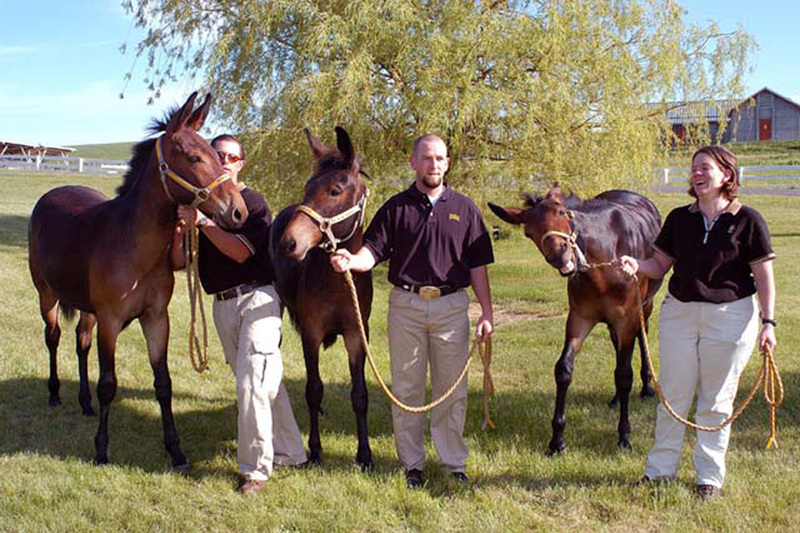
Each clone developed a distinct personality, proving that genetics is only part of what makes an individual, and each eventually went his own way. Utah Pioneer spent years as an educational ambassador on the University of Idaho campus in Moscow before his death. Idaho Star became a riding mule for a young equestrian in Latah County, while Idaho Gem, after his racing days, retired to a ranch in Texas.
US: The world's first cloned mule, Idaho BBC - May 29, 2003
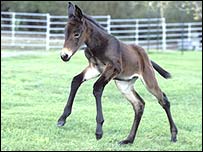
Scientists in the United States have announced the birth of the world's first cloned mule. The foal, called Idaho Gem, is nearly a month old and appears to be perfectly healthy, the researchers say. The first clone of any animal in the horse family.They suggest their work could lead to champion racehorses being routinely cloned in the future. The research is published in the journal Science.
Idaho Gem looks the perfect foal from his pointy ears to his still slightly unsteady legs. His birth sets a number of milestones. Gem is not only the first cloned mule, he is the first clone of any animal in the horse family; and he is the first clone of an animal which cannot normally reproduce. Mules are almost always sterile. They are formed when a male donkey breeds with a female horse; horses have 64 chromosomes, donkeys 62 - mules end up with 63. The success rate from cloning was typically low - from over three hundred embryos, only three viable foals developed; Gem himself plus two brothers which are yet to be born.
New race
The research was sponsored by an American mule-racing enthusiast; but the real implications could lie in horse-breeding. The scientist in charge of Gem's creation, Professor Gordon Woods of the University of Idaho, says the team has solved a technical hurdle which has until now prevented cloning in any member of the horse family. The cloning success rate was 1 in 100
So cloning champion racehorses or show-jumpers should now be possible. "It could also help with endangered species," said Professor Woods, "species like the Przewalski horse." International horse-racing rules currently outlaw any form of assisted reproduction, including cloning; but show-jumping has no such rules. Male show-jumping horses are routinely castrated, so cannot breed - making cloning, perhaps, an attractive option for their owners. Jacky Knightley, a spokeswoman for the British Show-Jumping Association, commented that cloning would take all the fun out of breeding, and could make the sport as boring as Formula One motor racing.