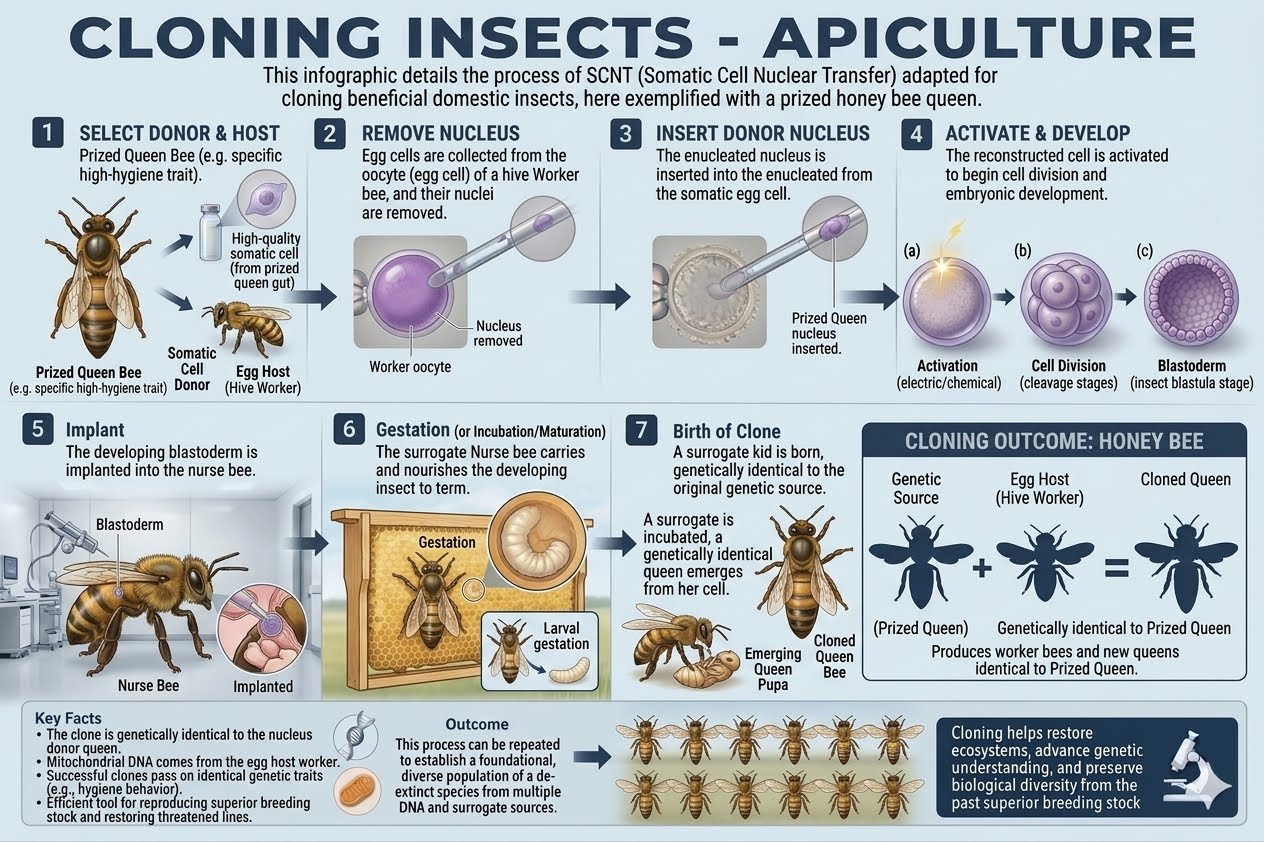

Cloning insects presents a fascinating departure from vertebrate cloning, as many insect species have spent millions of years mastering natural cloning without human intervention. While cloning an elephant or a dog requires intricate laboratory manipulation, duplicating an insect often involves simply triggering or studying their inherent reproductive systems.
The Natural Masters of Cloning: Parthenogenesis
Unlike mammals, which strictly require male and female genetic material, many insects utilize parthenogenesis - a natural form of asexual reproduction where females produce genetically identical offspring without fertilization.
Aphids (The Copy Machines): During the spring and summer, female aphids give birth to live, pregnant, clonal daughters. They bypass egg-laying entirely to rapidly multiply and overwhelm host plants before predators can react.
The Cape Honeybee: Workers of this specific South African bee subspecies can lay unfertilized eggs that develop into female workers and queens instead of males, effectively cloning themselves to take over hives.
Phasmids (Stick Insects): Several species of walking sticks lack males entirely. Populations consist solely of females that continuously lay unfertilized eggs, producing flawless genetic copies generation after generation.
Artificial Insect Cloning in the Lab
When scientists need to clone insects that do not naturally reproduce asexually (like specific fruit flies or mosquitoes), they rely on highly delicate micro-engineering:
Embryo Splitting: Because insect eggs are incredibly small and fragile, traditional Somatic Cell Nuclear Transfer (SCNT) is highly difficult. Instead, researchers use microscopic blades or lasers to split early-stage embryos, producing identical twins.
The CRISPR Connection: Rather than standard cloning, modern insect biotechnology relies heavily on gene drives. Scientists alter a single insect's DNA using CRISPR, ensuring that a specific trait (like malaria resistance in mosquitoes) is passed down to 100% of offspring, rapidly altering the entire wild population.
Why Scientists Clone Insects
Replicating insects at a mass scale serves critical purposes in global agriculture, medicine, and genetic research:
Eliminating Variables in Research: The fruit fly (Drosophila melanogaster) shares 75% of the genes that cause diseases in humans. By using genetically identical, cloned lineages of fruit flies, medical researchers can test drugs or radiation therapies without genetic anomalies skewing the data.
The Sterile Insect Technique (SIT): Environmental agencies clone and mass-produce identical, sterile male pests (like the screw-worm fly or Mediterranean fruit fly). Millions of these sterile clones are released into the wild to mate with wild females, causing the pest population to naturally collapse without using toxic chemical pesticides.
Preserving Silk and Honey Yields: Agricultural labs explore cloning elite lines of silkworms and honeybees that exhibit extreme resistance to pesticide exposure, fungal infections, or colony collapse disorder.
Nature - November 1, 2004
As if there weren't enough of them in the world already, scientists have succeeded in cloning flies. The identical fruit flies are the first insects ever cloned, says the Canadian team that created them. The question everyone asks, says group leader Vett Lloyd of Dalhousie University in Halifax, Nova Scotia, is why anyone would want to clone flies in the first place. She hopes that the insects, which are very easy to experiment with, will help to fine-tune the cloning process in other animals and even in humans, where the technique is being researched to aid production of therapeutic stem cells.
In cloning, the DNA-containing nucleus of an adult cell is injected into an egg whose own nucleus has been removed. At the moment, the majority of cloned mice, sheep and other animals die before birth. It is thought this is because the adult DNA is not properly 'reprogrammed' and cannot orchestrate the growth of an embryo.
Using flies, researchers might reveal genes that are important for this reprogramming, and that have counterparts in other animals. That is because it is relatively easy in flies to knock out the function of a single gene and then attempt cloning with these cells, which will test whether that gene is crucial. If such genes are identified, then in theory cloned mammalian embryos might be grown in tailored solutions that alter the activity of those genes to improve the technique's success rate.
Although some groups have attempted to clone insects before, Lloyd says this is the first time it has been successful. The team used a slight variation on the standard cloning process: they transferred nuclei taken from embryos rather than fully-fledged adult cells. They sucked several nuclei out of developing fly embryos, and injected them into a fertilized fly egg. From over 800 initial attempts, they conjured five adult insects, the group reports in the journal Genetics.
Keith Latham, who studies mouse cloning at Temple University School of Medicine in Philadelphia, Pennsylvania, points out that embryonic cells are much easier to reprogramme than adult cells. "I'm not sure there are many close parallels to what's going on in mammals," he says. Lloyd acknowledges this, and says the group are now working towards creating clones from adult fly cells.