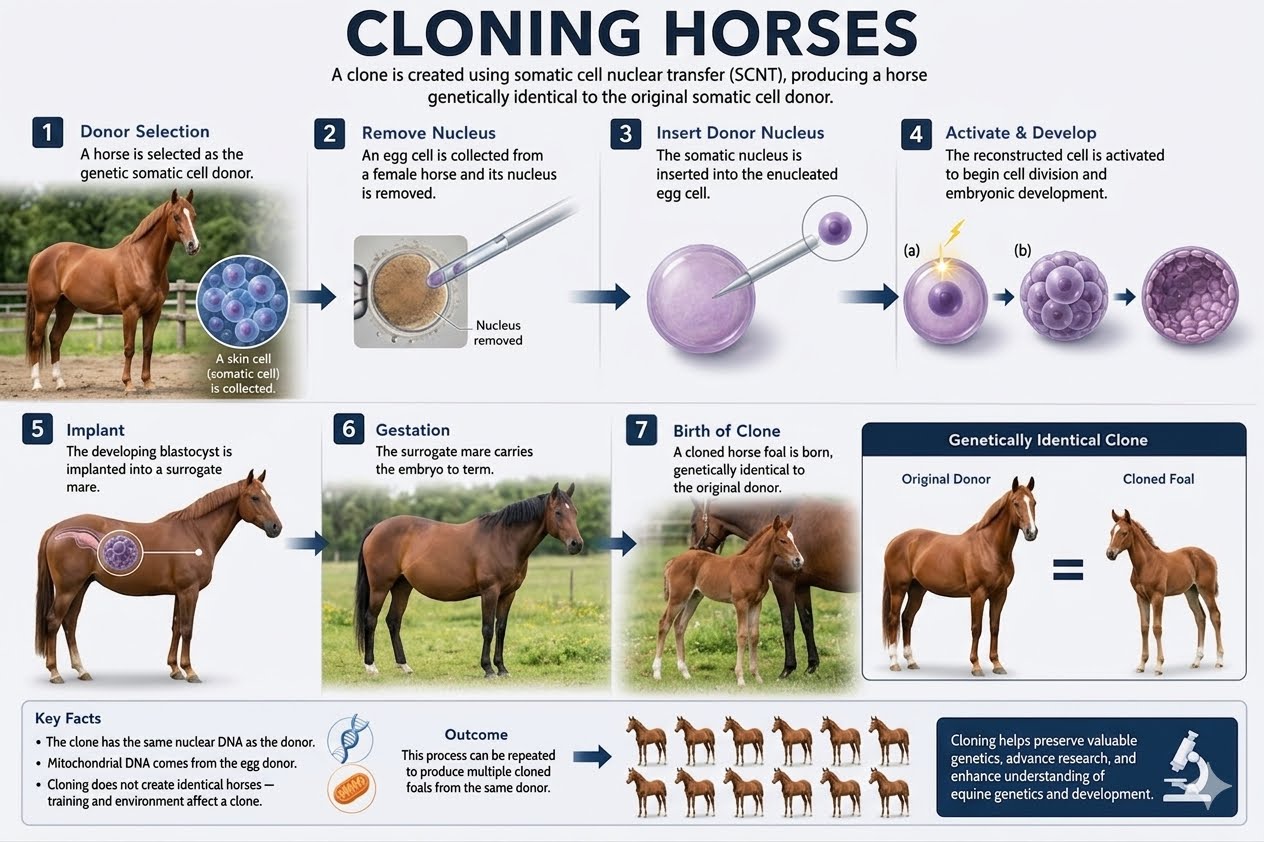
Horses are the seventh species to be cloned yet. Horse cloning is the process of obtaining a horse with genes identical to that of another horse, using an artificial fertilization technique. Interest in this technique began in the 1980s.
The Haflinger foal Prometea, the first living cloned horse, was obtained in 2003 in an Italian laboratory. (See below)
Over the years, the technique has improved. It is mainly used on high-performance but castrated or infertile animals, for reproductive cloning. These horses are then used as breeding stock.
Horse cloning is only mastered by a handful of laboratories worldwide, notably in France, Argentina, North America and China. The technique is limited by the fact that some differences remain between the original and its clone, due to the influence of mitochondrial DNA.
Reproductive cloning of the Pieraz and Quidam de Revel horses began in 2005. (See below)
The International Federation for Equestrian Sports (FEI by its acronym in French) decided to ban clones from competition in 2007, before authorizing them in 2012.
A few clones are used in equestrian sports, winning major titles such as the Argentine polo championship in 2013. Nevertheless, the number of cloned horses is growing every year.
The practice is highly controversial, particularly for bioethical reasons, since it involves a high failure rate on embryos. It also raises questions about the management of horses' genetic diversity, the future of the horse breeding profession, and the outbreak of new genetic disorders or fraud. Read more ...
More Top Horses Are Being Cloned, Rattling the World of Equestrian Sports WSJ - June 6, 2026

For generations, the world's top horse breeders have carefully mixed bloodlines for temperament, strength, conformation and athleticism. Now many are considering cloning. It isn't quite natural selection, but it is it far off.
Champion endurance horse cloned BBC - April 2005
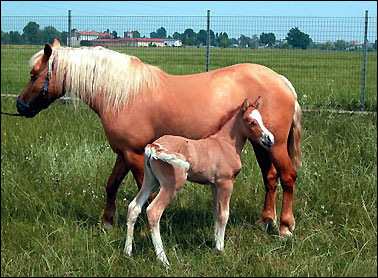
The birth of the world's second horse clone has been announced by scientists. The foal is a copy of a world endurance champion, Pieraz, an animal that has been castrated and was therefore incapable of normal reproduction. The research was undertaken by genetic engineering labs Cryozootech of Evry, France, and LTR-CIZ of Cremona, Italy, where the foal is being kept. The World's first horse clone Prometea, was produced by the same group of researchers in 2003.
Researchers give clone health warning BBC - August 7, 2003
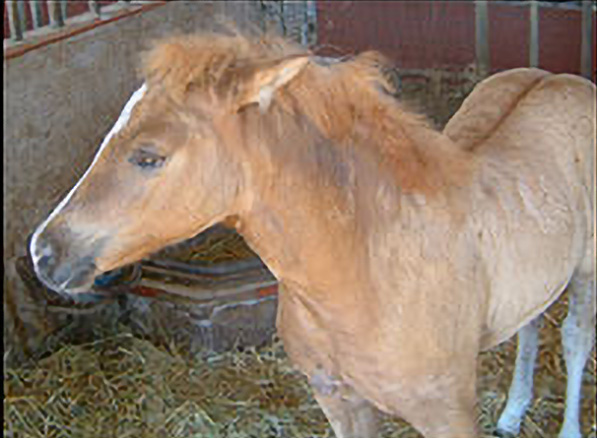
As Italian scientists succeed in creating the world's first horse clone, researchers in the UK have raised further questions about the future health of such animals. Scientists in Cambridge have found new evidence that the process of creating an animal copy damages the genetic mechanisms that enable it to develop normally. The discovery explains why it takes hundreds of attempts to create a living clone. But it also has implications for the long-term health of these creatures. Many leading cloning scientists are becoming increasingly concerned that even apparently healthy animals may be flawed.
One scientist told the BBC that the death of Dolly the sheep last year was probably just an indication of what was to come: that many more cow and sheep clones would die as they approached middle age. But the question has always been whether the supposedly healthy successful clones have more subtle defects that only show up later. The new Cambridge research shows this may well be the case. The work involved producing a series of images illustrating how the signals in an embryo tell its cells to develop properly. The Cambridge team found that the signals in clone embryos were abnormal. In most cases, these abnormalities prevent a clone from developing at all. But Professor Wolf Reik, the head of the research team at the Babraham Institute, believes that some defects may only become apparent in later life.