4th Emperor of the Roman Empire
4th Emperor of the Roman Empire
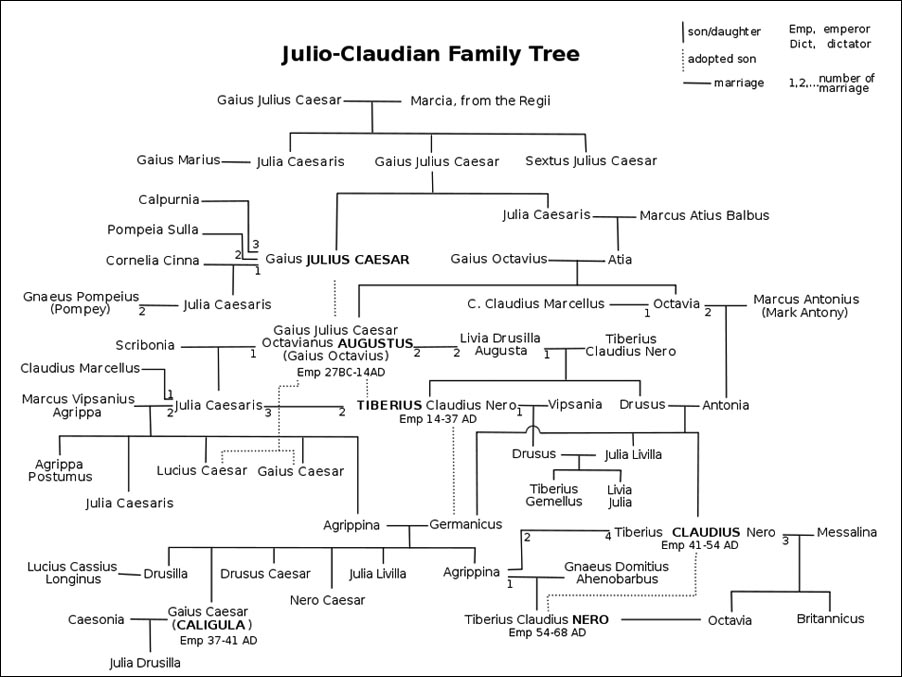
Claudius (1 August 10 BC Ð 13 October AD 54) was Roman Emperor from 41 to 54. A member of the Julio-Claudian dynasty, he was the son of Drusus and Antonia Minor. He was born at Lugdunum in Gaul and was the first Roman Emperor to be born outside Italy. Because he was afflicted with a limp and slight deafness due to sickness at a young age, his family ostracized him and excluded him from public office until his consulship, shared with his nephew Caligula in 37. Claudius' infirmity probably saved him from the fate of many other nobles during the purges of Tiberius and Caligula's reigns; potential enemies did not see him as a serious threat. His survival led to his being declared Emperor by the Praetorian Guard after Caligula's assassination, at which point he was the last adult male of his family.
Despite his lack of experience, Claudius proved to be an able and efficient administrator. He was also an ambitious builder, constructing many new roads, aqueducts, and canals across the Empire. During his reign the Empire conquered Thrace, Noricum, Pamphylia, Lycia and Judaea, and began the conquest of Britain. Having a personal interest in law, he presided at public trials, and issued up to twenty edicts a day. However, he was seen as vulnerable throughout his reign, particularly by the nobility. Claudius was constantly forced to shore up his position; this resulted in the deaths of many senators. These events damaged his reputation among the ancient writers, though more recent historians have revised this opinion. He was probably the first Roman emperor to be murdered by his own wife. After his death in 54, his grand-nephew and adopted son Nero succeeded him as Emperor.
Claudius was born on 1 August 10 BC in Lugdunum to Nero Claudius Drusus and Antonia on the day of the dedication of the altar to Augustus at the Sanctuary of the Three Gauls. He had two older siblings named Germanicus and Livilla. Antonia may have had two other children who died young. His maternal grandparents were Mark Antony and Octavia Minor, Augustus' sister, and therefore the great-great grandnephew of Gaius Julius Caesar. His paternal grandparents were Livia, Augustus' third wife, and Tiberius Claudius Nero. During his reign, Claudius revived the rumor that his father Drusus was actually the illegitimate son of Augustus, to give the false appearance that Augustus was Claudius' paternal grandfather.
In 9 BC, Drusus unexpectedly died on campaign in Germania, possibly from illness. Claudius was then left to be raised by his mother, who never remarried. When Claudius' disability became evident, the relationship with his family turned sour. Antonia referred to him as a monster, and used him as a standard for stupidity. She seems to have passed her son off on his grandmother Livia for a number of years.
Livia was little kinder, and often sent him short, angry letters of reproof. He was put under the care of a "former mule-driver" to keep him disciplined, under the logic that his condition was due to laziness and a lack of will-power. However, by the time he reached his teenage years his symptoms apparently waned and his family took some notice of his scholarly interests.
In 7, Livy was hired to tutor him in history, with the assistance of Sulpicius Flavus. He spent a lot of his time with the latter and the philosopher Athenodorus. Augustus, according to a letter, was surprised at the clarity of Claudius' oratory. Expectations about his future began to increase.
Ironically, it was his work as a budding historian that destroyed his early career. According to Vincent Scramuzza and others, Claudius began work on a history of the Civil Wars that was either too truthful or too critical of Octavian. In either case, it was far too early for such an account, and may have only served to remind Augustus that Claudius was Antony's descendant.
His mother and grandmother quickly put a stop to it, and this may have convinced them that Claudius was not fit for public office. He could not be trusted to toe the existing party line. When he returned to the narrative later in life, Claudius skipped over the wars of the second triumvirate altogether. But the damage was done, and his family pushed him to the background.
When the Arch of Pavia was erected to honor the Imperial clan in 8, Claudius' name (now Tiberius Claudius Nero Germanicus after his elevation to paterfamilias of Claudii Nerones on the adoption of his brother) was inscribed on the edge past the deceased princes, Gaius and Lucius, and Germanicus' children. There is some speculation that the inscription was added by Claudius himself decades later, and that he originally did not appear at all.
When Augustus died in 14, Claudius - then 23 - appealed to his uncle Tiberius to allow him to begin the cursus honorum. Tiberius, the new Emperor, responded by granting Claudius consular ornaments. Claudius requested office once more and was snubbed. Since the new Emperor was not any more generous than the old, Claudius gave up hope of public office and retired to a scholarly, private life.
Despite the disdain of the Imperial family, it seems that from very early on the general public respected Claudius. At Augustus' death, the equites, or knights, chose Claudius to head their delegation. When his house burned down, the Senate demanded it be rebuilt at public expense. They also requested that Claudius be allowed to debate in the Senate. Tiberius turned down both motions, but the sentiment remained. During the period immediately after the death of Tiberius' son, Drusus, Claudius was pushed by some quarters as a potential heir. This again suggests the political nature of his exclusion from public life. However, as this was also the period during which the power and terror of the Praetorian Sejanus was at its peak, Claudius chose to downplay this possibility.
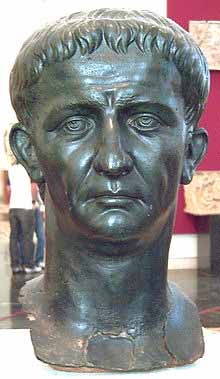
After the death of Tiberius the new emperor Caligula (the son of Claudius' brother Germanicus) recognized Claudius to be of some use. He appointed Claudius his co-consul in 37 in order to emphasize the memory of Caligula's deceased father Germanicus. Despite this, Caligula relentlessly tormented his uncle: playing practical jokes, charging him enormous sums of money, humiliating him before the Senate, and the like. According to Cassius Dio Claudius became very sickly and thin by the end of Caligula's reign, most likely due to stress. A possible surviving portrait of Claudius from this period may support this.
On 24 January, 41, Caligula was assassinated in a broad-based conspiracy involving the Praetorian commander Cassius Chaerea and several Senators. There is no evidence that Claudius had a direct hand in the assassination, although it has been argued that he knew about the plot particularly since he left the scene of the crime shortly before his nephew was murdered.
However, after the deaths of Caligula's wife and daughter, it became apparent that Cassius intended to go beyond the terms of the conspiracy and wipe out the Imperial family. In the chaos following the murder, Claudius witnessed the German guard cut down several uninvolved noblemen, including many of his friends. He fled to the palace to hide. According to tradition, a Praetorian named Gratus found him hiding behind a curtain and suddenly declared him princeps. A section of the guard may have planned in advance to seek out Claudius, perhaps with his approval. They reassured him that they were not one of the battalions looking for revenge. He was spirited away to the Praetorian camp and put under their protection.
The Senate quickly met and began debating a change of government, but this eventually devolved into an argument over which of them would be the new Princeps. When they heard of the Praetorians' claim, they demanded that Claudius be delivered to them for approval, but he refused, sensing the danger that would come with complying. Some historians, particularly Josephus, claim that Claudius was directed in his actions by the Judean King Herod Agrippa. However, an earlier version of events by the same ancient author downplays Agrippa's role so it is not known how large a hand he had in things. Eventually the Senate was forced to give in and, in return, Claudius pardoned nearly all the assassins.
Claudius took several steps to legitimize his rule against potential usurpers, most of them emphasizing his place within the Julio-Claudian family. He adopted the name "Caesar" as a cognomen the name still carried great weight with the populace. In order to do so, he dropped the cognomen "Nero" which he had adopted as paterfamilias of the Claudii Nerones when his brother Germanicus was adopted out.
While he had never been adopted by Augustus or his successors, he was the grandson of Octavia, and so felt he had the right. He also adopted the name "Augustus" as the two previous emperors had done at their accessions. He kept the honorific "Germanicus" in order to display the connection with his heroic brother. He deified his paternal grandmother Livia in order to highlight her position as wife of the divine Augustus. Claudius frequently used the term "filius Drusi" (son of Drusus) in his titles, in order to remind the people of his legendary father and lay claim to his reputation.
Because he was proclaimed Emperor on the initiative of the Praetorian Guard instead of the Senate the first Emperor thus proclaimed - Claudius' repute suffered at the hands of commentators (such as Seneca). Moreover, he was the first Emperor who resorted to bribery as a means to secure army loyalty. Tiberius and Augustus had both left gifts to the army and guard in their wills, and upon Caligula's death the same would have been expected, even if no will existed. Claudius remained grateful to the guard, however, issuing coins with tributes to the Praetorians in the early part of his reign.
In 43, Claudius sent Aulus Plautius with four legions to Britain (Britannia) after an appeal from an ousted tribal ally. Britain was an attractive target for Rome because of its material wealth particularly mines and slaves. It was also a haven for Gallic rebels and the like, and so could not be left alone much longer. Claudius himself travelled to the island after the completion of initial offensives, bringing with him reinforcements and elephants. The latter must have made an impression on the Britons when they were displayed in the large tribal centre of Camulodunum.
He left after 16 days, but remained in the provinces for some time. The Senate granted him a triumph for his efforts, as only members of the Imperial family were allowed such honors. Claudius later lifted this restriction for some of his conquering generals. He was granted the honorific "Britannicus" but only accepted it on behalf of his son, never using the title himself. When the British general Caractacus was captured in 50, Claudius granted him clemency. Caractacus lived out his days on land provided by the Roman state, an unusual end for an enemy commander.
Claudius conducted a census in 48 that found 5,984,072 Roman citizens, an increase of around a million since the census conducted at Augustus' death. He had helped increase this number through the foundation of Roman colonies that were granted blanket citizenship. These colonies were often made out of existing communities, especially those with elites who could rally the populace to the Roman cause. Several colonies were placed in new provinces or on the border of the Empire in order to secure Roman holdings as quickly as possible.
Claudius personally judged many of the legal cases tried during his reign. Ancient historians have many complaints about this, stating that his judgments were variable and sometimes did not follow the law. He was also easily swayed. Nevertheless, Claudius paid detailed attention to the operation of the judicial system. He extended the summer court session, as well as the winter term, by shortening the traditional breaks. Claudius also made a law requiring plaintiffs to remain in the city while their cases were pending, as defendants had previously been required to do. These measures had the effect of clearing out the docket. The minimum age for jurors was also raised to 25 in order to ensure a more experienced jury pool.
Claudius also settled disputes in the provinces. He freed the island of Rhodes from Roman rule for their good faith and exempted Troy from taxes. Early in his reign, the Greeks and Jews of Alexandria sent him two embassies at once after riots broke out between the two communities. This resulted in the famous "Letter to the Alexandrians", which reaffirmed Jewish rights in the city but also forbade them to move in more families en masse. According to Josephus, he then reaffirmed the rights and freedoms of all the Jews in the Empire.
One of Claudius's investigators discovered that many old Roman citizens based in the modern city of Trento were not in fact citizens. The Emperor issued a declaration that they would be considered to hold citizenship from then on, since to strip them of their status would cause major problems. However, in individual cases, Claudius punished false assumption of citizenship harshly, making it a capital offense. Similarly, any freedmen found to be impersonating equestrians were sold back into slavery.
Numerous edicts were issued throughout Claudius' reign. These were on a number of topics, everything from medical advice to moral judgments. Two famous medical examples are one promoting Yew juice as a cure for snakebite, and another promoting public flatulence for good health. One of the more famous edicts concerned the status of sick slaves. Masters had been abandoning ailing slaves at the temple of Aesculapius to die, and then reclaiming them if they lived. Claudius ruled that slaves who recovered after such treatment would be free. Furthermore, masters who chose to kill slaves rather than take the risk were liable to be charged with murder.
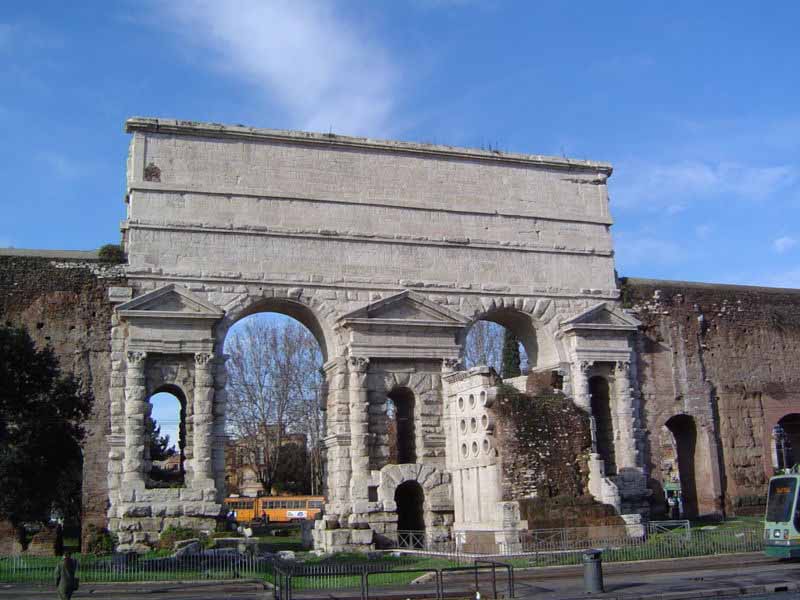
Porta Maggiore
Claudius embarked on many public works throughout his reign, both in the capital and in the provinces. He built two aqueducts, the Aqua Claudia, begun by Caligula, and the Anio Novus. These entered the city in 52 and met at the famous Porta Maggiore. He also restored a third, the Aqua Virgo.
He paid special attention to transportation. Throughout Italy and the provinces he built roads and canals. Among these was a large canal leading from the Rhine to the sea, as well as a road from Italy to Germany - both begun by his father, Drusus. Closer to Rome, he built a navigable canal on the Tiber, leading to Portus, his new port just north of Ostia. This port was constructed in a semicircle with two moles and a lighthouse at its mouth. The construction also had the effect of reducing flooding in Rome.
The port at Ostia was part of Claudius' solution to the constant grain shortages that occurred in winter, after the Roman shipping season. The other part of his solution was to insure the ships of grain merchants who were willing to risk travelling to Egypt in the off-season. He also granted their sailors special privileges, including citizenship and exemption from the Lex Papia-Poppaea, a law that regulated marriage. In addition, he repealed the taxes that Caligula had instituted on food, and further reduced taxes on communities suffering drought or famine.
The last part of Claudius' plan was to increase the amount of arable land in Italy. This was to be achieved by draining the Fucine lake, which would have the added benefit of making the nearby river navigable year-round. A tunnel was dug through the lake bed, but the plan was a failure.
The tunnel was crooked and not large enough to carry the water, which caused it to back up when opened. The resultant flood washed out a large gladiatorial exhibition held to commemorate the opening, causing Claudius to run for his life along with the other spectators. The draining of the lake was revisited many times in history, including by Emperors Trajan and Hadrian, and Holy Roman Emperor Frederick II in the Middle Ages. It was finally achieved by the Prince Torlonia in the 19th century, producing over 160,000 acres (650 km2) of new arable land. He expanded the Claudian tunnel to three times its original size.
Because of the circumstances of his accession, Claudius took great pains to please the Senate. During regular sessions, the Emperor sat among the Senate body, speaking in turn. When introducing a law, he sat on a bench between the consuls in his position as Holder of the Power of Tribune (The Emperor could not officially serve as a Tribune of the Plebes as he was a Patrician, but it was a power taken by previous rulers). He refused to accept all his predecessors' titles (including Imperator) at the beginning of his reign, preferring to earn them in due course. He allowed the Senate to issue its own bronze coinage for the first time since Augustus. He also put the Imperial provinces of Macedonia and Achaea back under Senate control.
In 47 he assumed the office of Censor with Lucius Vitellius, which had been allowed to lapse for some time. He struck the names of many senators and equites who no longer met qualifications, but showed respect by allowing them to resign in advance. At the same time, he sought to admit eligible men from the provinces. The Lyon Tablet preserves his speech on the admittance of Gallic senators, in which he addresses the Senate with reverence but also with criticism for their disdain of these men. He also increased the number of Patricians by adding new families to the dwindling number of noble lines. Here he followed the precedent of Lucius Junius Brutus and Julius Caesar.
Nevertheless, many in the Senate remained hostile to Claudius, and many plots were made on his life. This hostility carried over into the historical accounts. As a result, Claudius was forced to reduce the Senate's power for efficiency. The administration of Ostia was turned over to an Imperial Procurator after construction of the port. Administration of many of the empire's financial concerns was turned over to Imperial appointees and freedmen. This led to further resentment and suggestions that these same freedmen were ruling the Emperor.
Several coup attempts were made during Claudius' reign, resulting in the deaths of many senators. Appius Silanus was executed early in Claudius' reign under questionable circumstances. Shortly after, a large rebellion was undertaken by the Senator Vinicianus and Scribonianus, the governor of Dalmatia and gained quite a few senatorial supporters. It ultimately failed because of the reluctance of Scribonianus' troops, and the suicide of the main conspirators. Many other senators tried different conspiracies and were condemned. Claudius' son-in-law Pompeius Magnus was executed for his part in a conspiracy with his father Crassus Frugi. Another plot involved the consulars Lusiius Saturninus, Cornelius Lupus, and Pompeius Pedo.
In 46, Asinius Gallus, the grandson of Asinius Pollio, and Statilius Corvinus were exiled for a plot hatched with several of Claudius' own freedmen. Valerius Asiaticus was executed without public trial for unknown reasons. The ancient sources say the charge was adultery, and that Claudius was tricked into issuing the punishment. However, Claudius singles out Asiaticus for special damnation in his speech on the Gauls, which dates over a year later, suggesting that the charge must have been much more serious.
Asiaticus had been a claimant to the throne in the chaos following Caligula's death and a co-consul with the Statilius Corvinus mentioned above. Most of these conspiracies took place before Claudius' term as Censor, and may have induced him to review the Senatorial rolls. The conspiracy of Gaius Silius in the year after his Censorship, 48, is detailed in the section discussing Claudius' third wife, Messalina. Suetonius states that a total of 35 senators and 300 knights were executed for offenses during Claudius' reign. Needless to say, the responses to these conspiracies could not have helped Senate-emperor relations.
Claudius was hardly the first emperor to use freedmen to help with the day-to-day running of the Empire. He was, however, forced to increase their role as the powers of the Princeps became more centralized and the burden larger. This was partly due to the ongoing hostility of the Senate, as mentioned above, but also due to his respect for the senators. Claudius did not want free-born magistrates to have to serve under him, as if they were not peers.
The secretariat was divided into bureaus, with each being placed under the leadership of one freedman. Narcissus was the secretary of correspondence. Pallas became the secretary of the treasury. Callistus became secretary of justice. There was a fourth bureau for miscellaneous issues, which was put under Polybius until his execution for treason. The freedmen could also officially speak for the Emperor, as when Narcissus addressed the troops in Claudius' stead before the conquest of Britain.
Since these were important positions, the senators were aghast at their being placed in the hands of former slaves. If freedmen had total control of money, letters, and law, it seemed it would not be hard for them to manipulate the Emperor. This is exactly the accusation put forth by the ancient sources. However, these same sources admit that the freedmen were loyal to Claudius.
He was similarly appreciative of them and gave them due credit for policies where he had used their advice. However, if they showed treasonous inclinations, the Emperor did punish them with just force, as in the case of Polybius and Pallas' brother, Felix. There is no evidence that the character of Claudius' policies and edicts changed with the rise and fall of the various freedmen, suggesting that he was firmly in control throughout.
Regardless of the extent of their political power, the freedmen did manage to amass wealth through their positions. Pliny the Elder notes that several of them were richer than Crassus, the richest man of the Republican era.
Claudius, as the author of a treatise on Augustus' religious reforms, felt himself in a good position to institute some of his own. He had strong opinions about the proper form for state religion. He refused the request of Alexandrian Greeks to dedicate a temple to his divinity, saying that only gods may choose new gods. He restored lost days to festivals and got rid of many extraneous celebrations added by Caligula.
He re-instituted old observances and archaic language. Claudius was concerned with the spread of eastern mysteries within the city and searched for more Roman replacements. He emphasized the Eleusinian mysteries which had been practiced by so many during the Republic. He expelled foreign astrologers, and at the same time rehabilitated the old Roman soothsayers (known as haruspices) as a replacement. He was especially hard on Druidism, because of its incompatibility with the Roman state religion and its proselytizing activities.
It is also reported that at one time he expelled the Jews from Rome, probably because the Jews at Rome caused continuous disturbances at the instigation of Chrestus. Claudius opposed proselytizing in any religion, even in those regions where he allowed natives to worship freely. The results of all these efforts were recognized even by Seneca, who has an ancient Latin god defend Claudius in his satire.
According to Suetonius, Claudius was extraordinarily fond of games. He is said to have risen with the crowd after gladiatorial matches and given unrestrained praise to the fighters. Claudius also presided over many new and original events. Soon after coming into power, Claudius instituted games to be held in honor of his father on the latter's birthday. Annual games were also held in honor of his accession, and took place at the Praetorian camp where Claudius had first been proclaimed Emperor.
Claudius performed the Secular games, marking the 800th anniversary of the founding of Rome. Augustus had performed the same games less than a century prior. Augustus' excuse was that the interval for the games was 110 years, not 100, but his date actually did not qualify under either reasoning. Claudius also presented naval battles to mark the attempted draining of the Fucine lake, as well as many other public games and shows.
Claudius also restored and adorned many of the venues around Rome. The old wooden barriers of the Circus Maximus were replaced with ones made of gold-ornamented marble. A new section of the Circus was designated for seating the senators, who previously had sat among the general public. Claudius rebuilt Pompey's Theater after it had been destroyed by fire, organizing special fights at the re-dedication which he observed from a special platform in the orchestra box.
Claudius' love life was unusual for an upper-class Roman of his day, in that he was the only one out of the first 15 emperors not to take men or boys, but only women as lovers. Suetonius and the other ancient authors used this against Claudius. They accused him of being dominated by these same women and wives, of being uxorious, and of being a womanizer.
Claudius married four times, after two failed betrothals. The first betrothal was to his distant cousin Aemilia Lepida, but was broken for political reasons. The second was to Livia Medullina, which ended with Medullina's sudden death on their wedding day.
The historian Suetonius describes the physical manifestations of Claudius' affliction in relatively good detail. His knees were weak and gave way under him and his head shook. He stammered and his speech was confused. He slobbered and his nose ran when he was excited. The Stoic Seneca states in his Apocolocyntosis that Claudius' voice belonged to no land animal, and that his hands were weak as well; however, he showed no physical deformity, as Suetonius notes that when calm and seated he was a tall, well-built figure of dignitas. When angered or stressed, his symptoms became worse. Historians agree that this condition improved upon his accession to the throne. Claudius himself claimed that he had exaggerated his ailments to save his own life.
The modern diagnosis has changed several times in the past century. Prior to World War II, infantile paralysis (or polio) was widely accepted as the cause. This is the diagnosis used in Robert Graves' Claudius novels, first published in the 1930s. Polio does not explain many of the described symptoms, however, and a more recent theory implicates cerebral palsy as the cause, as outlined by Ernestine Leon.
Tourette syndrome has also been considered a possibility. Asperger Syndrome has also been theorized in recent years. As a person, ancient historians described Claudius as generous and lowbrow, a man who sometimes lunched with the plebeians. They also paint him as bloodthirsty and cruel, overly fond of both gladiatorial combat and executions, and very quick to anger (though Claudius himself acknowledged the latter trait, and apologized publicly for his temper).
To them he was also overly trusting, and easily manipulated by his wives and freedmen. But at the same time they portray him as paranoid and apathetic, dull and easily confused. The extant works of Claudius present a different view, painting a picture of an intelligent, scholarly, well-read, and conscientious administrator with an eye to detail and justice. Thus, Claudius becomes an enigma. Since the discovery of his "Letter to the Alexandrians" in the last century, much work has been done to rehabilitate Claudius and determine where the truth lies.
Claudius wrote copiously throughout his life. Arnaldo Momigliano states that during the reign of Tiberius which covers the peak of Claudius' literary career it became impolitic to speak of republican Rome. The trend among the young historians was to either write about the new empire or obscure antiquarian subjects. Claudius was the rare scholar who covered both. Besides the history of Augustus' reign that caused him so much grief, his major works included an Etruscan history and eight volumes on Carthaginian history, as well as an Etruscan Dictionary and a book on dice playing. (Claudius is actually the last person known to have been able to read Etruscan.) Despite the general avoidance of the Imperatorial era, he penned a defense of Cicero against the charges of Asinius Gallus. Modern historians have used this to determine both the nature of his politics and of the aborted chapters of his civil war history.
He proposed a reform of the Latin alphabet by the addition of three new letters, two of which served the function of the modern letters W and Y. He officially instituted the change during his censorship, but they did not survive his reign. Claudius also tried to revive the old custom of putting dots between successive words (Classical Latin was written with no spacing). Finally, he wrote an eight-volume autobiography that Suetonius describes as lacking in taste. Since Claudius (like most of the members of his dynasty) heavily criticized his predecessors and relatives in surviving speeches, it is not hard to imagine the nature of Suetonius' charge.
Unfortunately, none of the actual works survive. They do live on as sources for the surviving histories of the Julio-Claudian dynasty. Suetonius quotes Claudius' autobiography once, and must have used it as a source numerous times. Tacitus uses Claudius' own arguments for the orthographical innovations mentioned above, and may have used him for some of the more antiquarian passages in his annals. Claudius is the source for numerous passages of Pliny's Natural History.
The influence of historical study on Claudius is obvious. In his speech on Gallic senators, he uses a version of the founding of Rome identical to that of Livy, his tutor in adolescence. The detail of his speech borders on the pedantic, a common mark of all his extant works, and he goes into long digressions on related matters. This indicates a deep knowledge of a variety of historical subjects that he could not help but share. Many of the public works instituted in his reign were based on plans first suggested by Julius Caesar. Levick believes this emulation of Caesar may have spread to all aspects of his policies.
His censorship seems to have been based on those of his ancestors, particularly Appius Claudius Caecus, and he used the office to put into place many policies based on those of Republican times. This is when many of his religious reforms took effect and his building efforts greatly increased during his tenure. In fact, his assumption of the office of Censor may have been motivated by a desire to see his academic labors bear fruit. For example, he believed (as most Romans) that his ancestor Appius Claudius Caecus had used the censorship to introduce the letter "R" and so used his own term to introduce his new letters.
The consensus of ancient historians was that Claudius was murdered by poison - possibly contained in mushrooms or on a feather - and died in the early hours of 13 October 54. Accounts vary greatly. Some claim Claudius was in Rome while others claim he was in Sinuessa. Some implicate either Halotus, his taster, Xenophon, his doctor, or the infamous poisoner Locusta as the administrator of the fatal substance.
Some say he died after prolonged suffering following a single dose at dinner, and some have him recovering only to be poisoned again. Nearly all implicate his final wife, Agrippina, as the instigator. Agrippina and Claudius had become more combative in the months leading up to his death. This carried on to the point where Claudius openly lamented his bad wives, and began to comment on Britannicus' approaching manhood with an eye towards restoring his status within the imperial family. Agrippina had motive in ensuring the succession of Nero before Britannicus could gain power.
In modern times, some authors have cast doubt on whether Claudius was murdered or merely succumbed to illness or old age. Some modern scholars claim the universality of the accusations in ancient texts lends credence to the crime. But history in those days could not be objectively collected or written, so sometimes amounted to committing whispered gossip to parchment, often years after the events, when everyone who cared was dead. Claudius' ashes were interred in the Mausoleum of Augustus on 24 October, after a funeral in the manner of Augustus.
Roman Emperor Dressed As Egyptian Pharaoh in Newfound Carving Live Science - March 27, 2014
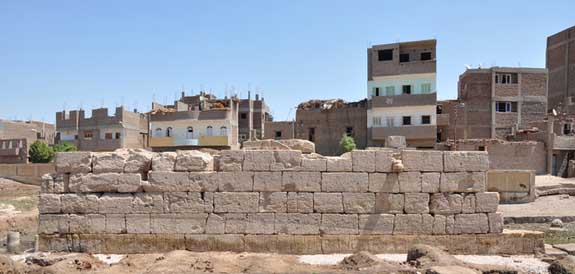
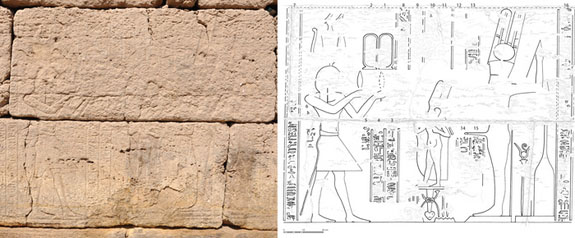
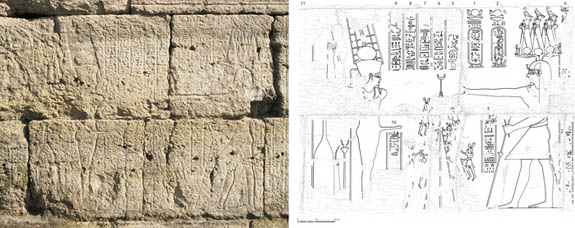
An ancient stone carving on the walls of an Egyptian temple depicts the Roman emperor Claudius dressed as an Egyptian pharaoh, wearing an elaborate crown, a team of researchers has discovered. In the carving, Emperor Claudius, who reigned from A.D. 41 to 54, is shown erecting a giant pole with a lunar crescent at the top. Eight men, each wearing two feathers, are shown climbing the supporting poles, with their legs dangling in midair. Egyptian hieroglyphs in the carving call Claudius the "Son of Ra, Lord of the Crowns," and say he is "King of Upper and Lower Egypt, Lord of the Two Lands." The hieroglyphs say he is raising the pole of the tent (or cult chapel) of Min (an ancient Egyptian god of fertility and power) and notes a date indicating a ritual like this took place around the summertime researchers say. It would have taken place even though Claudius never visited Egypt. A cult chapel is a place of worship and a tent could also be used for this purpose.