
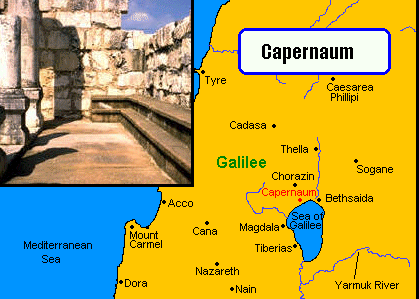
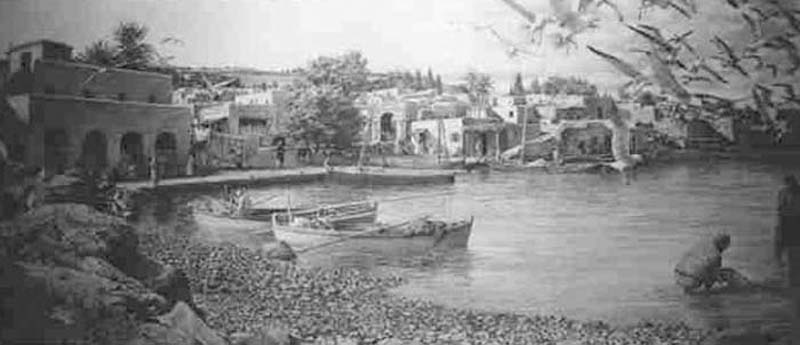
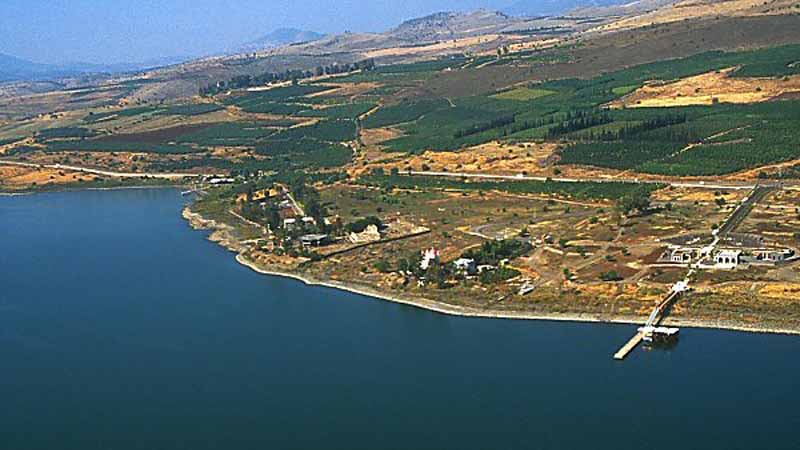
Capernaum (Kfar Nahum) was a settlement on the shore of the Sea of Galilee. The site is a ruin today, but was inhabited from 150 BC to about AD 750. Josephus refers to Capernaum as a fertile spring. He stayed the night there after spraining his ankle. It is located in northwestern shore of the Kinneret. A church near Capernaum is said to be the home of Peter himself. Recent excavations have revealed that there are actually two synagogues. One is made of limestone and the other is made of black basalt. The Romans never came to Capernaum.
The limestone synagogue is built on top of the older basalt synagogue. Of the earlier structure only foundation walls, column fragments and a cobblestone floor are the only things that remain. Capernaum started out as a fishing village, and was inhabited from the 1st century CE to 13th century AD. It had a population of 1500. There was a small amount of room here but enough room for a synagogue.
When Jesus abandoned Nazareth he went to Capernaum and made it into his home. In Capernaum he chose his first 4 disciples which are followers. Their names were James, John, Peter, and Andrew. During the first Jewish revolt Capernaum was not damaged, and this revolt happened during 66-70.
The town is mentioned in the New Testament: in the Gospel of Luke it was reported to have been the home of the apostles Peter, Andrew, James and John, as well as the tax collector Matthew. In Matthew 4:13 the town was reported to have been the home of Jesus.
According to Luke 4:31-44, Jesus taught in the synagogue in Capernaum on the Sabbath. In Capernaum also, Jesus healed a man who had the spirit of an unclean devil and healed a fever in Simon Peter's mother-in-law. According to Matthew 8:5-13, it is also the place where a Roman Centurion asked Jesus to heal his servant. A building which may have been a synagogue of that period has been found beneath the remains of a later synagogue.
Roman Ruins
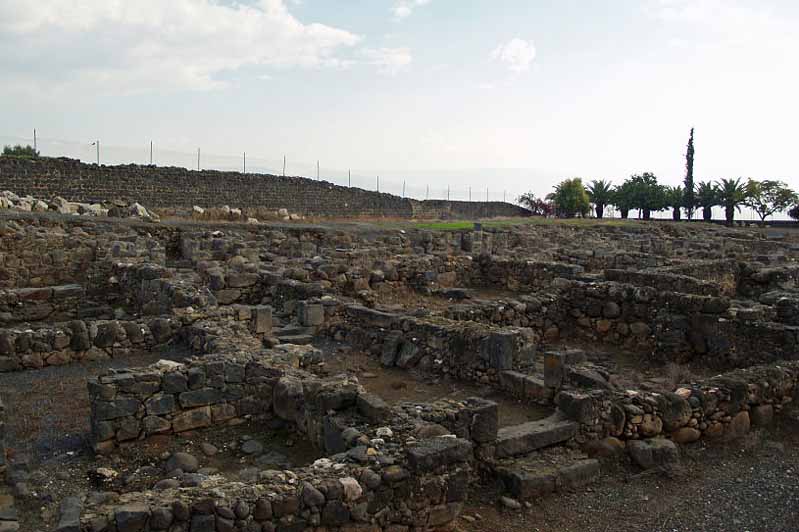
The layout of the town was quite regular. On both sides of an ample north-south main street arose small districts bordered by small cross-sectional streets and no-exit side-streets. The walls were constructed with coarse basalt blocks and reinforced with stone and mud, but the stones (except for the thresholds) were not dressed and mortar was not used.
The most extensive part of the typical house was the courtyard, where there was a circular furnace made of refractory earth, as well as grain mills and a set of stone stairs that led to the roof. The floors of the houses were cobbled. Around the open courtyard, modest cells were arranged which received light through a series of openings or low windows (Loffreda, 1984).
Given the coarse construction of the walls, there was no second story to a typical home, and the roof would have been constructed of light wooden beams and thatch mixed with mud. This, along with the discovery of the stairs to the roof, recalls the biblical story of the Healing of the Paralytic: "And when they could not come nigh unto him for the press, they uncovered the roof where he was: and when they had broken it up, let down the bed wherein the sick of the palsy lay." (Mark 2:4) With the type of construction seen in Capernaum, it would not have been difficult to raise the ceiling by the courtyard stairs and to remove a part to allow the bed to be brought down to where Jesus stood.
A study of the district located between the synagogue and the octagonal church showed that several families lived together in the patriarchal style, communally using the same courtyards and doorless internal passages. The houses were, in general, quite poor. There were no hygienic facilities nor drainage; the rooms were narrow and not very comfortable. Most objects found were made of clay: pots, plates, amphoras and lamps. Fish hooks, weights for fish nets, striker pins, weaving bobbins, and basalt mills for milling grain and pressing olives were also found (Loffreda, 1974). The mill was a true heirloom that was passed on from generation to generation during many centuries.
As of the 4th century, there was an improvement in the quality of life: the houses were constructed with good quality mortar and fine ceramics were also used. This was about the time that the synagogue now visible was built. Differences in social class were not noticeable. Buildings constructed at the founding of the town continued to be in use until the time of the abandonment of the town.
Drawing upon literary sources and the results of the excavations, it has been possible to reconstruct a part of the town's history.
Archaeological evidence demonstrates that the town came into existence in the second century BC, in the Hasmonean period. The site had no defensive wall and extended along the shore of the nearby lake (from east to west).
The cemetery zone is found 200 meters north of the synagogue, which places it beyond the inhabited area of the town. It extended 3 kilometers to Tabgha, an area which appears to have been dedicated to agriculture, judging by the many oil and grain mills which were discovered in the excavation. Fishing was also a source of income; the remains of another harbour were found to the west of that built by the Franciscans.
According to the Synoptic Gospels, Jesus selected this town as the center of his public ministry in Galilee after he left the small mountainous hamlet of Nazareth (Matthew 4:12-17). Capernaum has no obvious advantages over any other city in the area, so he probably chose it because it was the home of his first disciples, Simon (Peter) and Andrew. The Gospel of John suggests that Jesus' ministry was centered in a village called Cana.
No sources have been found for the belief that Capernaum was involved in the bloody Jewish revolts against the Romans, the First Jewish-Roman War (AD 66Ð73) or Bar Kokhba's revolt (132Ð135), although there is reason to believe that Josephus, one of the Jewish generals during the earlier revolt, was taken to Capernaum (which he called "Kapharnakos") after a fall from his horse in nearby Bethsaida (Josephus, Vita, 72).
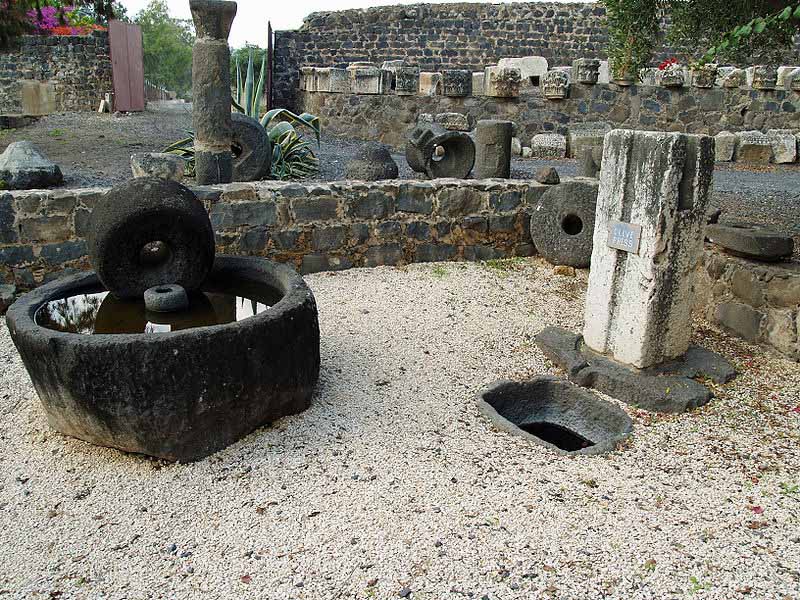 Olive Press
In 1838, the American explorer, Edward Robinson discovered the ruins of the ancient Capernaum. The city appeared to the first explorers to be a sad and desolate place.
In 1866, British Captain Charles W. Wilson identified the remains of the synagogue, and in 1894, Franciscan Friar Giuseppe Baldi of Naples, the Custodian of the Holy Land, was able to recover a good part of the ruins from the Bedouins.
The Franciscans raised a fence to protect the ruins from frequent vandalism, and planted palms and eucalyptus trees brought from Australia to create a small oasis for pilgrims. They also built a small harbor. These considerable labors were directed by the Franciscan Virgilio Corbo.
The most important excavations began in 1905 under the direction of the Germans Heinrich Kohl and Carl Watzinger. They were continued by the Franciscans Fathers Vendelin von Benden (1905-1915) and Gaudenzio Orfali (1921-1926).
The excavations resulted in the discovery of two public buildings, the synagogue (which was partially restored by Fr Orfali), and an octagonal church. Later, in 1968, excavation of the western portion of the site -- the portion owned by the Franciscans -- was restarted by Corbo and Stanislao Loffreda, with the financial assistance of the Italian government. During this phase, the major discovery was of a house which is claimed to be Saint Peter's house, in a neighborhood of the town from the First Century AD. These excavations have been ongoing, with some publication on the Internet as recently as 2003.
The excavations revealed that the site was established at the beginning of the Hasmonean Dynasty, roughly in the second century BC, and was abandoned in the eleventh century AD.
The eastern half of the site -- the portion owned by an Orthodox monastery -- has also been surveyed and partially excavated under the direction of Vasilios Tzaferis. This section has uncovered the village from the Byzantine and Arab periods. Features include a pool apparently used for the processing of fish and a hoard of gold coins. (Tzaferis, 1989).
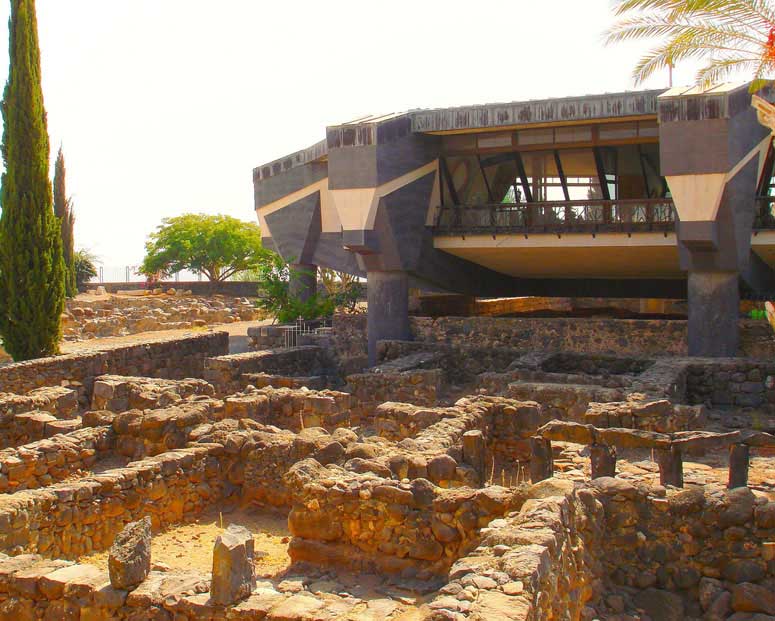
One block of homes, called by the Franciscan excavators the sacra insula or "holy insula" ("insula" refers to a block of homes around a courtyard) was found to have a complex history. Located between the synagogue and the lakeshore, it was found near the front of a labyrinth of houses from many different periods. Three principal layers have been identified:
The great transformation of one of the homes in the fourth century AD.
The octagonal church in the middle of the fifth century AD.
The city's basalt houses are grouped around two large courtyards, one to the north and the other to the south. One large room in particular, near the east side and joining both courtyards, was especially large (sides about 7.5 meters long) and roughly square. An open space on the eastern side contained a brick oven. A threshold which allowed crossing between the two courtyards remains well-preserved to this day.
Beginning in the latter half of the first century AD, this house displayed markedly different characteristics than the other excavated houses. The rough walls were reworked with care and were covered with inscriptions; the floor was covered with a fine layer of plaster. Furthermore, almost no domestic ceramics are recovered, but lamps abound. One explanation suggested for this treatment is that the room was venerated as a religious gathering place, a domus-ecclesia or house church, for the Christian community. (Loffreda, 1984)
This suggestion has been critiqued by several scholars, however. In particular, where excavators had claimed to find graffiti including the name of Peter, others have found very little legible writing (Strange and Shanks, 1982). Others have questioned whether the space is actually a room; the paved floor, the large space without supports, and the presence of a cooking space have prompted some to note that these are more consistent with yet another courtyard (Freyne, 2001).
In this period, the sacra insula acquired a new appearance. First, a thick-walled, slightly trapezoidal enclosure was built surrounding the entire insula; its sides were 27-30 meters long. Made of plaster, they reached a height of 2.3 meters on the north side. It had two doors, one in the southwest corner and the other in the northeast corner.
Next, although there is evidence that the private houses remained in use after the transformation, the one particular room that had before been treated differently was profoundly altered and expanded. A central archway was added to support a roof and the north wall was strengthened with mortar. New pavement was installed, and the walls and floor were plastered. (Loffreda, 1974)
This structure remained until the middle of the fifth century when the sacra insula was dismantled and replaced with a larger basilica.
The fifth-century church consists of a central octagon with eight pillars, an exterior octagon with thresholds still in situ, and a gallery or portico that leads both into the interior of the church as well as into a complex of associated buildings to the East, a linkage achieved via a short passageway. Later, this passage was blocked and an apse with a pool for baptism was constructed in the middle of the east wall. From this wall ascended two stairs on either side of the baptistry, and the excess water from the rite would have escaped along this path.
There is a close relationship between the octagonal church and the house of Saint Peter. The Byzantines, upon constructing the new church, placed the central octagon directly on top of the walls of the house with the aim of preserving its exact location. Although Byzantine worshippers stood on the very site where Jesus was believed to have stood, virtually none of the original house was visible any longer, as the walls had been torn down the floor covered in mosaics.
In the portico, the pattern of the mosaic was purely geometric, with four rows of contiguous circles and small crosses. In the zone of the external octagon, the mosaics represented plants and animals in a style similar to that found in the Basilica of the Feeding of the Five Thousand, in Taghba. In the central octagon, the mosaic was composed of a strip of calcified flowers, of a field of schools of fish with small flowers, and of a great circle with a peacock in the center.
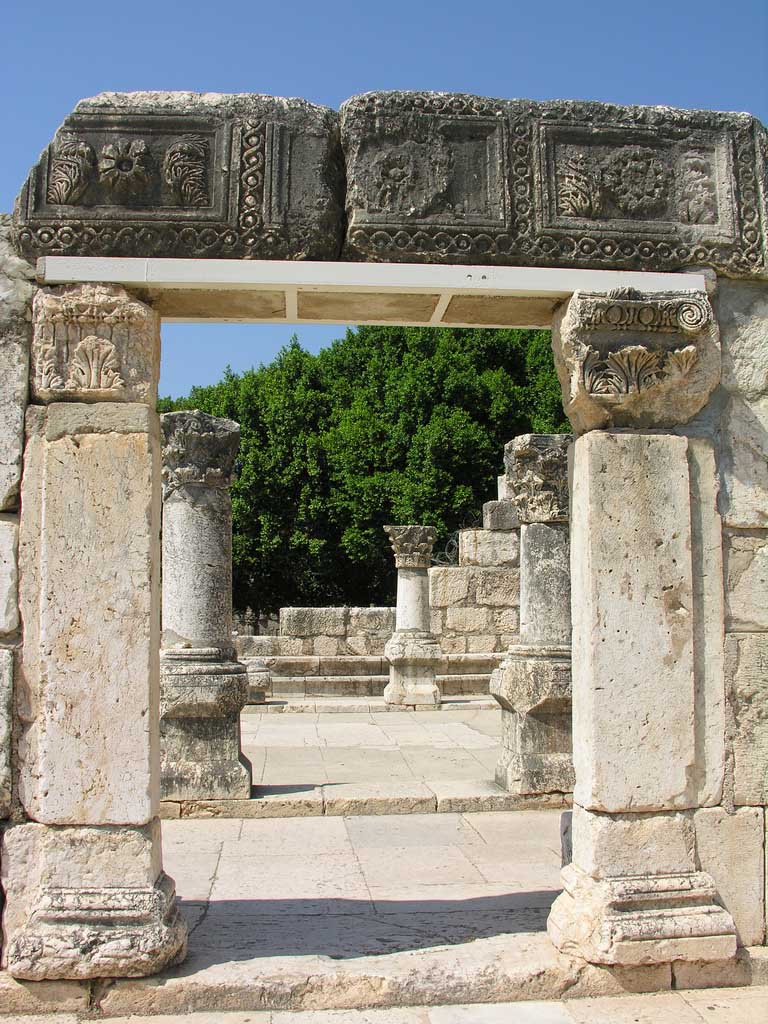
Doorway
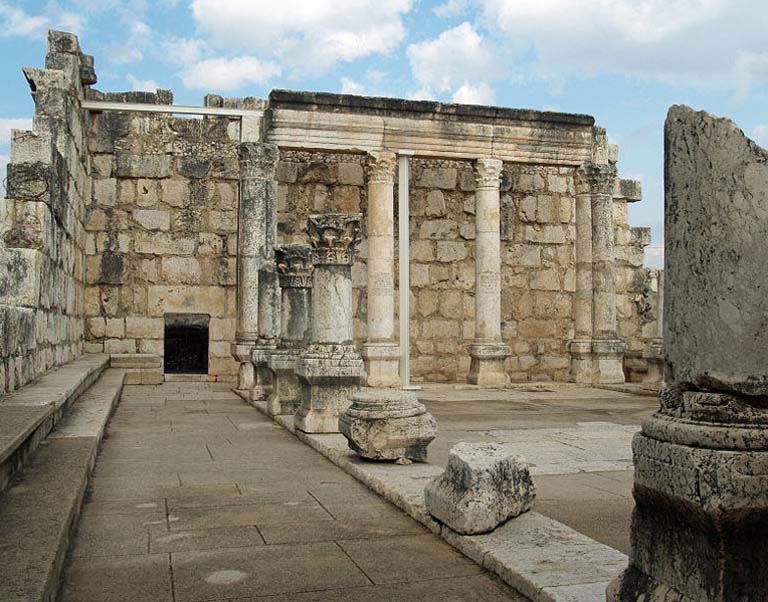
Most recent excavations have revealed two synagogues, a white limestone synagogue dating from the fourth to fifth centuries CE, and a black basalt synagogue dating from the first half of the first century CE. Only foundation walls, gray marble column fragments and a cobblestone floor remain from the earlier structure, which measured 24.5 by 18.7 meters on the exterior and possessed walls over a meter thick.
The ruins of the limestone building, among the Oldest synagogues in the world were identified by Wilson. The large, ornately carved, white building stones of the synagogue stood out prominently among the smaller, plain blocks of local black basalt used for the towns other buildings, almost all residential.
The synagogue was built almost entirely of white blocks of calcareous stone brought from distant quarries.
The building consists of four parts: the praying hall, the western patio, a southern balustrade and a small room at the northwest of the building. The praying hall measured 24.40 ms by 18.65 m, with the southern face looking toward Jerusalem.
The internal walls were covered with painted plaster and superbly well-done stucco work found during the excavations. Watzinger, like Orfali, believed that there had been an upper floor reserved for women, with access by means of an external staircase located in the small room. But this opinion was not substantiated by the later excavations of the site.
The synagogue appears to have been built around the fourth or fifth century AD. Beneath the foundation of this synagogue lies another foundation made of basalt, and Loffreda suggests that this is the foundation of a synagogue from the first century AD, perhaps the one mentioned in the Gospels (Loffreda, 1974). This, too, has been open for debate. Later excavation work was attempted underneath the synagogue floor, but while Loffreda claimed to have found a paved surface, others are of the opinion that this was an open, paved market area.
The ancient synagogue still has two inscriptions, one in Greek and the other in Aramaic, that remember the benefactors that helped in the construction of the building. There are also carvings of five- and six-pointed stars and of palm trees.
In 1926, the Franciscan Orfali began the restoration of the synagogue. After his death, this work was continued by Virgilio Corbo beginning in 1976.
In 1986 the water of the lake reached an unusually low point. At that time, an ancient fishing boat was discovered that has been claimed to date from the first century BC. The vessel was 8 metres long and was preserved in the mud of the lake. After a difficult unearthing process that had to be completed before the water rose again, the excavated boat was put on display in its modern-day position near the kibbutz Ginosar as The Sea of Galilee Boat. Capernaum
In March 2000, John Paul II visited the ruins of Capernaum during his visit to Israel.