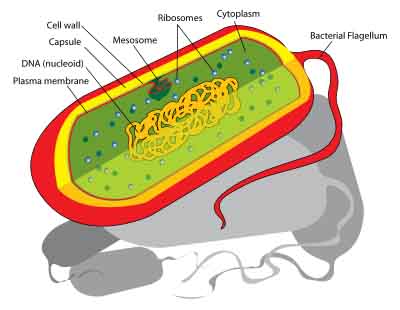
The generally accepted parts of modern cell theory include: All known living things are made up of one or more cells. All living cells arise from pre-existing cells by division.
The cell (from Latin cella, meaning "small room") is the basic structural, functional, and biological unit of all known living organisms. A cell is the smallest unit of life. Cells are often called the "building blocks of life". The study of cells is called cell biology.
Cells consist of cytoplasm enclosed within a membrane, which contains many biomolecules such as proteins and nucleic acids. Organisms can be classified as unicellular (consisting of a single cell; including bacteria) or multicellular (including plants and animals). While the number of cells in plants and animals varies from species to species, humans contain more than 10 trillion (1013) cells. Most plant and animal cells are visible only under a microscope, with dimensions between 1 and 100 micrometres.
The cell was discovered by Robert Hooke in 1665, who named the biological units for their resemblance to cells inhabited by Christian monks in a monastery. Cell theory, first developed in 1839 by Matthias Jakob Schleiden and Theodor Schwann, states that all organisms are composed of one or more cells, that cells are the fundamental unit of structure and function in all living organisms, that all cells come from preexisting cells, and that all cells contain the hereditary information necessary for regulating cell functions and for transmitting information to the next generation of cells. Cells emerged on Earth at least 3.5 billion years ago. Read more ...
Scientists discover never-before-seen part of human cells Live Science - July 1, 2025

A new organelle has been discovered in human cells - and scientists call it a "hemifusome." Like the full-size organs in our bodies, the organelles within cells are specialized structures that carry out specific functions. While observing filaments that maintain the shape of cells, Seham Ebrahim, an assistant professor at the University of Virginia, and her team noticed a new structure that was consistently appearing in the 3D images they were making. What at first seemed like an artifact in the images turned out to be a new organelle that may be involved in sorting, recycling and discarding proteins within human cells. Ebrahim likened the hemifusome's shape to that of a snowman wearing a scarf; picture a small head attached to a larger body, with a thin border separating the two ends.
Improving RNA drug delivery through intracellular traffic control Medical.net - July 1, 2025

A recent study involving researchers from the University of Basel reveals that slowing down the intracellular transport of RNA-based drugs can significantly enhance their effectiveness. These promising therapeutics are currently used to treat rare genetic diseases.
Customizable AI tool developed at Stanford Medicine helps pathologists identify diseased cells Stanford Research - June 19, 2024

The artificial intelligence technology can be trained by pathologists, giving them personalized assistance in identifying cells that might indicate diseases such as cancer or endometritis.
New life form answers question about evolution of cells PhysOrg - March 19, 2018

Bacteria and Archaea are two of the three domains of life. Both must have evolved from the putative last universal common ancestor (LUCA). One hypothesis is that this happened because the cell membrane in LUCA was an unstable mixture of lipids. Now, scientists from the University of Groningen and Wageningen University have created such a life form with a mixed membrane and discovered it is, in fact, stable, refuting this hypothesis.

Anton van Leeuwenhoek Father of Microbiology - Videos