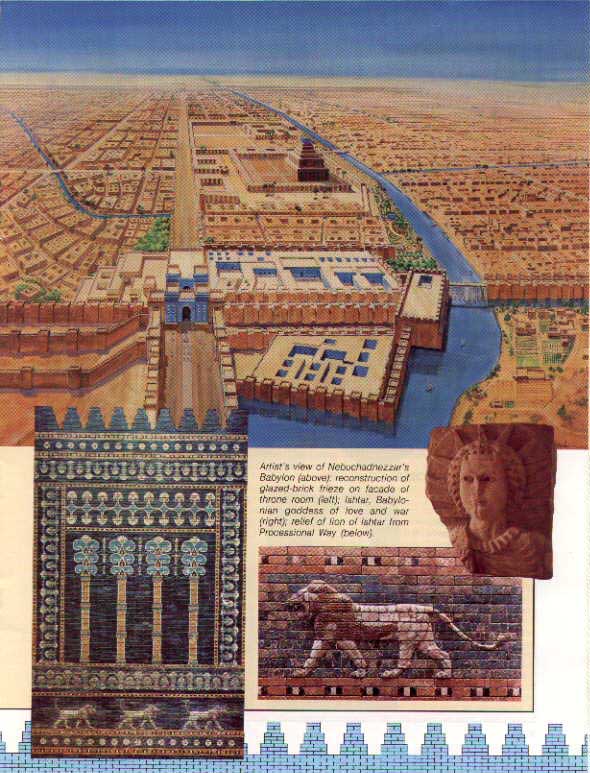
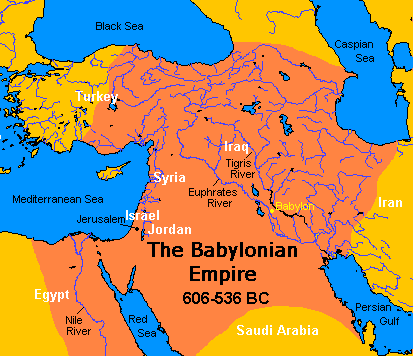
While related, Babylonia and Babylon are not the same. Babylon was a city, while Babylonia was the broader region or state centered around that city, according to eHRAF World Cultures.
Babylonia was an ancient cultural region in central-southern Mesopotamia (present-day Iraq), with Babylon as its capital. Babylonia emerged as a major power when Hammurabi (1792 - 1750 BC or fl. ca. 1696 - 1654 BC, short chronology) created an empire out of the territories of the former Akkadian Empire.
Babylonia retained the written Semitic Akkadian language for official use (the language of its native populace), despite its Amorite founders and Kassite successors not being native Akkadians. It retained the Sumerian language for religious use, which by the time Babylon was founded was no longer a spoken language. The Akkadian and Sumerian traditions played a major role in later Babylonian culture, and the region would remain an important cultural center, even under protracted and lengthy periods of outside rule.
The earliest mention of the city of Babylon can be found in a tablet from the reign of Sargon of Akkad (2334- 2279 BC), dating back to the 23rd century BC. Babylon was a religious and cultural centre at this point and not an independent state, and like the rest of Mesopotamia, it was subject to the Akkadian Empire which united all the Akkadian and Sumerian speakers under one rule. After the collapse of the Akkadian empire the region was ruled by Gutians for a few decades before the rise of the Sumerian third dynasty of Ur which encompassed the whole of Mesopotamia, including Babylon.
Following the collapse of the last Sumerian "Ur-III" dynasty at the hands of the Elamites (2002 BC traditional, 1940 BC short), another Semitic people, the Amorites gradually gained control over most of southern Mesopotamia, where they formed a series of small kingdoms. During the first centuries of what is called the "Amorite period", the most powerful city states were Isin and Larsa, although Shamshi-Adad I usurped the throne of Assyria and formed a short lived empire in the north. One of these Amorite dynasties founded the city-state of Babylon, which would ultimately take over the others and form the first Babylonian empire, during what is also called the Old Babylonian Period.
During the first centuries of the "Old Babylonian" period (that followed the Sumerian revival under Ur-III), kings and people in high position often had Amorite names, and supreme power rested at Isin.
A constant intercourse was maintained between Babylonia and the West - with Babylonian officials and troops passing to Syria and Canaan, while "Amorite" colonists were established in Babylonia for the purposes of trade. One of these Amorites, Abi-ramu or Abram by name, is the father of a witness to a deed dated in the reign of Hammurabi's grandfather.
The city of Babylon was given hegemony over Mesopotamia by their sixth ruler, Hammurabi (1780-1750 BC; dates highly uncertain). He was a very efficient ruler, giving the region stability after turbulent times, and transforming it into the central power of Mesopotamia.
A great literary revival followed the recovery of Babylonian independence. One of the most important works of this "First Dynasty of Babylon", as it was called by the native historians, was the compilation of a code of laws. This was made by order of Hammurabi after the expulsion of the Elamites and the settlement of his kingdom.
A copy of the Code of Hammurabi was found by J. de Morgan at Susa, where it had been taken as plunder, and is now in the Louvre.
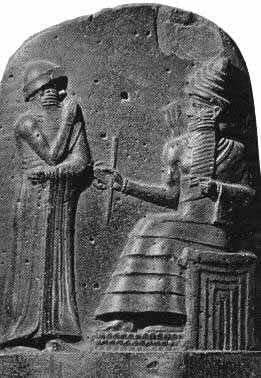
It shows rules and punishments if those rules are broken. It focuses on theft, farming (or shepherding), property damage, women's rights, marriage rights, children's rights, slave rights, murder, death, and injury. The punishment is different for different classes of offenders and victims. For a comprehensive summary.
The laws do not accept excuses or explanations for mistakes or fault: the Code was openly displayed for all to see, so no man could plead ignorance of the law as an excuse. Few people, however, could read in that era (literacy mainly being the domain of scribes).
Hammurabi (1728 BC-1686 BC) felt he had to write the code to please his gods. Unlike many earlier and contemporary kings, he did not consider himself related to any god, although he did call himself "the favorite of the gods". In the upper part of the stela Hammurabi is shown in front of the throne of the Sun god Shamash.
The laws (numbered from 1 to 282, but numbers 13, and 66-99 are missing) are inscribed in Old Babylonian on an 8 foot tall stela of black diorite. It was discovered in December 1901 in Susa, Elam, which is now Khuzistan, where it had been taken as plunder by the Elamites in the 12th century BC.
It is currently on display at the Louvre Museum in Paris, France.The code is often pointed to as the first example of the legal concept that some laws are so basic as to be beyond the ability of even a king to change. By writing the laws on stone they were immutable. This concept lives on in most modern legal systems and has given rise to the term written in stone.
The Code of Hammurabi was one of many sets of laws in the Ancient Near East. Most of these law codes, coming from similar cultures and racial groups in a relatively small geographical area, necessarily have passages that resemble each other. For example, the laws found in the later Hittite code of laws (ca. 1300 BC) have some individual laws that bear a passing resemblance to those in the Code of Hammurabi, as well as other codices from the same geographic area.
The earlier Ur-Nammu, of the written literature prolific Ur-III dynasty (2050 BC), also produced a code of laws, some of which bear resemblance to certain specific laws in the Code of Hammurabi. The later Mosaic Law (according to the modern documentary hypothesis ca 700-500 BC - under Hezekiah/Josiah; traditionally ca 1200 BC - under Moses) also has some laws that resemble the Code of Hammurabi, as well as other law codes of the region.
The divine origin of the written law is emphasized by a bas-relief in which the king is depicted receiving the code from the sun god, Shamash. The quality most usually associated with this god is justice. The code is set down in horizontal columns of cuneiform writing: 16 columns of text on the obverse side and 28 on the reverse. The text begins with a prologue that explains the extensive restoration of the temples and religious cults of Babylonia and Assyria. The code itself, composed of 28 paragraphs, seems to be a series of amendments to the common law of Babylonia, rather than a strict legal code.
It begins with direction for legal procedure and the statement of penalties for unjust accusations, false testimony, and injustice done by judges; then follow laws concerning property rights, loans, deposits, debts, domestic property, and family rights. The sections covering personal injury indicate that penalties were imposed for injuries sustained through unsuccessful operations by physicians and for damages caused by neglect in various trades. Rates are fixed in the code for various forms of service in most branches of trade and commerce.
The 'Code of Hammurabi' contains no laws having to do with religion. The basis of criminal law is that of equal retaliation, comparable to the Semitic law of "an eye for an eye." The law offers protection to all classes of Babylonian society; it seeks to protect the weak and the poor, including women, children, and slaves, against injustice at the hands of the rich and powerful.
The code is particularly humane for the time in which it was promulgated; it attests to the law and justice of Hammurabi's rule. It ends with an epilogue glorifying the mighty works of peace executed by Hammurabi and explicitly states that he had been called by the gods "to cause justice to prevail in the land, to destroy the wicked and the evil."
He describes the laws in his compilation as enabling "the land to enjoy stable government and good rule," and he states that he had inscribed his words on a pillar in order "that the strong may not oppress the weak, that justice may be dealt the orphan and the widow." Hammurabi counsels the downtrodden in these ringing words: "Let any oppressed man who has a cause come into the presence of my statue as king of justice, and have the inscription on my stele read out, and hear my precious words, that my stele may make the case clear to him; may he understand his cause, and may his heart be set at ease!"
Law and justice were key concepts in the Babylonian way of life. Justice was administered by the courts, each of which consisted of from one to four judges. Often the elders of a town constituted a tribunal. The judges could not reverse their decisions for any reason, but appeals from their verdicts could be made to the king. Evidence consisted either of statements from witnesses or of written documents. Oaths, which played a considerable role also in the administration of justice, could be either promissory, declaratory, or exculpatory.
The courts inflicted penalties ranging from capital punishment and mutilation to flogging, reduction to slavery, and banishment. Awards for damages were from 3 to 30 times the value of the object to be restored.
To ensure that their legal, administrative, and economic institutions functioned effectively, the Babylonians used the cuneiform system of writing developed by their Sumerian predecessors. To train their scribes, secretaries, archivists, and other administrative personnel, they adopted the Sumerian system of formal education, under which secular schools served as the cultural centers of the land.
The curriculum consisted primarily of copying and memorizing both textbooks and Sumero-Babylonian dictionaries containing long lists of words and phrases, including the names of trees, animals, birds, insects, countries, cities, villages, and minerals, as well as a large and diverse assortment of mathematical tables and problems. In the study of literature, the pupils copied and imitated various types of myths, epics, hymns, lamentations, proverbs, and essays in both the Sumerian and the Babylonian languages.
Ammiditana, the great-grandson of Hammurabi, still titled himself "king of the land of the Amorites", and his father and son bore the Canaanite names of Abieshuh and Ammisaduqa.
The armies of Babylonia were well-disciplined, and they conquered the city-states of Isin, Elam, and Uruk, and the strong Kingdom of Mari. The rule of Babylon was even obeyed as far as the shores of the Mediterranean. But Mesopotamia had no clear boundaries, making it vulnerable to attack. Trade and culture thrived for 150 years, until the fall of Babylon in 1595 BC.
The last king of the dynasty was Samsu-Ditana, son of Ammisaduqa. He was overthrown following the sack of Babylon in 1595 BC by the Hittite king Mursili I, and Babylonia was turned over to the Kassites (Kossaeans) from the mountains of Iran, with whom Samsu-Iluna had already come into conflict in his 6th year. The Kassite dynasty was founded by Kandis or Gandash of Mari.
The Kassites renamed Babylon "Kar-Duniash", and their rule lasted for 576 years. With this foreign dominion - that offers a striking analogy to the contemporary rule of the Hyksos in Egypt - Babylonia lost its empire over western Asia. Syria and Canaan became independent, and the high-priests of Asshur made themselves kings of Assyria. Most divine attributes ascribed to the Semitic kings of Babylonia disappeared at this time; the title of "god" was never given to a Kassite sovereign. However, Babylon continued to be the capital of the kingdom and the 'holy' city of western Asia, where the priests were all-powerful, and the only place where the right to inheritance of the old Babylonian empire could be conferred.
Through the centuries of Assyrian domination, Babylonia enjoyed a prominent status, or revolting at the slightest indication that it did not. However, the Assyrians always managed to restore Babylonian loyalty, whether through granting of increased privileges, or militarily. That finally changed in 627 BC with the death of the last strong Assyrian ruler, Ashurbanipal, and Babylonia rebelled under Nabopolassar the Chaldean the following year. With help from the Medes, Niniveh was sacked in 612, and the seat of empire was again transferred to Babylonia.
Nabopolassar was followed by his son Nebuchadnezzar II, whose reign of 43 years made Babylon once more the mistress of the civilized world. Only a small fragment of his annals has been discovered, relating to his invasion of Egypt in 567 BC, and referring to "Phut of the Ionians".Of the reign of the last Babylonian king, Nabonidus (Nabu-na'id), and the conquest of Babylonia by Cyrus, there is a fair amount of information available.
This is chiefly derived from a chronological tablet containing the annals of Nabonidus, supplemented by another inscription of Nabonidus where he recounts his restoration of the temple of the Moon-god at Harran; as well as by a proclamation of Cyrus issued shortly after his formal recognition as king of Babylonia. It was in the sixth year of Nabonidus (549 BC) that Cyrus, the Achaemenid Persian "king of Anshan" in Elam, revolted against his suzerain Astyages, "king of the Manda" or Medes, at Ecbatana. Astyages' army betrayed him to his enemy, and Cyrus established himself at Ecbatana, thus putting an end to the empire of the Medes. Three years later Cyrus had become king of all Persia, and was engaged in a campaign in the north of Mesopotamia. Meanwhile, Nabonidus had established a camp in the desert, near the southern frontier of his kingdom, leaving his son Belshazzar (Belsharutsur) in command of the army.
In 538 BC Cyrus invaded Babylonia. A battle was fought at Opis in the month of June, where the Babylonians were defeated; and immediately afterwards Sippara surrendered to the invader. Nabonidus fled to Babylon, where he was pursued by Gobryas, the governor of Kurdistan, and on the 16th of Tammuz, two days after the capture of Sippara, "the soldiers of Cyrus entered Babylon without fighting."
Nabonidus was dragged from his hiding-place, and Kurdish guards were placed at the gates of the great temple of Bel, where the services continued without interruption. Cyrus did not arrive until the 3rd of Marchesvan (October), Gobryas having acted for him in his absence. Gobryas was now made governor of the province of Babylon, and a few days afterwards the son of Nabonidus died.
A public mourning followed, lasting six days, and Cambyses accompanied the corpse to the tomb.Cyrus now claimed to be the legitimate successor of the ancient Babylonian kings and the avenger of Bel-Marduk, who was assumed to be wrathful at the impiety of Nabonidus in removing the images of the local gods from their ancestral shrines, to his capital Babylon.
Nabonidus, in fact, had excited a strong feeling against himself by attempting to centralize the religion of Babylonia in the temple of Merodach (Marduk) at Babylon, and while he had thus alienated the local priesthoods, the military party despised him on account of his antiquarian tastes. He seems to have left the defence of his kingdom to others, occupying himself with the more congenial work of excavating the foundation records of the temples and determining the dates of their builders.
The invasion of Babylonia by Cyrus was doubtless facilitated by the existence of a disaffected party in the state, as well as by the presence of foreign exiles like the Jews, who had been planted in the midst of the country. One of the first acts of Cyrus accordingly was to allow these exiles to return to their own homes, carrying with them the images of their gods and their sacred vessels. The permission to do so was embodied in a proclamation, whereby the conqueror endeavoured to justify his claim to the Babylonian throne. The feeling was still strong that none had a right to rule over western Asia until he had been consecrated to the office by Bel and his priests; and accordingly, Cyrus henceforth assumed the imperial title of "king of Babylon."
A year before Cyrus' death, in 529 BC, he elevated his son Cambyses II in the government, making him king of Babylon, while he reserved for himself the fuller title of "king of the (other) provinces" of the empire. It was only when Darius Hystaspis ("the Magian") acquired the Persian throne and ruled it as a representative of the Zoroastrian religion, that the old tradition was broken and the claim of Babylon to confer legitimacy on the rulers of western Asia ceased to be acknowledged. Darius, in fact, entered Babylon as a conqueror.
After the murder of Darius, it briefly recovered its independence under Nidinta-Bel, who took the name of Nebuchadnezzar III, and reigned from October 521 BC to August 520 BC, when the Persians took it by storm. A few years later, probably 514 BC, Babylon again revolted under Arakha; on this occasion, after its capture by the Persians, the walls were partly destroyed.
E-Saggila, the great temple of Bel, however, still continued to be kept in repair and to be a center of Babylonian patriotism, until at last the foundation of Seleucia diverted the population to the new capital of Babylonia and the ruins of the old city became a quarry for the builders of the new seat of government.
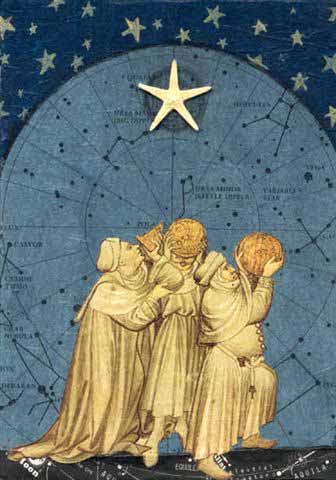
Among the sciences, astronomy and astrology occupied a conspicuous place in Babylonian society. Astronomy was of old standing in Babylonia, and the standard work on the subject, written from an astrological point of view, later translated into Greek by Berossus, was believed to date from the age of Sargon of Akkad.
The zodiac was a Babylonian invention of great antiquity; and eclipses of the sun and moon could be foretold. Observatories were attached to the temples, and reports were regularly sent by astronomers to the king. The stars had been numbered and named at an early date, and we possess tables of lunar longitudes and observations of the phases of Venus. Great attention was naturally paid to the calendar, and we find a week of seven days and another of five days in use.
Like the Chinese, Babylonian astrologers kept careful records about celestial happenings including the motions of Mercury, Venus, the Sun, and the Moon on tablets dating from 1700 to 1681 BC.
Later records identified a total solar eclipse on July 31, 1063 BC, that "turned day into night," and the famous eclipse of June 15, 763 BC, recorded by Assyrian observers in Nineveh. Babylonian astronomers are credited with having discovered the 223-month period for lunar eclipses.
At this time, the same lunar phase would be recorded at the same time of the solar calendar year. This period also gives a rough guide to when a lunar eclipse will recur at the same geographic location. Ptolemy (ca 150 AD) represents the epitome of knowledge of Grecian astronomy. Records such as the Almagest show he had a sophisticated scheme for predicting both lunar and solar eclipses.
Ptolemy knew, for example, the details of the orbit of the Moon including its nodal points. He also knew that the Sun must be within 20 degrees 41' of the node point, and that up to two solar eclipses could occur within seven months in the same part of the world. Lunar eclipses were especially easy to calculate because of the vast area covered by Earth's shadow on the Moon.
Solar eclipses however required much greater knowledge. The shadow of the Moon on Earth is less than 100 kilometers wide, and its track across the daytime hemisphere is the result of many complex factors that cannot be anticipated without a nearly complete understanding of the lunar orbit and speed. In Seleucid and Parthian times, the astronomical reports were of a thoroughly scientific character; how much earlier their advanced knowledge and methods were developed is uncertain.
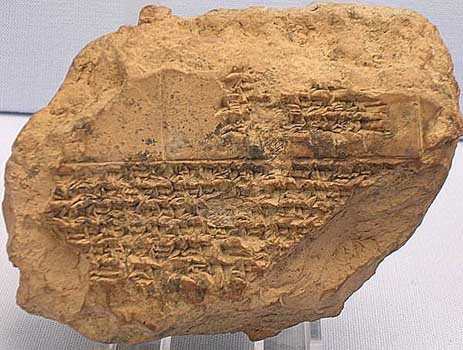
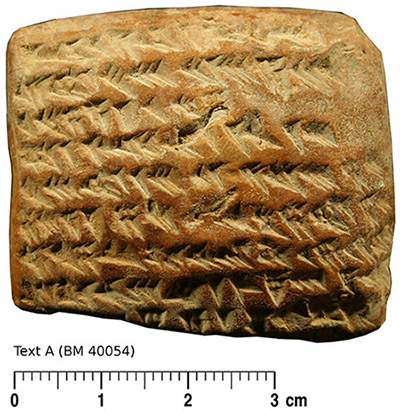
Clay tablets reveal Babylonians discovered astronomical geometry 1,400 years before Europeans Washington Post - January 28, 2016
The medieval mathematicians of Oxford, toiling in torchlight in a land ravaged by plague, managed to invent a simple form of calculus that could be used to track the motion of heavenly bodies. But now a scholar studying ancient clay tablets suggests that the Babylonians got there first, and by at least 1,400 years. The astronomers of Babylonia, scratching tiny marks in soft clay, used surprisingly sophisticated geometry to calculate the orbit of what they called the White Star - the planet Jupiter. These tablets are quite incomprehensible to the untrained eye. Thousands of clay tablets - many unearthed in the 19th century by adventurers hoping to build museum collections in Europe, the United States and elsewhere - remain undeciphered.
Babylonians Tracked Jupiter with Fancy Math, Tablet Reveals Live Science - January 28, 2016
For a text that may rewrite the history of mathematics, it looks rather sloppy. The brown clay tablet, which could fit in the palm of your hand, is scrawled with hasty, highly abbreviated cuneiform characters. And, according to science historian Mathieu Ossendrijver, it proves that the ancient Babylonians used a complex geometrical model that looks like a rudimentary form of integral calculus to calculate the path of Jupiter. Scientists previously thought this mathematical technique was invented in medieval Europe.
Babylonian Tablet Holds Oldest Evidence of Trigonometry Live Science - August 24, 2017
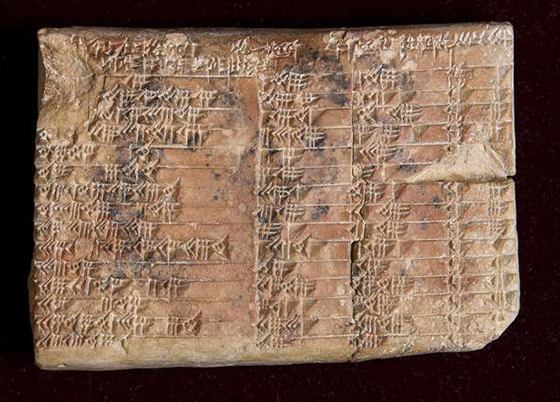
Mathematical mystery of ancient Babylonian clay tablet solved PhysOrg - August 24, 2017
UNSW Sydney scientists have discovered the purpose of a famous 3700-year old Babylonian clay tablet, revealing it is the world's oldest and most accurate trigonometric table, possibly used by ancient mathematical scribes to calculate how to construct palaces and temples and build canals.
The new research shows the Babylonians beat the Greeks to the invention of trigonometry - the study of triangles - by more than 1000 years, and reveals an ancient mathematical sophistication that had been hidden until now. Known as Plimpton 322, the small tablet was discovered in the early 1900s in what is now southern Iraq by archaeologist, academic, diplomat and antiquities dealer Edgar Banks, the person on whom the fictional character Indiana Jones was based. It has four columns and 15 rows of numbers written on it in the cuneiform script of the time using a base 60, or sexagesimal, system.
The development of astronomy implies considerable progress in mathematics; it is not surprising that the Babylonians should have invented an extremely simple method of ciphering, or have discovered the convenience of the duodecimal system. The ner of 600 and the sar of 3600 were formed from the unit of 60, corresponding with a degree of the equator. Tablets of squares and cubes, calculated from 1 to 60, have been found at Senkera, and a people acquainted with the sun-dial, the clepsydra, the lever and the pulley, must have had no mean knowledge of mechanics. A crystal lens, turned on the lathe, was discovered by Austen Henry Layard at Nimrud along with glass vases bearing the name of Sargon; this could explain the excessive minuteness of some of the writing on the Assyrian tablets, and a lens may also have been used in the observation of the heavens.
The Babylonian system of mathematics was sexagesimal, or a base 60 numeral system. From this we derive the modern day usage of 60 seconds in a minute, 60 minutes in an hour, and 360 (60 x 6) degrees in a circle. The Babylonians were able to make great advances in mathematics for two reasons. First, the number 60 has many divisors (2, 3, 4, 5, 6, 10, 12, 15, 20, and 30), making calculations easier. Additionally, unlike the Egyptians and Romans, the Babylonians had a true place-value system, where digits written in the left column represented larger values.
Among the Babylonians mathematical accomplishments were the determination of the square root of two correctly to seven places (YBC 7289 clay tablet). They also demonstrated knowledge of the Pythagorean theorem well before Pythagoras, as evidenced by this tablet translated by Dennis Ramsey and dating to c. 1900 BC.
The Babylonians divided the day into 24 hours, each hour into 60 minutes, each minute into 60 seconds. This form of counting has survived for 4000 years. Calendars
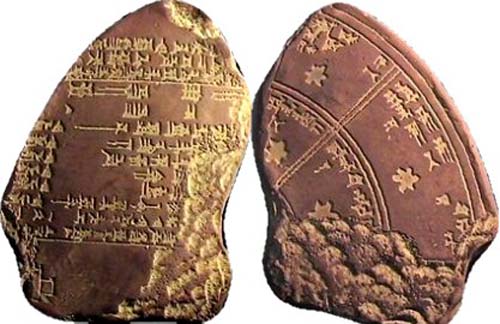
Babylonian Star Calendar
The ancient Babylonians used a calendar with alternating 29 and 30 day months. This system required the addition of an extra month three times every eight years, and as a further adjustment the king would periodically order the insertion of an additional extra month into the calendar.
The Babylonians, who lived in what is now Iraq, added an extra month to their years at irregular intervals. Their calendar, composed of alternate 29-day and 30-day months, kept roughly in step with the lunar year.
To balance the calendar with the solar year, the early Babylonians calculated that they needed to add an extra month three times every eight years. But this system still did not accurately make up for the accumulated differences between the solar year and the lunar year.
Whenever the king felt that the calendar had slipped too far out of step with the seasons, he ordered another extra month. However, the Babylonian calendar was quite confused until the 300's B.C., when the Babylonians began to use a more reliable system.
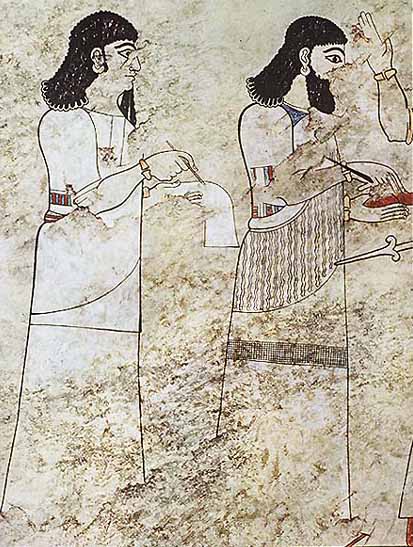
Two Scribes Using Alphabetic and Cuneiform Script
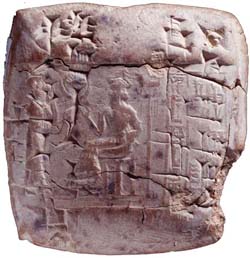
Tablets
Babylonians developed an abstract form of writing based on cuneiform symbols. Their symbols were written on wet clay tablets which were baked in the hot sun. It was the use of a stylus on a clay medium that led to the use of cuneiform symbols since curved lines could not be drawn. Many thousands of these tablets have survived to this day.
In the field of medicine, surgery was well known and often practiced, judging from the Hammurabi law code, which devotes several paragraphs to the surgeon. Pharmacology, too, doubtless had made considerable progress, although the only major direct evidence of this comes from a Sumerian tablet written several centuries before Hammurabi.
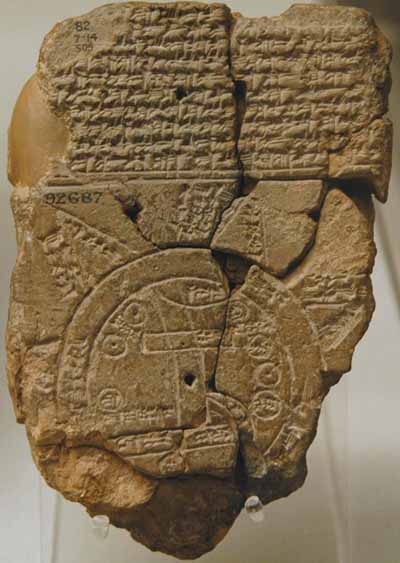
World Map
The Babylonians inherited the technical achievements of the Sumerians in irrigation and agriculture. Maintaining the system of canals, dikes, weirs, and reservoirs constructed by their predecessors demanded considerable engineering knowledge and skill. Preparation of maps, surveys, and plans involved the use of leveling instruments and measuring rods.
Farming was a complicated and methodical occupation requiring foresight, diligence, and skill. A recently translated document written in Sumerian but used as a textbook in the Babylonian schools is a veritable farmer's almanac; it records a series of instructions and directions to guide farm activities from the watering of the fields to the winnowing of the harvested crops.
Babylonian artisans were skilled in metallurgy, in the processes of fulling, bleaching, and dyeing, and in the preparation of paints, pigments, cosmetics, and perfumes.
Babylon society consisted of three classes represented by
Awilu, a free person of the upper class
Mushkenu, a free person of low estate, who ranked legally between the awilu and the wardu. The position of the mushkenu in society can be surmised from a number of legal provisions in the Code of Hammurabi. To cite comparative examples, if a mushkenu was injured in eye or limb, he was indemnified by the payment of a mina (roughly 0.45 kg, or 1 lb, of silver); in the case of an awilu similarly injured, the law of retaliation (lex talionis) was applied; whereas for an injured slave, the indemnity was to be half the slave's market value. If the injury required surgical treatment, the awilu had to pay a fee of ten shekels, but the mushkenu paid five shekels; and, in the case of a slave, the master had to pay a fee of only two shekels.
Wardu, or slave - Slaves were the property of their master, like any other chattel. Most slaves were prisoners of war, but some were recruited from the Babylon citizenry as well. For example, free persons might be reduced to slavery as punishment for certain offenses; parents could sell their children as slaves in time of need; or a man might even turn over his entire family to creditors in payment of a debt, but for no longer than three years. Slaves could be branded and flogged, and they were severely punished if they attempted to escape. On the other hand, because it was to the advantage of the master that the slaves stay strong and healthy, they usually were well treated. Slaves had certain legal rights and could engage in business, borrow money, and buy their freedom. If a slave married a free person and had children, the latter were free. The sale price of a slave varied with the market, as well as with the attributes of the individual; the average price for a grown man was usually 20 shekels of silver, a sum that could buy some 35 bushels of barley.
The family was the basic unit of Babylonian society. Marriages were arranged by the parents, and the betrothal was recognized legally as soon as the groom had presented a bridal gift to the father of the bride; the ceremony often was concluded with a contract inscribed on a tablet. Although marriage was thus reduced to a practical arrangement, some evidence exists to show that surreptitious premarital lovemaking was not altogether unknown.
The Babylonian woman had certain important legal rights. She could hold property, engage in business, and qualify as a witness. Her husband, however, could divorce her on relatively light grounds, or, if she had borne him no children, he could marry a second wife.
Children were under the absolute authority of their parents, who could disinherit them or, as mentioned before, could sell them into slavery. In the normal course of events children were loved and, at the death of the parents, inherited their property. Adopted children were not uncommon and were treated with care.
The populations of the Babylonian cities cannot be estimated with any reasonable degree of accuracy, because the authorities, so far as extant documents reveal, took no census. The number of inhabitants of a city probably ranged from 10,000 to 50,000. The city streets were narrow, winding, and quite irregular, with high, windowless walls of houses on both sides.
The streets were unpaved and undrained. The average house was a small, one-story, mud-brick structure, consisting of several rooms grouped around a court. The house of a well-to-do Babylonian, on the other hand, was probably a two-story brick dwelling of about a dozen rooms and was plastered and whitewashed both inside and out.
The ground floor consisted of a reception room, kitchen, lavatory, servants' quarters, and, sometimes, even a private chapel. Furniture consisted of low tables, high-backed chairs, and beds with wooden frames. Household vessels were made of clay, stone, copper, and bronze, and baskets and chests of reed and wood. Floors and walls were adorned with reed mats, skin rugs, and woolen hangings.
Below the house was often located a mausoleum in which the family dead were buried. The Babylonians believed that the souls of the dead traveled to the nether world, and that, at least to some extent, life continued there as on earth. For this reason, pots, tools, weapons, and jewels were buried with the dead.
After the Persians overthrew Babylon, the Babylonian social structure, economic organization, arts and crafts, science and literature, judicial system, and religious beliefs underwent considerable modification, generally only in details, not in essence. Grounded almost wholly on the culture of Sumer, Babylonian cultural achievements left a deep impress on the ancient world, particularly on the Hebrews and Greeks. Future civilizations would culturally reflect the Babylonian civilization to some extent. For example, Babylonian influence is pervasive throughout the Bible and in the works of such Greek poets as Homer and Hesiod, in the geometry of the Greek mathematician Euclid, in astronomy, in astrology, and in heraldry.
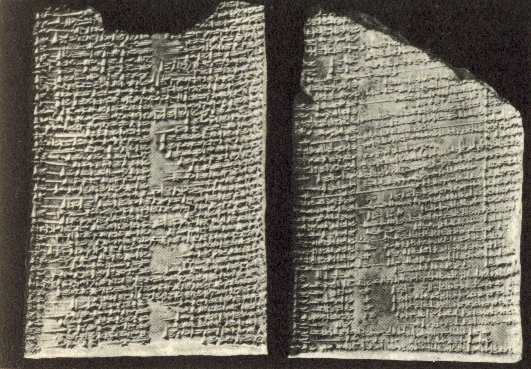
Enuma Elish Babylonian Creation Story
Written on seven tablets, each containing between 115 and 170 lines.
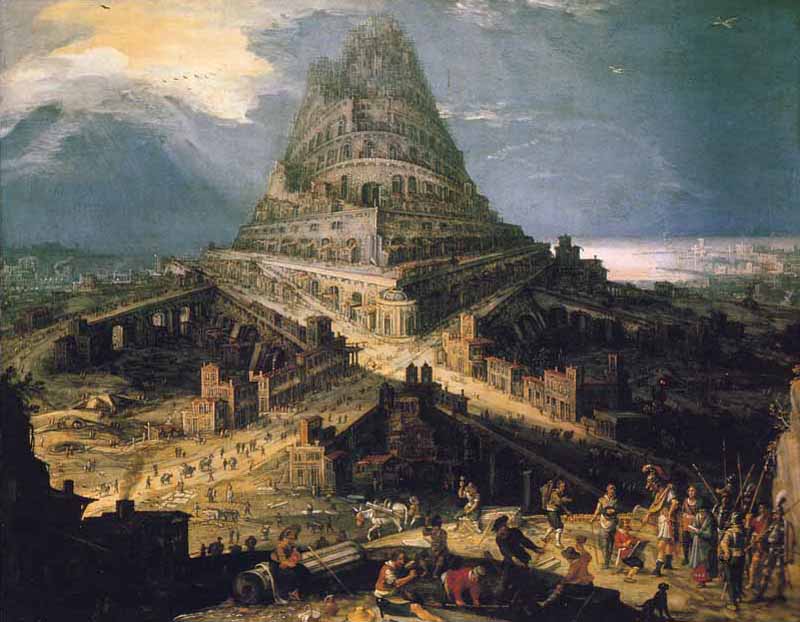
The Hanging Gardens of Babylon

Hymn to Babylon, missing for a millennium, has been discovered PhysOrg - July 1, 2025
It's a fascinating hymn that describes Babylon in all its majesty and gives insights into the lives of its inhabitants, male and female. Babylon was founded in Mesopotamia around 2000 BCE. Once the largest city in the world, it was a cultural metropolis in which works were written that form part of our global literary heritage today.
Babylonian texts were composed in cuneiform writing on clay tablets, which have survived only in fragments. One of the goals of the collaboration with the University of Baghdad is to decipher hundreds of cuneiform tablets from the famous Sippar Library and preserve them for posterity. Legend has it that Noah hid them here from the floodwaters before boarding the ark.