AVIATION

Flying has been part of our reality since man first saw birds soar into the skies. People have dreams of flying where they are free from the physical grid and travel to places of endless wonders and possibilities. In metaphysics we speak of the Phoenix - Angels - and other Winged Beings. The historical record of planet Earth speaks UFOs recorded on tablets, stone monuments, petroglyphs, and other art forms. There is are tales of ancient flying vehicles called Vimanas in India and Egypt. Flying seems to hold many of the answers to the ancient mysteries that have always intrigued humanity.
Mythology

In our myths and legends gods and goodess fly into the heaven of UFOs where they live.

There are many Mythological beings, often fierce and manacing, that fly into the sky.

Greek Legends:

King Kaj Kaoos of Persia attached eagles to his throne and flew around his kingdom.

Early Efforts of Flight

This object (shown in sketch) was found in 1898 in a tomb at Saqquara, Egypt and was later dated as having been created near 200 BCE. As airplanes were unknown in the days when it was found, it was thrown into a box marked "wooden bird model" and then stored in the basement of the Cairo museum. It was rediscovered by Dr. Khalil Messiha, who studied models made by ancients. The "discovery" was considered so important by the Egyptian government that a special committee of leading scientists was established to study the object. 

The model has the exact proportions of a very advanced form of "pusher-glider" that is still having "some bugs ironed out". This type of glider will stay in the air almost by itself - even a very small engine will keep it going at low speeds, as low as 45 to 65 mph., while it can carry an enormous payload. This ability is dependent on the curious shape of wings and their proportions. The tipping of wings downward, a reversedihedral wing as it is called, is the feature behind this capability. A similar type of curving wings are implemented on the Concorde airplane, giving the plane a maximum lift without detracting from its speed.

In that context, it seems rather incredible that someone, more than 2,000 years ago, for any reason, devised a model of a flying device with such advanced features, requiring quite extensive knowledge of aerodynamics. There were no such things as airplanes in these times, we are told by archeologists and historians. But this case seems to be an exception, living in the midst of the rather unimaginative and rigid paradigm of contemporary science. It is also necessary to point out that Egyptians are known to have nearly always made scale-models of projects and objects which they planned to create or build.

Precolombian Airplane Models

< IMG SRC="airplanecolom2.jpg">

Gold trinkets were found in an area covering Central America and coastal areas of South America, estimated to belong to a period between 500 and 800 CE, but since they are made from gold, accurate dating is impossible and based essentially on stratigraphy which may be deceptive. However, we can safely say that these goldobjects are more than 1000 years old. These may have been animals. The spirals represent - spiral consciousness linked to flight and ascension sacred geometry golden mean.

The structures just in front of the tail are strongly reminiscent of elevons (a combination of ailerons and elevators) with a slight forward curve, but they are attached to the fuselage, rather than the wings. In any case, they look more like airplane parts than like the claspers of a fish.

Around 400 BC in China: The discovery of the kite that could fly in the air by the Chinese started humans thinking about flying. Kites were used by the Chinese in religious ceremonies. They built many colorful kites for fun, also. More sophisticated kites were used to test weather conditions. Kites have been important to the invention of flight as they were the forerunner to hot air balloons and gliders.

For many centuries, people tried to fly just like the birds. Wings made of feathers or light weight wood have been attached to arms to test their ability to fly. The results were often disastrous as the muscles of the human arms are not like a birds and can not move with the strength of a bird.

Aeolipile - The ancient Greek engineer, Hero of Alexandria, worked with air pressure and steam to create sources of power. One experiment that he developed was the aeolipile which used jets of steam to create rotary motion.

Hero mounted a sphere on top of a water kettle. A fire below the kettle turned the water into steam, and the gastraveled through pipes to the sphere. Two L-shaped tubes on opposite sides of the sphere allowed the gas to escape, which gave a thrust to the sphere that caused it to rotate.

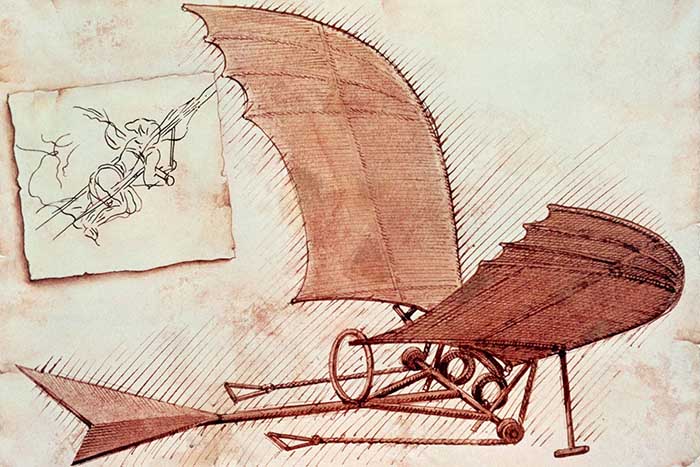
1485 Leonardo da Vinci made the first real studies of flight in the 1480's. He had over 100 drawings that illustrated his theories on flight.

The Ornithopter flying machine was never actually created. It was a design that Leonardo da Vinci created to show how man could fly. The modern day helicopter is based on this concept.

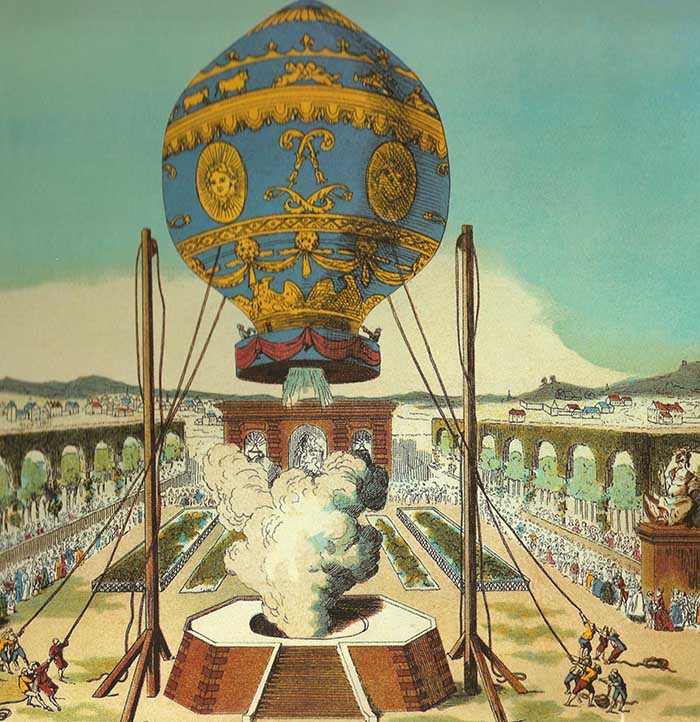
1783 - Joseph and Jacques Montgolfier- the First Hot Air Balloon

One of The Montgolfier's Balloons The brothers, Joseph Michel and Jacques Etienne Montgolfier, were inventors of the first hot air balloon. They used the smoke from a fire to blow hot air into a silk bag. The silk bag was attached to a basket. The hot air then rose and allowed the balloon to be lighter-than-air.

In 1783, the first passengers in the colorful balloon were a sheep, rooster and duck. It climbed to a height of about 6,000 feet and traveled more than 1 mile. After this first success, the brothers began to send men up in balloons. The first manned flight was on November 21, 1783, the passengers were Jean-Francois Pilatre de Rozier and Francois Laurent.

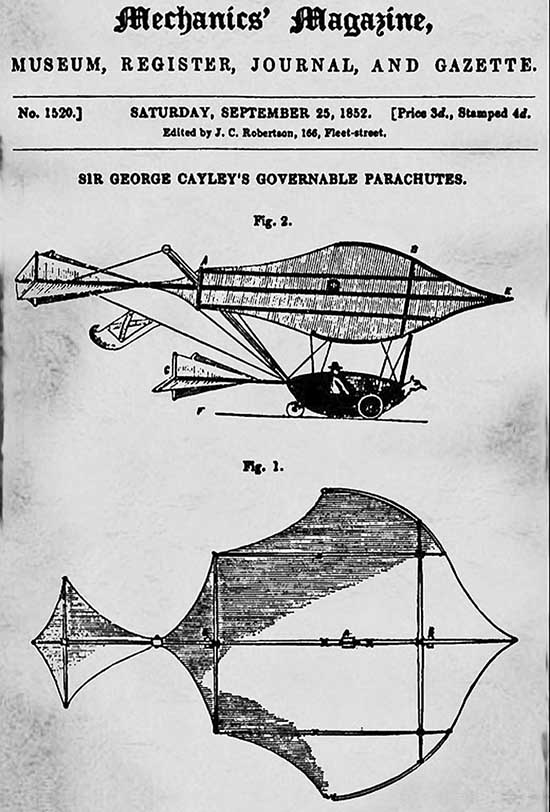
1799 - 1850's - George Cayley - One Version of a Glider George Cayley worked to discover a way that man could fly. He designed many different versions of gliders that used the movements of the body to control. A young boy, whose name is not known, was the first to fly one of his gliders.

Over 50 years he made improvements to the gliders. He changed the shape of the wings so that the air would flow over the wings correctly. He designed a tail for the gliders to help with the stability. He tried a biplane design to add strength to the glider. He also recognized that there would be a need for power if the flight was to be in the air for a long time.

Cayley wrote On Ariel Navigation which shows that a fixed-wing aircraft with a power system for propulsion and a tail to assist in the control of the airplane would be the best way to allow man to fly.

1891 Otto Lilienthal's Gliders - German engineer, Otto Lilienthal, studied aerodynamics and worked to design a glider that would fly. He was the first person to design a glider that could fly a person and was able to fly long distances.

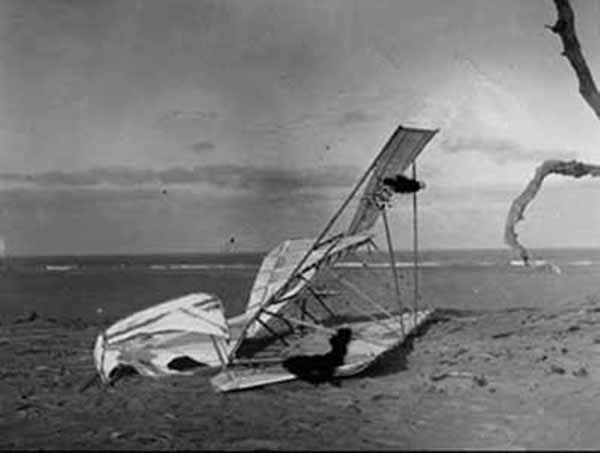
He was fascinated by the idea of flight. Based on his studies of birds and how they fly, he wrote a book on aerodynamics that was published in 1889 and this text was used by the Wright Brothers as the basis for their designs. After more than 2500 flights, he was killed when he lost control because of a sudden strong wind and crashed into the ground.

Lilienthal's Glider in Flight 891

Samuel P. Langley - Langley's Aerodrome -

Samuel Langley was an astronomer, who realized that power was needed to help man fly. He built a model of a plane, which he called an aerodrome, that included a steam-powered engine. In 1891, his model flew for 3/4s of a mile before running out of fuel. Langley received a $50,000 grant to build a full sized aerodrome. It was too heavy to fly and it crashed. He was very disappointed. He gave up trying to fly. His major contributions to flight involved attempts at adding a power plant to a glider. He was also well known as the director of the Smithsonian Institute in Washington, DC

Model of Langley Aerodrome

1894 Octave Chanute - Octave Chanute published Progress in Flying Machines in 1894. It gathered and analyzed all the technical knowledge that he could find about aviation accomplishments. It included all of the world's aviation pioneers. The Wright Brothers used this book as a basis for much of their experiments. Chanute was also in contact with the Wright Brothers and often commented on their technical progress.

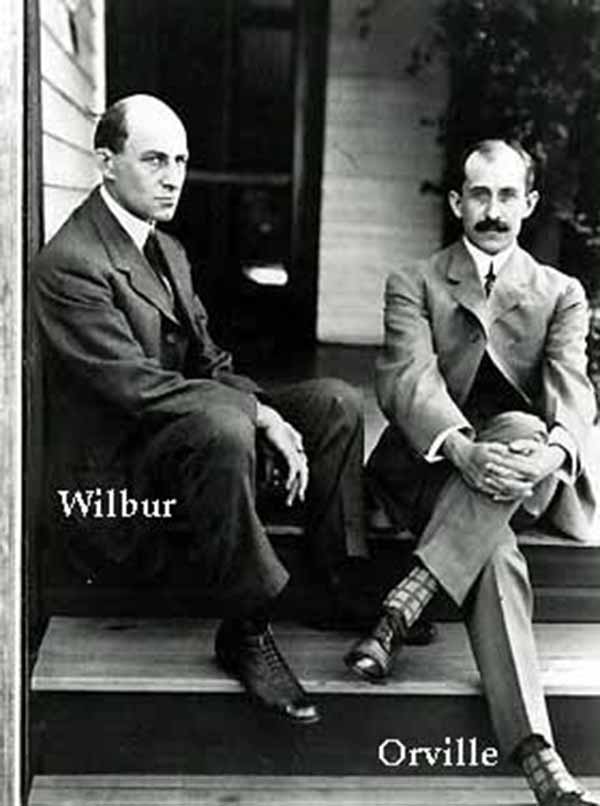
1903 Orville and Wilbur Wright and the First Flight

Orville and Wilbur Wright were very deliberate in their quest for flight. First, they spent many years learning about all the early developments of flight. They completed detailed research of what other early inventors had done. They read all the literature that was published up to that time. Then, they began to test the early theories with balloons and kites. They learned about how the wind would help with the flight and how it could affect the surfaces once up in the air.

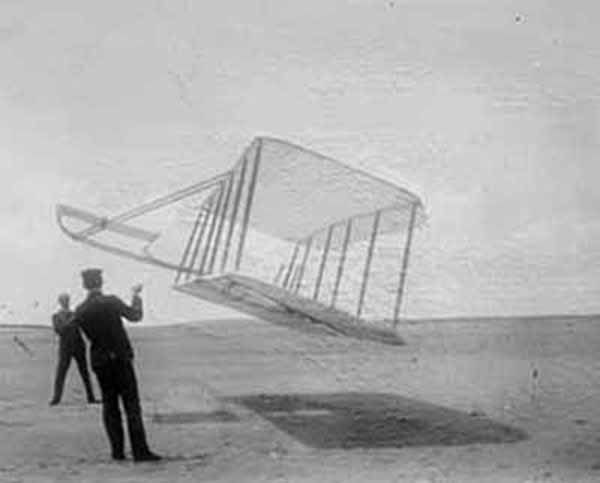
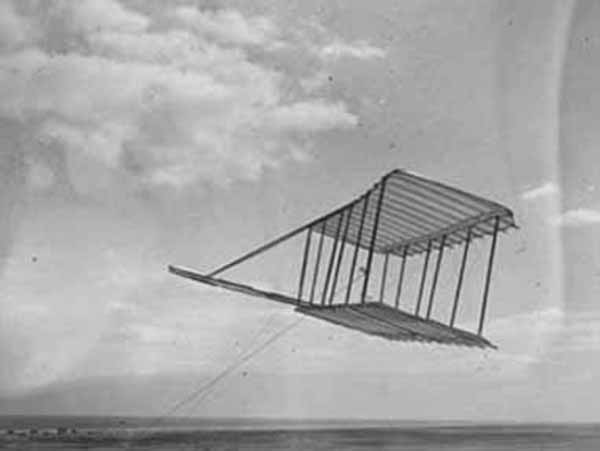
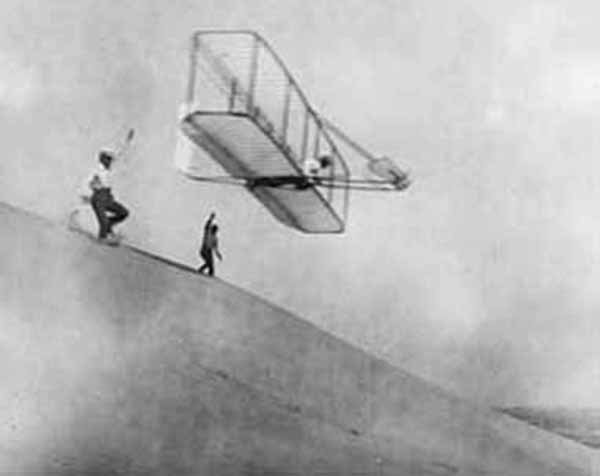
A Model of a Wright Brothers Glider (1900) -The next step was to test the shapes of gliders much like George Cayley did when he was testing the many different shapes that would fly. They spent much time testing and learning about how gliders could be controlled.

Picture of the actual 12 horsepower engine used in flight

They designed and used a wind tunnel to test the shapes of the wings and the tails of the gliders. After they found a glider shape that consistently would fly in the tests in the North Carolina Outer Banks dunes, then they turned their attention to how to create a propulsion system that would create the lift needed to fly.

The early engine that they used generated almost 12 horsepower.

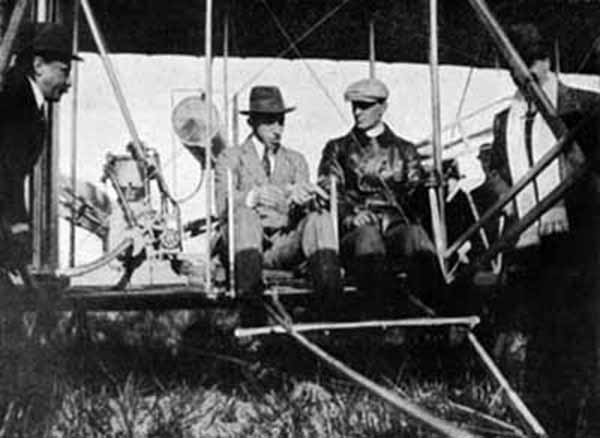
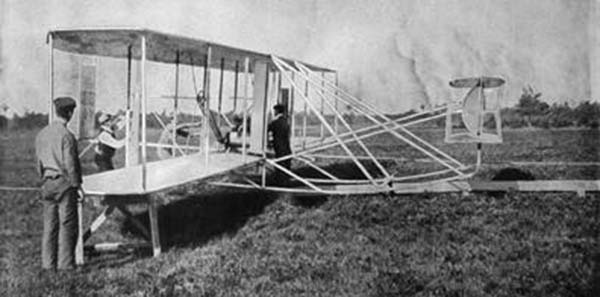
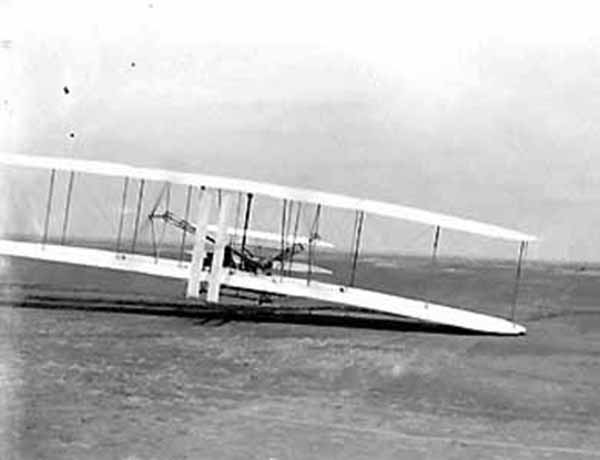
The Wright Brother's Flyer

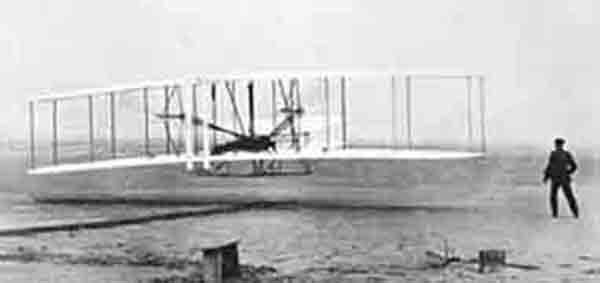
The "Flyer" lifted from level ground to the north of Big Kill Devil Hill, at 10:35 a.m., on December 17, 1903. Orville piloted the plane which weighed six hundred and five pounds.

Actual Flight of The Flyer at Kitty Hawk

The first heavier-than-air flight traveled one hundred twenty feet in twelve seconds. The two brothers took turns during the test flights. It was Orville's turn to test the plane, so he is the brother that is credited with the first flight. Humankind was now able to fly! During the next century, many new airplanes and engines were developed to help transport people, luggage, cargo military personnel and weapons. The 20th century's advances were all based on this first flight at Kitty Hawk by the Wright Brothers from Ohio.

Reference: NASA


Aviation

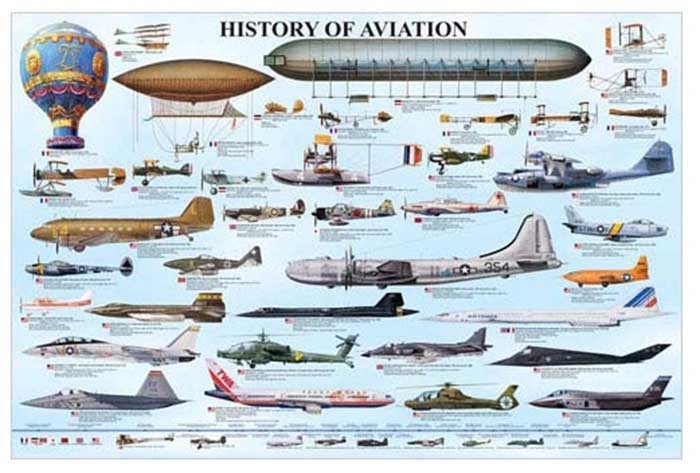
Aviation or air transport refers to the activities surrounding human flight and the aircraft industry. Aircraft include fixed-wing aircraft, rotary wing (helicopter/autogyro) types, and ornithopters, as well as lighter-than-air craft such as balloons and airships (also known as dirigibles).

There are records of early, short-distance glider flights from the 10th and 11th centuries, and possibly earlier human-carrying kites from China, but practical human aviation (trips lasting more than a few seconds) began on November 21, 1783 with the first untethered human flight in a hot air balloon designed by the Montgolfier brothers. A little over a century later, on December 17, 1903, the Wright brothers flew the first successful powered, heavier-than-air flight, though their aircraft was impractical to fly for more than a short distance, due to control problems. The widespread adoption of ailerons made aircraft much easier to manage, and only a decade later, at the start of World War I, heavier-than-air powered aircraft had become practical for reconnaissance, artillery spotting, and even attacks against ground positions.

Between the wars, aircraft grew larger and more reliable, and began to be used to transport people and cargo. In the 1930s, the Douglas DC-3 was the first airliner that was profitable carrying passengers exclusively, starting the modern era of passenger airline service. By the beginning of World War II, many towns and cities had built airports, and there were a large number of qualified pilots available. The war brought many innovations to aviation, including the first jet aircraft and the first liquid-fueled rockets.

After the war, especially in North America, there was a boom in general aviation, both private and commercial, as thousands of pilots were released from military service and many inexpensive war-surplus transport and training aircraft were available. Small aircraft manufacturers such as Cessna, Piper, and Beechcraft expanded production to provide small aircraft for the new middle class market.

By the 1950s, the development of civil jets grew, beginning with the de Havilland Comet, though the first widely-used passenger jet was the Boeing 707. At the same time, turboprop propulsion began to appear for smaller commuter planes, making it possible to serve small-volume routes in a much wider range of weather conditions.Yuri Gagarin was the first human to travel to space on April 12, 1961 while the Apollo 11 crew first were the first to set foot on the moon on July 21, 1969.

Since the 1960s, composite airframes and quieter, more efficient engines have become available, but the most important innovations have taken place in instrumentation and control. The arrival of solid-state electronics, the Global Positioning System, satellite communications, and increasingly small and powerful computers and LED displays, have dramatically changed the cockpits of airliners and, increasingly, of smaller aircraft as well. Pilots can navigate much more accurately and view terrain, obstructions, and other nearby aircraft on a map or through synthetic vision, even at night or in low visibility.

On June 21, 2004, Space Ship One became the first privately-funded aircraft to make a spaceflight, opening the possibility of an aviation market outside the earth's atmosphere.

History of Aviation Wikipedia

General Aviation Wikipedia

Civil Aviation Wikipedia

Military Aviation - Aerial Warfare Wikipedia

Aviation Wikipedia

Air Traffc Control Wikipedia

List of Aviation Topics Wikipedia


In the News ...


Many Mysteries of Flight Remain Live Science - March 4, 2008

Who Was the First Person to Fly? Live Science - March 4, 2008

Full-size Unmanned Aircraft Flies on Hydrogen Fuel Scientific American - August 30, 2006

Plane Flies on Power of Five Light Bulbs Live Science - August 29, 2006

New York to L.A. in Two Hours Wired - August 29, 2006

First hydrogen plane tested in US BBC - July 3, 2005

Airbus A380 - world's largest passenger plane makes historic maiden flight BBC - April 2005

The Next 100 Years of Flight New Scientist - December 16, 2003

Final Concorde Flight Lands in Great Britain Space.com - October 24, 2002


HOT AIR BALLOON

UFOS

FOO FIGHTERS OF WW II

ANCIENT AND LOST CIVILIZATIONS

PHYSICAL SCIENCES INDEX


ALPHABETICAL INDEX OF ALL FILES

CRYSTALINKS MAIN PAGE

CRYSTALINKS MAILING LIST, NEWSLETTER, UPDATES

PSYCHIC READING WITH ELLIE


Google