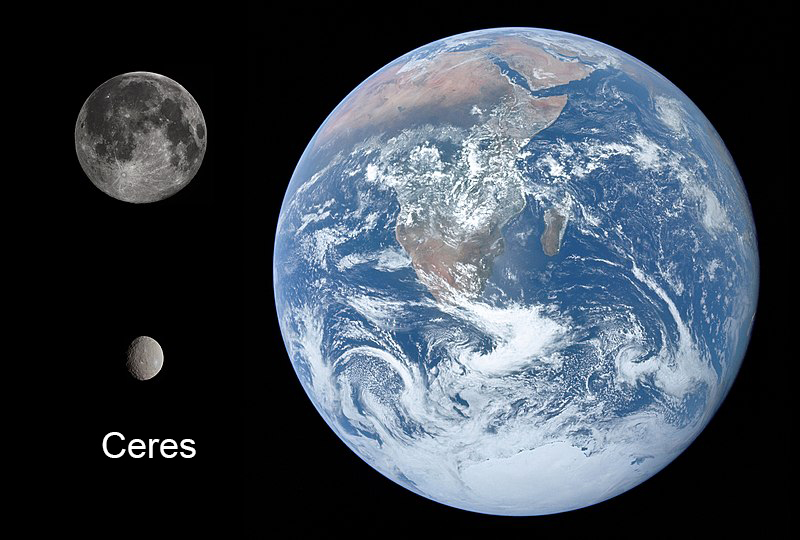
The asteroid belt is the region of the Solar System located roughly between the orbits of the planets Mars and Jupiter. It is occupied by numerous irregularly shaped bodies called asteroids or minor planets. The asteroid belt is also termed the main asteroid belt or main belt to distinguish its members from other asteroids in the Solar System such as near-Earth asteroids and trojan asteroids. About half the mass of the belt is contained in the four largest asteroids, Ceres, Vesta, Pallas, and Hygiea. Vesta, Palas, and Hygiea have mean diameters of more than 400 km, whereas Ceres, the asteroid belt's only dwarf planet, is about 950 km in diameter.
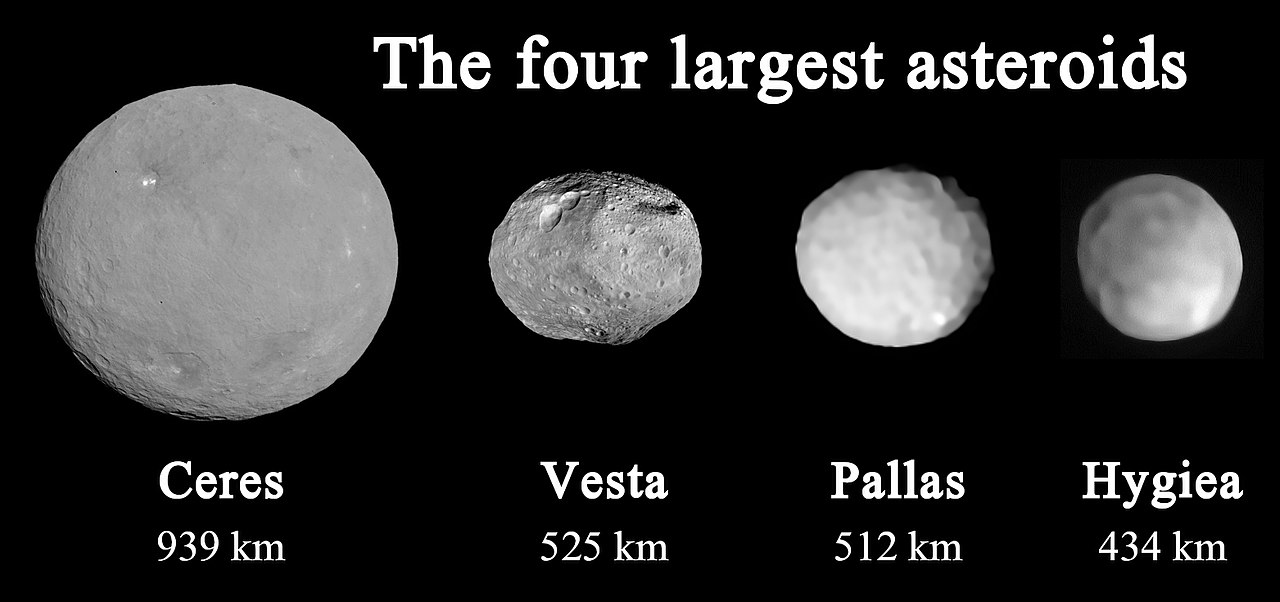
The remaining bodies range down to the size of a dust particle. The asteroid material is so thinly distributed that numerous unmanned spacecraft have traversed it without incident. Nonetheless, collisions between large asteroids do occur, and these can form an asteroid family whose members have similar orbital characteristics and compositions. Individual asteroids within the asteroid belt are categorized by their spectra, with most falling into three basic groups: carbonaceous (C-type), silicate (S-type), and metal-rich (M-type).
The asteroid belt formed from the primordial solar nebula as a group of planetesimals, the smaller precursors of the planets, which in turn formed protoplanets. Between Mars and Jupiter, however, gravitational perturbations from Jupiter imbued the protoplanets with too much orbital energy for them to accrete into a planet. Collisions became too violent, and instead of fusing together, the planetesimals and most of the protoplanets shattered. As a result, 99.9% of the asteroid belt's original mass was lost in the first 100 million years of the Solar System's history. Some fragments can eventually find their way into the inner Solar System, leading to meteorite impacts with the inner planets. Asteroid orbits continue to be appreciably perturbed whenever their period of revolution about the Sun forms an orbital resonance with Jupiter. At these orbital distances, a Kirkwood gap occurs as they are swept into other orbits.
Classes of small Solar System bodies in other regions include the centaurs, Kuiper belt and scattered disk objects, and Oort cloud comets.
Dawn's Second Look Reveals Vesta - the second-largest object in the main asteroid belt - could be part of a Lost World Science Alert - May 1, 2025

While smaller asteroids in the belt are considered fragments of collisions, scientists think Vesta and the other three large objects in the belt are likely primordial and have survived for billions of years.
New astronomical measurements in the infrared range have led to the identification of a heretofore unknown class of water-rich asteroids PhysOrg - February 21, 2023
They are located in the asteroid belt between Mars and Jupiter and are similar to the dwarf planet Ceres rich in water. According to computer models, complex dynamic processes shifted these asteroids from the outer regions of our solar system into today's asteroid belt shortly after their creation.
In 1802, shortly after discovering Pallas, Heinrich Olbers suggested to William Herschel that Ceres and Pallas were fragments of a much larger planet that once occupied the Mars-Jupiter region, this planet having suffered an internal explosion or a cometary impact many million years before.
Over time, however, this hypothesis has fallen from favor. The large amount of energy that would have been required to destroy a planet, combined with the belt's low combined mass, which is only about 4% of the mass of the Earth's Moon do not support the hypothesis. Further, the significant chemical differences between the asteroids are difficult to explain if they come from the same planet. Today, most scientists accept that, rather than fragmenting from a progenitor planet, the asteroids never formed a planet at all.
In general in the Solar System, planetary formation is thought to have occurred via a process comparable to the long-standing nebular hypothesis: a cloud of interstellar dust and gas collapsed under the influence of gravity to form a rotating disk of material that then further condensed to form the Sun and planets.
During the first few million years of the Solar System's history, an accretion process of sticky collisions caused the clumping of small particles, which gradually increased in size. Once the clumps reached sufficient mass, they could draw in other bodies through gravitational attraction and become planetesimals. This gravitational accretion led to the formation of the rocky planets and the gas giants.
Planetesimals within the region which would become the asteroid belt were too strongly perturbed by Jupiter's gravity to form a planet. Instead they continued to orbit the Sun as before, and occasionally colliding. In regions where the average velocity of the collisions was too high, the shattering of planetesimals tended to dominate over accretion, preventing the formation of planet-sized bodies. Orbital resonances occurred where the orbital period of an object in the belt formed an integer fraction of the orbital period of Jupiter, perturbing the object into a different orbit; the region lying between the orbits of Mars and Jupiter contains many such orbital resonances. As Jupiter migrated inward following its formation, these resonances would have swept across the asteroid belt, dynamically exciting the region's population and increasing their velocities relative to each other.
During the early history of the Solar System, the asteroids melted to some degree, allowing elements within them to be partially or completely differentiated by mass. Some of the progenitor bodies may even have undergone periods of explosive volcanism and formed magma oceans. However, because of the relatively small size of the bodies, the period of melting was necessarily brief (compared to the much larger planets), and had generally ended about 4.5 billion years ago, in the first tens of millions of years of formation.
In August 2007, a study of zircon crystals in an Antarctic meteorite believed to have originated from 4 Vesta suggested that it, and by extension the rest of the asteroid belt, had formed rather quickly, within ten million years of the Solar System's origin.
The asteroids are not samples of the primordial Solar System. They have undergone considerable evolution since their formation, including internal heating (in the first few tens of millions of years), surface melting from impacts, space weathering from radiation, and bombardment by micrometeorites. Although some scientists refer to the asteroids as residual planetesimals, other scientists consider them distinct.
The current asteroid belt is believed to contain only a small fraction of the mass of the primordial belt. Computer simulations suggest that the original asteroid belt may have contained mass equivalent to the Earth. Primarily because of gravitational perturbations, most of the material was ejected from the belt within about a million years of formation, leaving behind less than 0.1% of the original mass. Since their formation, the size distribution of the asteroid belt has remained relatively stable: there has been no significant increase or decrease in the typical dimensions of the main-belt asteroids.
The 4:1 orbital resonance with Jupiter, at a radius 2.06 AU, can be considered the inner boundary of the asteroid belt. Perturbations by Jupiter send bodies straying there into unstable orbits. Most bodies formed inside the radius of this gap were swept up by Mars (which has an aphelion at 1.67 AU) or ejected by its gravitational perturbations in the early history of the Solar System. The Hungaria asteroids lie closer to the Sun than the 4:1 resonance, but are protected from disruption by their high inclination.
When the asteroid belt was first formed, the temperatures at a distance of 2.7 AU from the Sun formed a "snow line" below the freezing point of water. Planetesimals formed beyond this radius were able to accumulate ice.
In 2006 it was announced that a population of comets had been discovered within the asteroid belt beyond the snow line, which may have provided a source of water for Earth's oceans. According to some models, there was insufficient outgassing of water during the Earth's formative period to form the oceans, requiring an external source such as a cometary bombardment.
Despite popular imagery, the asteroid belt is mostly empty. The asteroids are spread over such a large volume that it would be highly improbable to reach an asteroid without aiming carefully. Nonetheless, hundreds of thousands of asteroids are currently known, and the total number ranges in the millions or more, depending on the lower size cutoff that is assumed. A survey in the infrared wavelengths shows that the main belt has 700,000 to 1.7 million asteroids with a diameter of 1 km or more.
Over 200 of the asteroids in the belt are larger than 100 km. The biggest asteroid belt member, and the only dwarf planet found there, is Ceres. The total mass of the Asteroid belt is estimated to be 3.0-3.6X10²¹ kilograms, which is 4% of the Earth's Moon. Of that total mass, one-third is accounted for by Ceres alone. The eleven largest asteroids contain about half the total mass within the main belt.
The center of mass of the asteroid belt occurs at an orbital radius of 2.8 A.U. The large majority of the asteroids within the main belt have orbital eccentricities of less than 0.4, and an inclination of less than 30¡. The orbital distribution of the asteroids peak at an eccentricity of around 0.07 and an inclination of under 4¡. Thus while a typical asteroid has a relatively circular orbit and lies near the plane of the ecliptic, some asteroid orbits can be highly eccentric or travel well outside the ecliptic plane.
Sometimes, the term main belt is used to refer only to the more compact "core" region where the greatest concentration of bodies is found. This lies between the strong 4:1 and 2:1 Kirkwood gaps at 2.06 and 3.27 A.U., and at orbital eccentricities less than roughly 0.33, along with orbital inclinations below about 20¡. This "core" region contains approximately 93.4% of all numbered minor planets within the Solar System.
The absolute magnitudes of most asteroids are 11-19, with the median at about 16. By contrast, Ceres has a much higher absolute magnitude of 3.32. The temperature of the asteroid belt varies with the distance from the Sun. For dust particles within the belt, typical temperatures range from 200 K (-73¡C) at 2.2 A.U. down to 165 K (-108¡C) at 3.2 A.U. However, due to rotation, the surface temperature of an asteroid can vary considerably as the sides are alternately exposed to solar radiation and then to the stellar background.
During the early history of the Solar System, minor planets underwent some degree of melting, allowing elements to be partially or completely segregated by mass. Some of the progenitor bodies may even have undergone periods of explosive volcanism and formed magma oceans. However, because of the relatively small size of these bodies, this period of melting was necessarily brief (compared to the much larger planets), and had generally ended about 4.5 billion years ago.
The current belt consists primarily of two categories of asteroids. In the outer portion of the belt, closer to Jupiter's orbit, carbon-rich asteroids predominate. These C-type (carbonaceous) asteroids include over 75% of the visible asteroids. They are more red in hue than the other asteroid categories and have a very low albedo. Their surface composition is similar to carbonaceous chondrite meteorites. Chemically, their spectra indicate a match with the primordial composition of the early Solar System, with the lighter elements and volatiles (e.g. ices) removed.
Toward the inner portion of the belt, within 2.5 A.U. of the Sun, S-type (silicate) chondrite asteroids are more common. The spectra of their surfaces reveal the presence of silicates as well as some metal, but no significant carbonaceous compounds. This indicates that they are made of materials that have been significantly modified from the primordial Solar System composition. The expected mechanism was melting early in their history, which caused mass differentiation. They have a relatively high albedo, and form about 17% of the total asteroid population.
A third category of asteroids, forming about 10% of the total population, is the M-type. These have a spectrum that resembles metallic iron-nickel, with a white or slightly red appearance and no absorption features in the spectrum. M-type asteroids are believed to be formed from the metallic cores of differentiated progenitor bodies that were disrupted through collision. However, there are also some silicate compounds that can produce a similar appearance. Thus, the large M-type asteroid 22 Kalliope does not appear to be primarily composed of metal. Within the main belt, the number distribution of M-type asteroids peaks at a semi-major axis of about 2.7 A.U.
Measurements of the rotation periods of large asteroids in the main belt show that there is a lower limit to the duration. No asteroid with a diameter larger than 100 metres has a period of rotation of less than once every 2.2 hours. For asteroids rotating faster than this rate, the centripetal force at the surface is greater than the force of gravity, so any loose surface material would become scattered. Yet a solid object should be able to rotate much more rapidly. This suggests that the majority of asteroids with a diameter over 100 metres are actually rubble piles formed through collisions between asteroids.
The high population of the main belt makes for a very active environment, where collisions between asteroids occur frequently (on astronomical time scales). Collisions between main belt bodies with a mean radius of 10-km are expected to occur about once every 10 million years. A collision may fragment an asteroid in numerous small pieces (leading to the formation of a new asteroid family), and some of the debris from these collisions can form meteoroids that enter the Earth's atmosphere. Collisions that occur at low relative speeds may even join two asteroids together. After more than 4 billion years of this process, the members of the asteroid belt now bear little resemblance to the original population.
In addition to the asteroid bodies, the main belt also contains bands of dust with particle radii of up to a few hundred micrometres. This fine material is produced, at least in part, from collisions between asteroids, or by the impact of micrometeorites upon the asteroids. Due to Poynting-Robertson drag, the pressure of solar radiation causes this dust to slowly spiral inward toward the Sun.
The combination of fine asteroid dust, as well as ejected cometary material, produces the zodiacal light. This faint auroral glow can be viewed at night extending from the direction of the Sun along the plane of the ecliptic. Particles that produce the visible zodiacal light average about 40 urm in radius. The typical lifetimes of such particles is on the order of 700,000 years. Thus, in order to maintain the bands of dust, new particles must be steadily produced within the asteroid belt.
Asteroid belts are a staple of science fiction stories less concerned with realism than with drama, since they are frequently portrayed as being so dense that adventurous measures must be taken to avoid an impact. Proto-planets in the process of formation and planetary rings may look like that, but asteroid belts do not.
In reality, the asteroids are spread over such a high volume that it would be highly improbable even to pass close to a random asteroid. For example, the numerous space probes sent to the outer solar system, just across the main asteroid belt, have never had any problems, and asteroid rendezvous missions have elaborate targeting procedures.
The inaccurate image of an overcrowded Asteroid Belt is especially frequent in science fiction films, apparently because it makes for dramatic visual images which the true nearly empty space does not provide. The film 2001: A Space Odyssey is unusual in that it does portray realistically the ship's "encounter" with a lone asteroid pair. On the other hand, written depictions of human encounters with asteroids, their mining and their colonization - an increasingly frequent science fiction theme since the late 1940s - are more often scientifically accurate.