Archaeology on Land


Subatomic Archaeology: Muons Meet the Mayan Pyramids Science News Online - December 14, 2007
Physicists plan to use muons generated by cosmic rays to probe the interior of the Pyramid of the Sun at Teotihuacán.
Muon Wikipedia

Cambodia Sprawling Angkor Brought Down By Overpopulation, Study Suggests National Geographic - August 14, 2007
Photo Gallery (6 Great Images) National Geographic - August 14, 2007
Map reveals ancient urban sprawl BBC - August 14, 2007

Long-lost community found around Angkor MSNBC - August 13, 2007

King Herod's Tomb Unearthed Near Jerusalem, Expert Says BBC - May 8, 2007

King Herod's ancient tomb 'found' BBC - May 8, 2007

Archaeologist have searched for the tomb at Herodium for 30 years.

King Herod's Tomb Unearthed Near Jerusalem, Expert Says National Geographic - May 8, 2007

Photo Gallery National Geographic - May 9, 2007

Ancient amber shows rich Amazon life News in Science - August 29, 2006
Fossilized Amber Wikipedia

Newfound Book of Psalms Doesn't Predict Doom, Experts Say National Geographic - July 28, 2006

Some observers have expressed concern about the passage to which the book was open when it was discovered: Psalm 83. In the King James Bible the psalm tells of "the name of Israel" being wiped out.


Olive Branch Buried by Volcano Revises History Live Science - April 28, 2006
The discovery of an olive branch buried in volcanic ash for centuries is helping scientists pinpoint the date of one of the most powerful volcanic eruptions in the last 10,000 years. The finding could force archeologists to revise historical timelines for civilizations inhabiting the Mediterranean basin during the Late Bronze Age. Cultures traditionally thought to have been trading and influencing one another might have actually existed at different times. About 3,500 years ago, a volcano on the Greek island of Thera erupted with such force that it created a column of smoke and debris 23 miles high and flung ash to places as far away as China, Greenland and the western United States. The blast also triggered 40-foot-high tsunamis that slammed into the island of Crete nearly 70 miles away and likely contributed to the downfall of its famed Minoan civilization.Despite its widespread influence, the precise date of the eruption has been hard to pin down. Some archeologists have put the event at around 1500 B.C., based on similarities between pottery shards found in Akrotiri, a town buried in ash by the blast, and pottery in Egypt from a period known as the New Kingdom. Radiocarbon experts, meanwhile, have consistently dated the event to about 100 years earlier.


Indonesia: 'Pompeii of the East' discovered - Lost Kingdom of Tambora BBC - February 28, 2006

An expedition to the site of the largest volcanic eruption in modern times has uncovered a lost kingdom. Wiped out in 1815 by the largest volcanic eruption in human history, the tiny kingdom is known only from a few reports from the Dutch and British colonial governments that ruled the East Indies in the 18th and early 19th centuries.
Lost civilization unearthed in Indonesia MSNBC - March 1, 2006

Settlement buried by ash, Pompeii-style, in volcanic eruption of 1815

Russian researchers discover giants' graves in Syria Pravda - December 2, 2005
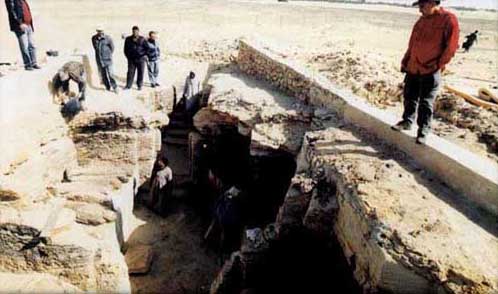
The grave of Abel, the second son of Adam and Eve, is the most famous and significant grave

Report Examines Ancient Mexican Footprint Claim BBC - December 1, 2005
Footprints discovered in Mexico are either more than one million years older than other evidence of humans in the Western Hemisphere or not footprints at all

Stone Age Cemetery, Artifacts Unearthed in Sahara National Geographic - October 29, 2005
Human skeletons and artifacts on the shores of an ancient lake in the Sahara.
Sahara Wikipedia

Rare Scrolls Reveal Early Biblical Writing Discovery - July 22, 2005

Three ancient scrolls - one parchment and two silver - recently have been identified as containing some of the world's earliest known verses from the Hebrew Bible, also known as the Old Testament.

The discovery of two fragments of a 2,000-year-old parchment scroll in the Judean Desert was announced last week by Israeli archaeologist Chanan Eshel of Tel Aviv's Bar Ilan University. The fragments contain verses from Leviticus, the third book of the Hebrew Bible, attributed to the tribe of Levi from which Israeli priests are said to be descended. The book consists of regulations for both the priests and their followers.

The two silver scrolls were found by Bar Ilan archaeologist Gabriel Barkay in 1979 in a cave at Ketef Hinnom near Jerusalem. It was only until recently, however, that technology made it possible for scientists to read the scrolls, which date to the 7th century B.C. and likely were worn around the neck as protective amulets.

Project leader Bruce Zuckerman told Discovery News that the scrolls not only are the oldest known Hebrew amulets, but they also are the earliest known artifacts to quote Biblical verses.

"The silver amulets are even older than the Dead Sea Scrolls," said Zuckerman, who is associate professor of religion at the University of Southern California.

The more than 800 documents that comprise the Dead Sea Scrolls have been dated to about 300-200 B.C., meaning they were created as much as four centuries after the amulets.

Zuckerman and his team utilized electronic cameras, specialized imaging software, and infrared systems from NASA to peer into the etched surfaces of the once-rolled silver scroll amulets.

The scrolls contain only consonants, and one is etched with the Priestly Benediction from Numbers 6:24-26.

New Method Developed For Dating Archaeological Pottery Science Daily - October 2003


ARTICLES CONTINUED


ARCHAEOLOGY INDEX

PHYSICAL SCIENCES INDEX


ALPHABETICAL INDEX OF ALL FILES

CRYSTALINKS MAIN PAGE

CRYSTALINKS MAILING LIST, NEWSLETTER, UPDATES

PSYCHIC READING WITH ELLIE


Google