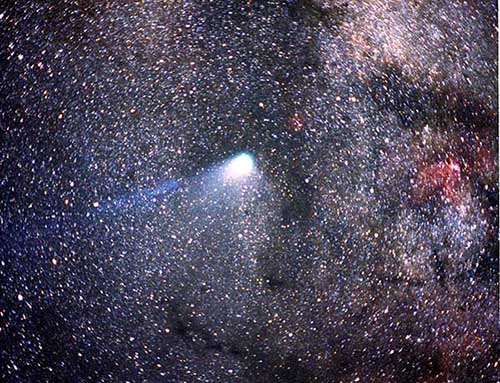
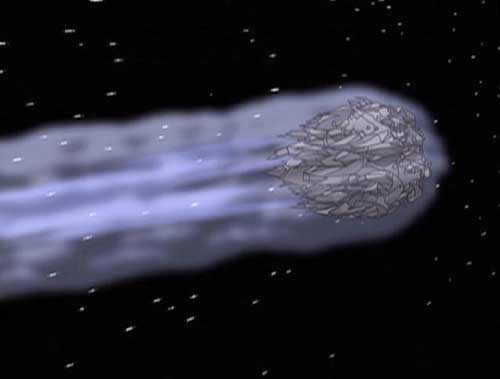

Halley's Comet or Comet Halley officially designated 1P/Halley, is the best-known of the short-period comets and is visible from Earth every 75-76 years. Halley's Comet is the only short-period comet that is clearly visible to the naked eye from Earth, and thus the only naked-eye comet that might appear twice in a human lifetime. Other naked-eye comets may be brighter and more spectacular, but will appear only once in thousands of years.
Halley's Comet returns to the inner Solar System have been observed and recorded by astronomers since at least 240 BCE. Clear records of the comet's appearances were made by Chinese, Babylonian, and medieval European chroniclers, but were not recognized as reappearances of the same object at the time. The comet's periodicity was first determined in 1705 by English astronomer Edmond Halley, after whom it is now named. Halley's Comet last appeared in the inner Solar System in 1986 and will next appear in mid-2061.
During its 1986 apparition, Halley's Comet became the first to be observed in detail by spacecraft, providing the first observational data on the structure of a comet nucleus and the mechanism of coma and tail formation. These observations supported a number of longstanding hypotheses about comet construction, particularly Fred Whipple's "dirty snowball" model, which correctly predicted that Halley's Comet would be composed of a mixture of volatile ices -such as water, carbon dioxide and ammonia -and dust. The missions also provided data which substantially reformed and reconfigured these ideas; for instance it is now understood that the surface of Halley's Comet is largely composed of dusty, non-volatile materials, and that only a small portion of it is icy.
Halley may have been recorded as early as 467 BCE, but this is uncertain. A comet was recorded in ancient Greece between 468 and 466 BCE; its timing, location, duration, and associated meteor shower all suggest it was Halley. According to Pliny the Elder, that same year a meteorite fell in the town of Aegospotami, in Thrace. He described it as brown in color and the size of a wagon load.Chinese chroniclers also mention a comet in that year.
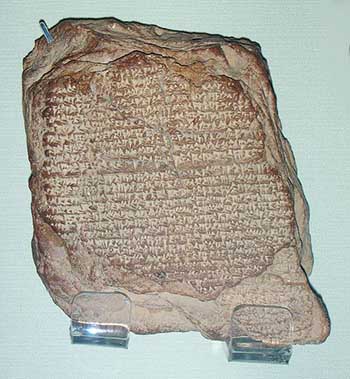
The first certain appearance of Halley's Comet in the historical record is a description from 240 BCE, in the Chinese chronicle Records of the Grand Historian or Shiji, which describes a comet that appeared in the east and moved north. The only surviving record of the 164 BCE apparition is found on two fragmentary Babylonian tablets, now owned by the British Museum.
The apparition of 87 BCE was recorded in Babylonian tablets which state that the comet was seen "day beyond day" for a month. This appearance may be recalled in the representation of Tigranes the Great, an Armenian king who is depicted on coins with a crown that features, according to Vahe Gurzadyan and R. Vardanyan, "a star with a curved tail that may represent the passage of Halley's Comet in 87 BCE." Gurzadyan and Vardanyan argue that "Tigranes could have seen Halley's Comet when it passed closest to the Sun on August 6 in 87 BCE" as the comet would have been a "most recordable event"; for ancient Armenians it could have heralded the New Era of the brilliant King of Kings.
The apparition of 12 BCE was recorded in the Book of Han by Chinese astronomers of the Han Dynasty who tracked it from August through October. It passed within 0.16 AU of Earth. Halley's appearance in 12 BCE, only a few years distant from the conventionally assigned date of the birth of Jesus Christ, has led some theologians and astronomers to suggest that it might explain the biblical story of the Star of Bethlehem. There are other explanations for the phenomenon, such as planetary conjunctions, and there are also records of other comets that appeared closer to the date of Jesus' birth.
If, as has been suggested, the reference in the Talmud to "a star which appears once in seventy years that makes the captains of the ships err" refers to Halley's Comet, it may be a reference to the 66 CE appearance, because this passage is attributed to the Rabbi Yehoshua ben Hananiah. This apparition was the only one to occur during ben Hananiah's lifetime.
The 141 CE apparition was recorded in Chinese chronicles. The 374 CE and 607 approaches each came within 0.09 AU of Earth.[57] The 684 CE apparition was recorded in Europe in one of the sources used by the compiler of the 1493 Nuremberg Chronicles. Chinese records also report it as the "broom star".
In 837, Halley's Comet may have passed as close as 0.03 AU (3.2 million miles; 5.1 million kilometers) from Earth, by far its closest approach. Its tail may have stretched 60 degrees across the sky. It was recorded by astronomers in China, Japan, Germany and the greater Middle East. In 912, Halley's Comet is recorded in the Annals of Ulster, which state "A dark and rainy year. A comet appeared."
In 1066, the comet was seen in England and thought to be an omen: later that year Harold II of England died at the Battle of Hastings; it was a bad omen for Harold, but a good omen for the man who defeated him, William the Conqueror. The comet is represented on the Bayeux Tapestry as a fiery star, and the surviving accounts describe it as appearing to be four times the size of Venus and shining with a light equal to a quarter of that of the Moon. Halley came within 0.10 AU of Earth at that time.
This appearance of the comet is also noted in the Anglo-Saxon Chronicle. Eilmer of Malmesbury may have seen Halley previously in 989, as he wrote of it in 1066: "You've come, have you? ... You've come, you source of tears to many mothers, you evil. I hate you! It is long since I saw you; but as I see you now you are much more terrible, for I see you brandishing the downfall of my country. I hate you!"
The Irish Annals of the Four Masters recorded the comet as "A star [that] appeared on the seventh of the Calends of May, on Tuesday after Little Easter, than whose light the brilliance or light of the moon was not greater; and it was visible to all in this manner till the end of four nights afterwards." Chaco Native Americans in New Mexico may have recorded the 1066 apparition in their petroglyphs.
The 1145 apparition was recorded by the monk Eadwine. The 1986 apparition exhibited a fan tail similar to Eadwine's drawing. Some claim that Genghis Khan was inspired to turn his conquests toward Europe by the 1222 apparition.
The 1301 apparition may have been seen by the artist Giotto di Bondone, who represented the Star of Bethlehem as a fire-colored comet in the Nativity section of his Arena Chapel cycle, completed in 1305. No record survives of the 1378 apparition.
In 1456, the year of Halley's next apparition, the Ottoman Empire invaded the Kingdom of Hungary, culminating in the Siege of Belgrade in July of that year. In a Papal Bull, Pope Calixtus III ordered special prayers be said for the city's protection. Halley's apparition of 1456 was also witnessed in Kashmir and depicted in great detail by Srivara, a Sanskrit poet and biographer to the Sultans of Kashmir. He read the apparition as a cometary portent of doom foreshadowing the imminent fall of Sultan Zayn al-Abidin ( AD 1418/1420-1470). After witnessing a bright light in the sky (which most historians have identified as Halley's Comet, visible in Ethiopia in 1456), Emperor Zara Yaqob, ruler from 1434 to 1468, founded the city of Debre Berhan (tr. City of Light) and made it his capital for the remainder of his reign.
Halley's periodic returns have been subject to scientific investigation since the 16th century. The three apparitions from 1531 to 1682 were noted by Edmond Halley, enabling him to predict its 1759 return. Streams of vapor observed during the comet's 1835 apparition prompted astronomer Friedrich Wilhelm Bessel to propose that the jet forces of evaporating material could be great enough to significantly alter a comet's orbit.
The 1910 approach, which came into naked-eye view around April 10th and came to perihelion on April 20th was notable for several reasons: it was the first approach of which photographs exist, and the first for which spectroscopic data were obtained. Furthermore, the comet made a relatively close approach of 0.15AU, making it a spectacular sight. Indeed, on May 19th, Earth actually passed through the tail of the comet.
One of the substances discovered in the tail by spectroscopic analysis was the toxic gas cyanogen, which led astronomer Camille Flammarion to claim that, when Earth passed through the tail, the gas "would impregnate the atmosphere and possibly snuff out all life on the planet." His pronouncement led to panicked buying of gas masks and quack "anti-comet pills" and "anti-comet umbrellas" by the public. In reality, as other astronomers were quick to point out, the gas is so diffuse that the world suffered no ill effects from the passage through the tail.
The comet was also fertile ground for hoaxes. One that reached major newspapers claimed that the Sacred Followers, a supposed Oklahoma religious group, attempted to sacrifice a virgin to ward off the impending disaster, but were stopped by the police.
American satirist and writer Mark Twain was born on 30 November 1835, exactly two weeks after the comet's perihelion. In his autobiography, published in 1909, he said,
Twain died on 21 April 1910, the day following the comet's subsequent perihelion.[80] The 1985 fantasy film The Adventures of Mark Twain was inspired by the quotation.
Halley's 1910 apparition is distinct from the Great Daylight Comet of 1910, which surpassed Halley in brilliance and was actually visible in broad daylight for a short period, approximately four months before Halley made its appearance.
On 12 February 1991, at a distance of 14.4 AU rom the Sun, Halley displayed an outburst that lasted for several months, releasing a cloud of dust 300,000 km across. The outburst likely started in December 1990, and then the comet brightened from magnitude 24.3 to magnitude 18.9. Halley was most recently observed in 2003 by three of the Very Large Telescopes at Paranal, Chile, when Halley's magnitude was 28.2. The telescopes observed Halley, at the faintest and farthest any comet has ever been imaged, in order to verify a method for finding very faint trans-Neptunian objects. Astronomers are now able to observe the comet at any point in its orbit.
The next predicted perihelion of Halley's Comet is July 28, 2061, when it is expected to be better positioned for observation than during the 1985-1986 apparition, as it will be on the same side of the Sun as Earth. Read more ...
Halley's comet 'was spotted by the ancient Greeks' BBC - September 11, 2010
A celestial event seen by the ancient Greeks may be the earliest sighting of Halley's comet, new evidence suggests. According to ancient writers, a large meteorite smacked into northern Greece between 466BC and 467BC. The writers also described a comet in the sky at the time the meteorite fell to Earth, but this detail has received little attention, say the researchers. Comet Halley would have been visible for about 80 days in 466 BC, researchers write in the Journal of Cosmology. New Scientist magazine reports that, until now, the earliest probable sighting of the comet was an orbit in 240BC, an event recorded by Chinese astronomers. If the new findings are confirmed, the researchers will have pushed back the date of the first observation of Comet Halley by 226 years.