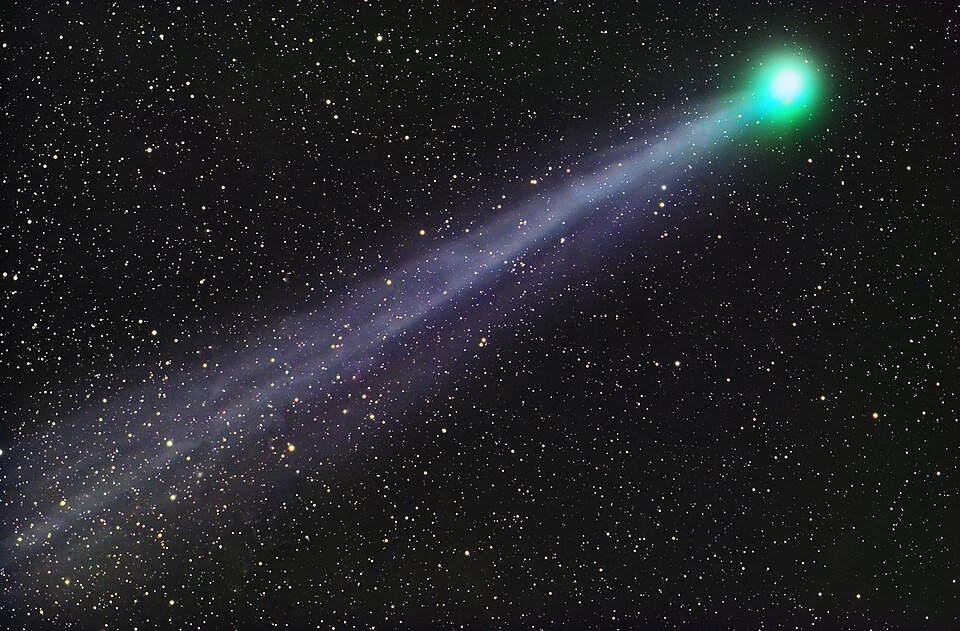
C/2014 Q2 (Lovejoy) is a non-periodic comet discovered on August 17, 2014 by Terry Lovejoy using a 0.2-meter (8 in) Schmidt–Cassegrain telescope. It was discovered as a 15th-magnitude object in the southern constellation of Puppis. It is the fifth comet discovered by Terry Lovejoy.
By December 2014, the comet had brightened to roughly magnitude 7.4, making it a small telescope and binoculars target. By mid-December, the comet was visible to the naked eye for experienced observers with dark skies and keen eyesight. On 28–29 December 2014, the comet passed 1/3° from globular cluster Messier 79.
In January 2015, it brightened to roughly magnitude 4, and became one of the brightest comets located high in a dark sky since comet C/1995 O1 (Hale–Bopp) in 1997. On 7 January 2015, the comet passed 0.469 AU (70.2 million km; 43.6 million mi) from Earth. It crossed the celestial equator on 9 January 2015, becoming better seen from the Northern Hemisphere. The comet came to perihelion (closest approach to the Sun) on 30 January 2015, at a distance of 1.29 AU (193 million km; 120 million mi) from the Sun. At perihelion, its water production rate exceeded 20 metric tons per second. Read more ...
Comet Lovejoy shows asymmetric behavior at perihelion PhysOrg - July 27, 2016
Indian astronomers have recently conducted spectrographic observations of long-period Comet Lovejoy to study its gas emission. They found that this comet showcases an asymmetric behavior at perihelion and an increase in the activity during the post-perihelion phase. The findings were detailed in a paper published July 22 on the arXiv pre-print server.
In unexpected discovery, comet contains alcohol, sugar PhysOrg - October 23, 2015
Comet Lovejoy lived up to its name by releasing large amounts of alcohol as well as a type of sugar into space, according to new observations by an international team. The discovery marks the first time ethyl alcohol, the same type in alcoholic beverages, has been observed in a comet. The finding adds to the evidence that comets could have been a source of the complex organic molecules necessary for the emergence of life.
The Complex Ion Tail of Comet Lovejoy APOD - January 20, 2015
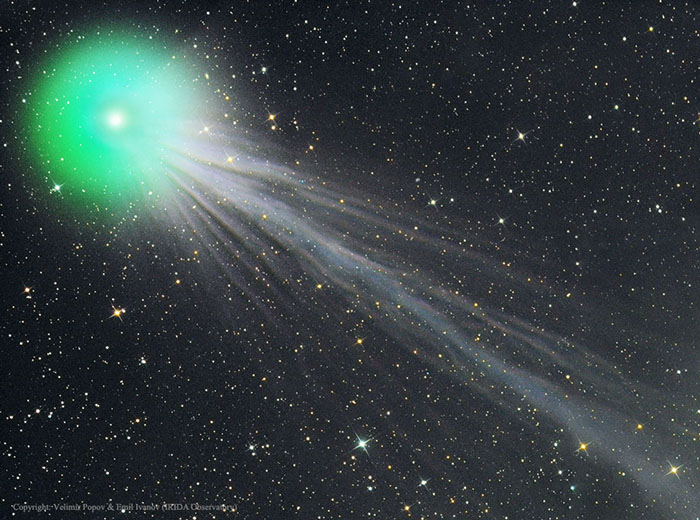
What causes the structure in Comet Lovejoy's tail? Comet C/2014 Q2 (Lovejoy), which is currently at naked-eye brightness and near its brightest, has been showing an exquisitely detailed ion tail. As the name implies, the ion tail is made of ionized gas -- gas energized by ultraviolet light from the Sun and pushed outward by the solar wind. The solar wind is quite structured and sculpted by the Sun's complex and ever changing magnetic field. The effect of the variable solar wind combined with different gas jets venting from the comet's nucleus accounts for the tail's complex structure.
Following the wind, structure in Comet Lovejoy's tail can be seen to move outward from the Sun even alter its wavy appearance over time. The blue color of the ion tail is dominated by recombining carbon monoxide molecules, while the green color of the coma surrounding the head of the comet is created mostly by a slight amount of recombining diatomic carbon molecules. The featured three-panel mosaic image was taken nine days ago from the IRIDA Observatory in Bulgaria. Comet Lovejoy made it closest pass to the Earth two weeks ago and will be at its closest to the Sun in about ten days. After that, the comet will fade as it heads back into the outer Solar System, to return only in about 8,000 years.