
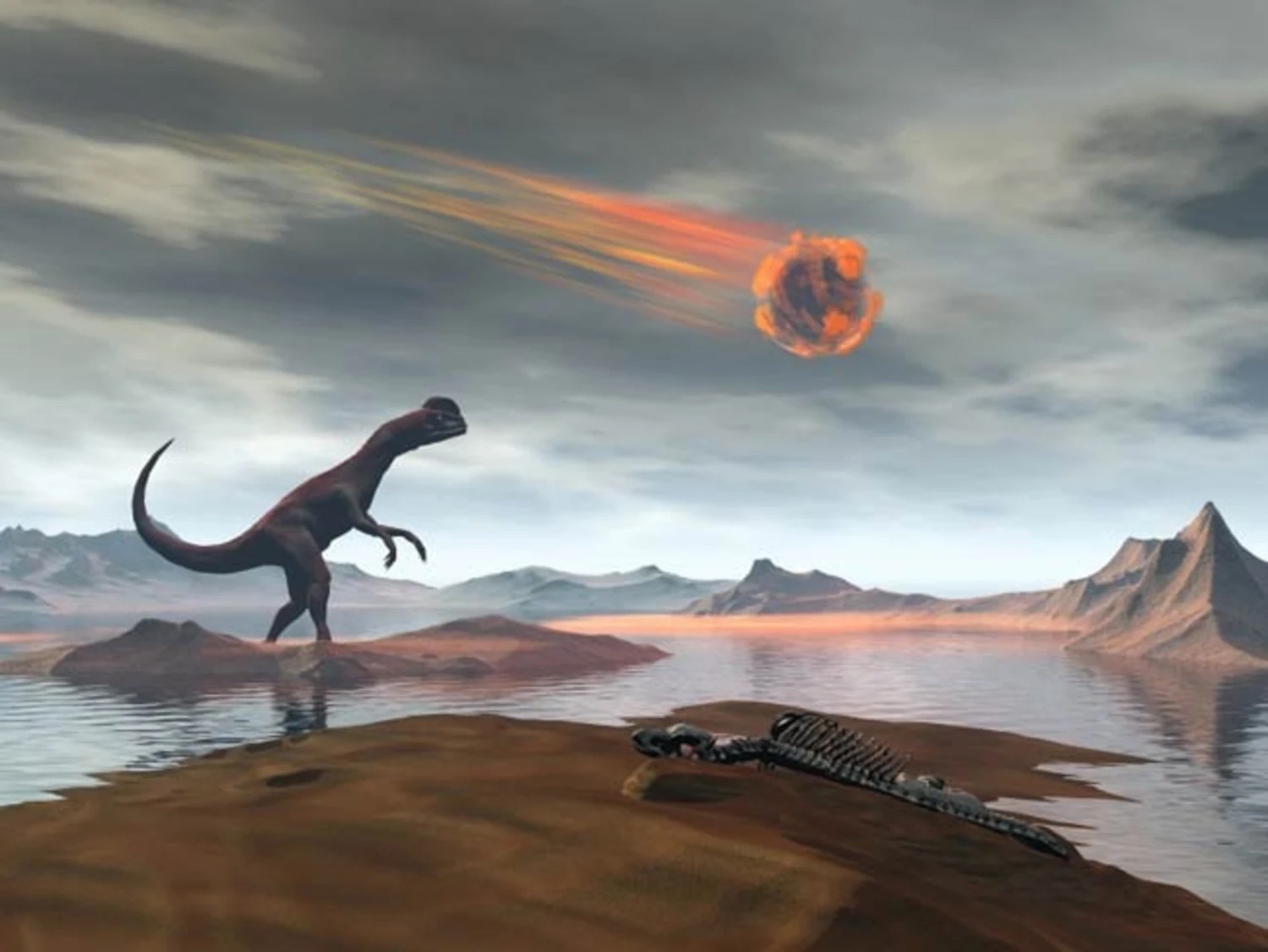
The Chicxulub Crater Event was an asteroid impact that occurred approximately 66 million years ago, creating the Chicxulub crater off the Yucatan Peninsula in Mexico. It was an approximately 6- to 9-mile-wide asteroid that struck the Earth 66 million years ago, creating the Chicxulub crater in what is now Mexico.
This event is widely considered the cause of the Cretaceous-Paleogene extinction event, which wiped out about 80% of all species on Earth, including the non-avian dinosaurs.
The impact triggered massive wildfires, tsunamis, and a prolonged "impact winter" caused by dust and soot blocking the sun, leading to a global climate collapse.
The impact triggered a mass extinction event by causing devastating tsunamis, wildfires, and a long-term "impact winter" by throwing debris and gases into the atmosphere, which blocked the sun and caused global temperatures to plummet.
The asteroid hit at a high speed and steep angle, maximizing the vaporized rock and debris sent into the atmosphere. Immediate effects: The impact caused powerful earthquakes, massive tsunamis, and widespread wildfires.
Long-term effects: The impact winter, which may have lasted for years, led to a drastic drop in global temperatures, impacting ecosystems and food chains.
The aftermath: The impact left behind the massive Chicxulub crater, which is mostly hidden under the Yucatan Peninsula and the Gulf of Mexico.
The Chicxulub crater is an impact crater buried underneath the Yucatan Peninsula in Mexico. Its center is offshore, but the crater is named after the onshore community of Chicxulub Pueblo (not the larger coastal town of Chicxulub Puerto). It was formed slightly over 66 million years ago when an asteroid, about ten kilometers (six miles) in diameter, struck Earth.
The crater is estimated to be 200 kilometers (120 miles) in diameter and 30 kilometers (19 miles) in depth. It is one of the largest impact structures on Earth, alongside the much older Sudbury and Vredefort impact structures, and the only one whose peak ring is intact and directly accessible for scientific research.
The crater was discovered by Antonio Camargo and Glen Penfield, geophysicists who had been looking for petroleum in the Yucatan Peninsula during the late 1970s. Penfield was initially unable to obtain evidence that the geological feature was a crater and gave up his search.
Later, through contact with Alan R. Hildebrand in 1990, Penfield obtained samples that suggested it was an impact feature. Evidence for the crater's impact origin includes shocked quartz, a gravity anomaly, and tektites in surrounding areas.
9-Kilometer Impact Crater Beneath Atlantic Reveals Dino-Killing Asteroid Had A Friend. The crater lies deep beneath the Atlantic Ocean and was formed around 66 million years ago - making it a contemporary of Chicxulub IFL Science - October 4, 2024
The Chicxulub impactor, as it is called, famously wiped out the non-avian dinosaurs and left a huge crater at the edge of the Yucatan peninsula - but it may not have acted alone. New research has revealed that a second, smaller space rock smashed into our planet during the same era, creating a 9.2-kilometer (5.7-mile) crater deep below the Atlantic.
The Nadir Crater was discovered back in 2022, located off the coast of Guinea in West Africa and lying 300 meters (984 feet) under the floor of the Atlantic Ocean. It is believed to have been created at the end of the Cretaceous period, around 66 million years ago, right when Chicxulub hit. However, the exact circumstances of how it came to be have remained uncertain - until now. Thanks to the new study, which has mapped the crater in unparalleled detail, researchers have finally confirmed how it was formed.
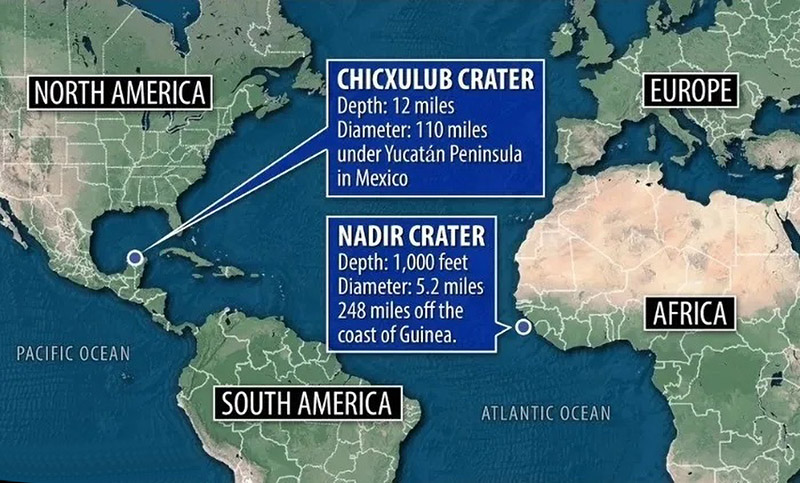
Nadir crater is a buried impact crater on the Guinea Plateau in the Atlantic Ocean, 400 kilometres (248 miles) off the coast of Guinea. The feature is named after the Nadir Seamount, located 100 km to the south. The paper announcing the discovery of the feature was published in Science Advances in 2022, with an impact origin being confirmed in 2024. The crater is around 9.2 km (5.7 mi) in diameter, and formed around 66 million years ago, close to the Cretaceous-Paleogene boundary when a small asteroid struck the ocean floor.
The crater features all characteristics of an impact crater: appropriate ratio of width to depth, the height of the rims, and the height of the central uplift. It was formed at or near the Cretaceous-Paleogene boundary about 66 mya around the same time as the Chicxulub crater. The impactor is estimated to be around 400 m (1⁄4 mi) in diameter, roughly equivalent to the size of the Bennu asteroid.[1] The authors of the paper speculated that it may have been part of a binary asteroid with the Chicxulub impactor or part of an impact cluster, but it is also probable that it is unrelated. Impacts similar in size to Nadir occur on average every 50,000 to 100,000 years.
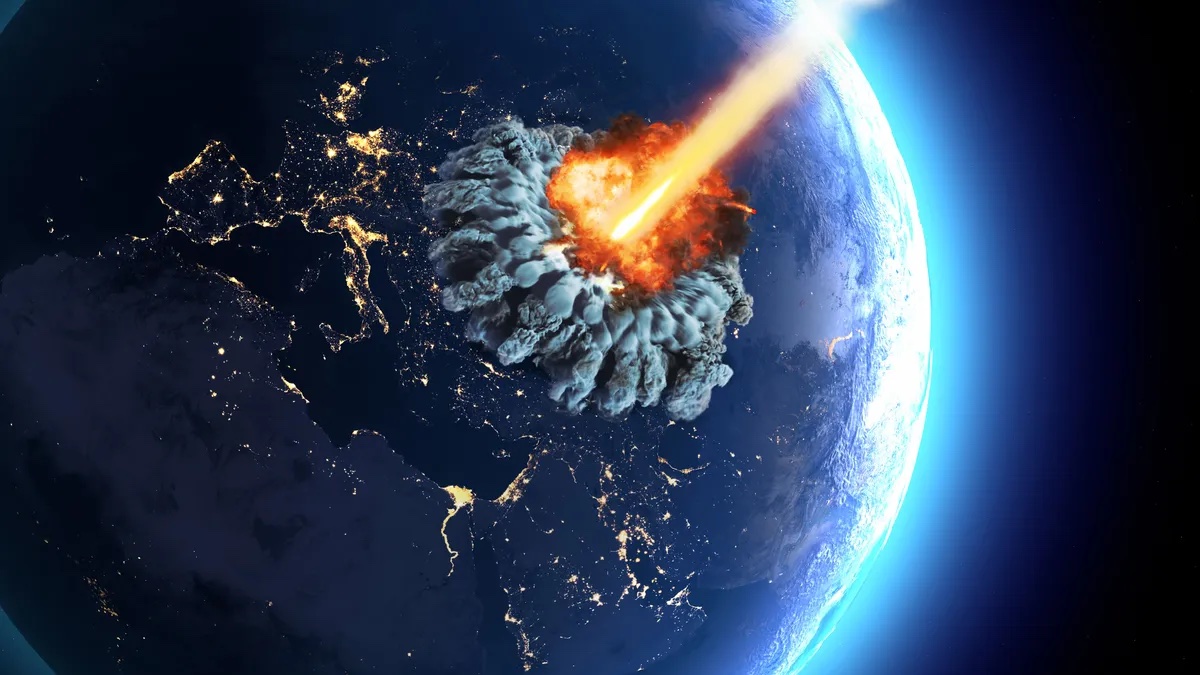
52-foot-tall 'megaripples' from dinosaur-killing asteroid are hiding under Louisiana Live Science - July 20, 2021
These are the largest known megaripples on Earth. The 52-foot-tall (16 meters) megaripples are about 5,000 feet (1,500 m) under the Iatt Lake area, in north central Louisiana, and date to the end of the Cretaceous period 66 million years ago, when that part of the state was underwater, the researchers said.
The megaripples' size and orientation suggest that they formed after the giant space rock, known as the Chicxulub asteroid, slammed into the Yucatan Peninsula, leading to the Chicxulub impact tsunami, whose waves then rushed into shallower waters and created the megaripple marks on the seafloor, the researchers said.