European Space Agency's (ESA) Comet Interceptor robotic spacecraft

European Space Agency's (ESA) Comet Interceptor robotic spacecraft
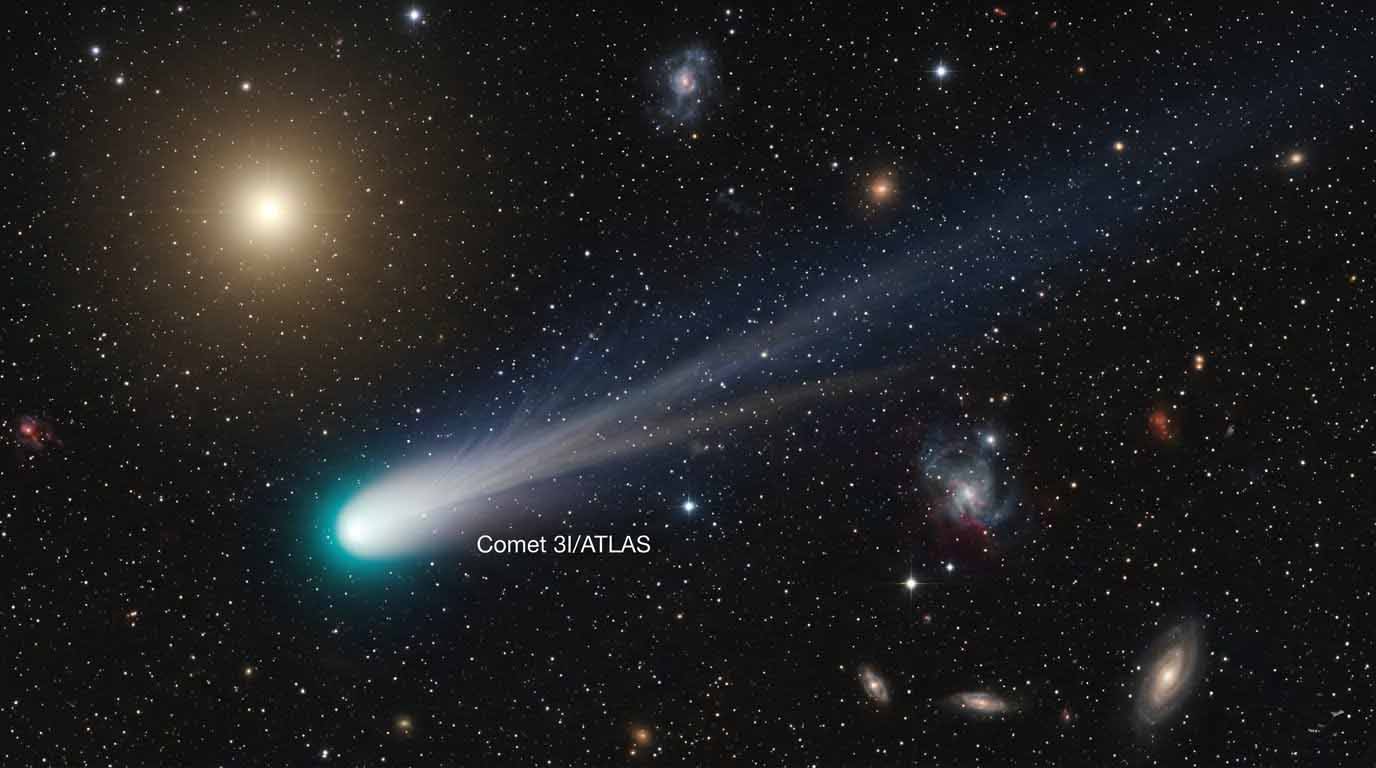
This astrophotography image captures a stunning green-headed comet streaking across a deep space field crowded with stars and distant galaxies. The glowing, cyan-tinted coma of the comet shines intensely on the lower-left side, trailing a dramatic, multi-layered ion tail that extends diagonally upward toward the upper right. The text "Comet 3I/ATLAS" is overlaid near the center of the image directly below the tail.

Near the center of the frame, the comet is captured as a horizontal sequence of seven distinct, evenly spaced white dots or point-like exposures, mapping its movement over time relative to the stars.
The Background Starfield: The surrounding area is densely packed with hundreds of stationary stars appearing as pinpoints of light against the blackness of deep space.
Reference Star: Directly to the left of the comet's dotted trajectory sits a conspicuously large, bright background star that serves as a prominent focal point near the center of the image.
3I/ATLAS, also known as C/2025 N1 (ATLAS) and previously as A11pl3Z, is an interstellar comet discovered on July 1, 2025 by the Asteroid Terrestrial-impact Last Alert System (ATLAS) station. The comet follows an unbound, hyperbolic trajectory past the Sun, and passed by Earth at 1.8 AU, posing no threat. The prefix "3I" designates it as the third confirmed interstellar object passing through the Solar System, after 1I/'Oumuamua and 2I/Borisov.
3I/ATLAS is an active comet consisting of a solid icy nucleus and a coma, which is a cloud of gas and icy dust escaping from the nucleus. The Sun is responsible for the comet's activity because it heats up the comet's nucleus to sublimate its ice into gas, which outgasses and lifts up dust from the comet's surface to form its coma.
Images taken by the Hubble Space Telescope and various interplanetary spacecraft suggest that the diameter of 3I/ATLAS's nucleus is less than 1 km (0.62 mi).
Observations by the James Webb Space Telescope (JWST) have shown that 3I/ATLAS is unusually rich in carbon dioxide, and contains a small amount of water ice, water vapor, carbon monoxide, carbonyl sulfide, and methane.
Observations by the Very Large Telescope have also shown that 3I/ATLAS is emitting cyanide gas and atomic nickel vapor, at concentrations similar to those seen in Solar System comets.
3I/ATLAS is recognized as an interstellar object because of its extremely hyperbolic path and very high speed relative to the Solar System. 3I/ATLAS did not pass close enough to any of the Solar System's planets to have gained its speed, so it could not have originated from the Solar System. Tracing the path of 3I/ATLAS in the sky shows that the comet originated from interstellar space in the direction of the constellation Sagittarius, near the Milky Way's Galactic Center.
Unlike the previous two interstellar objects, 3I/ATLAS originated from the southern celestial hemisphere in a direction opposite to the solar apex in the north, which is the direction of the Sun's movement relative to local stars. The southern origin of 3I/ATLAS was unexpected because astronomers initially predicted that more interstellar objects should come from the solar apex, and that telescopes should have a more difficult time discovering southern-origin interstellar objects. It is possible that either 3I/ATLAS is a rare discovery, or southern-origin interstellar objects may be more common than initially thought. Read more ...
31/ATLAS is not spacecraft. It's just another comet with an interesting history that leaves a lot to the imagination.
On July 16, 2025, astrophysicist Avi Loeb and other researchers of the Initiative for Interstellar Studies posted a paper on arXiv speculating that 3I/ATLAS could be an extraterrestrial spacecraft because they believed the object had "anomalous" characteristics, such as having an apparently large size, lack of identifiable chemicals, and an apparently improbable trajectory aligned with the Solar System's ecliptic plane.
Other astronomers immediately criticized Loeb's speculation; the science news website Live Science reported that "the overwhelming consensus is that it is a comet", with many researchers "disappointed with the new paper and pointed out that it distracts from the work of other scientists". Several astrophysicists, including Scott Manley and David Kipping, promptly pointed out flaws in Loeb's statistical analysis of 3I/ATLAS's trajectory. Read more ...
Interstellar Visitor 3I/ATLAS Just Got Even Weirder, And May Contain 10-Billion-Year-Old Material Science Alert - October 31, 2026
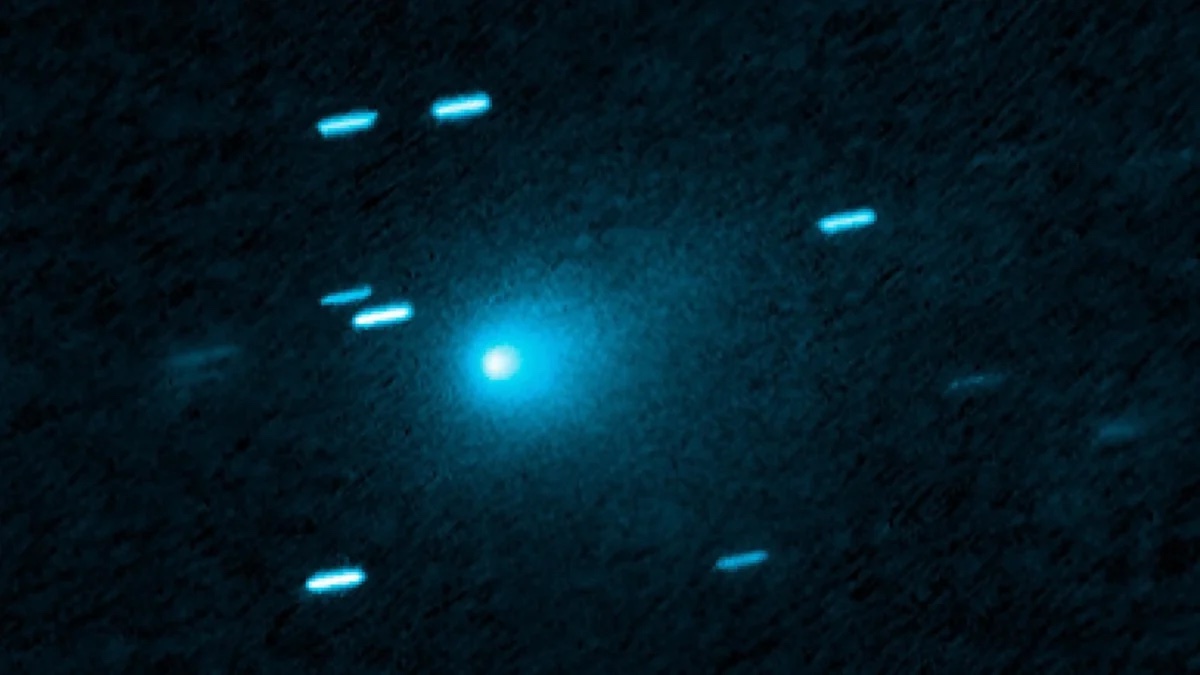
Exiled interstellar visitors like comet 3I/ATLAS are time capsules from the cosmos at large, yeeted from their exosolar homes by an unknown cataclysm and forced to drift through lonely space for billions of years, perhaps. If they're lucky, they may cross paths with another star, such as the Sun, and warm themselves at our solar hearth for a short while before speeding back out into darkness. This is lucky for us, too, since we get an unprecedented look at a chunk of an alien Solar System, which may have formed long before ours with chemistry unlike anything glimpsed before. In fact, the exosolar system that formed 3I/ATLAS may have assembled it more than 7 billion years before our Sun ignited into life - possibly even before 3I/ATLAS's own star erupted.
Interstellar comet 3I/ATLAS lost meters of its surface, giving scientists a depth scale for its chemistry - October 25, 2026
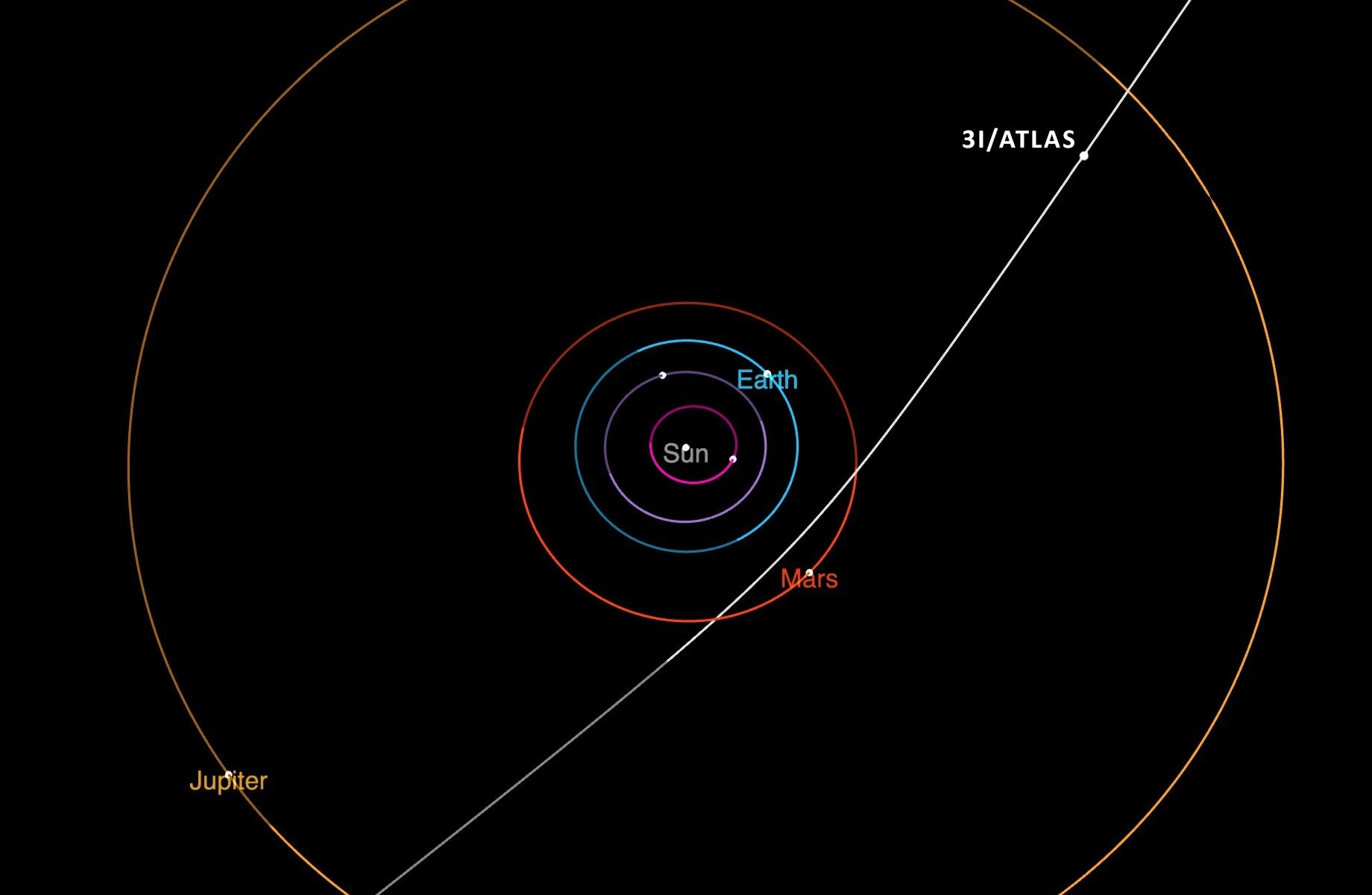
New calculations based on reported production rates indicate that interstellar comet 3I/ATLAS lost the equivalent of about 1.71-5.24 m (5.6-17.2 feet) of its radius from gas alone during its passage through the Solar System, while models that include dust produce erosion depths above 10 m (33 feet). The result gives researchers a way to relate the chemistry escaping from the comet to possible depths inside its nucleus, an important constraint when trying to determine how much of its observed material still reflects its history before entering the Solar System.
Interstellar comet 3I/ATLAS contains strange water never seen in our solar system Science Daily - May 8, 2026

Less than a year ago, astronomers spotted a comet passing through our solar system that originated far beyond it. The object, known as 3I/ATLAS, is only the third confirmed interstellar visitor ever detected, and scientists are now uncovering clues about the alien environment where it formed.
Scientists Traced Interstellar Comet 3I/ATLAS to an Extremely Cold Origin Science Alert - April 24, 2026
The comet that rambled past us from another star last year likely originated in a cold, isolated corner of the galaxy that had yet to gel into its own solar system, astronomers reported Thursday. Comet 3I/ATLAS is only the third interstellar visitor to be confirmed and quite possibly the oldest. Scientists estimate it could be up to 11 billion years old, more than twice as old as the Sun.
Interstellar comet 3I/ATLAS is rapidly moving away from us. Can we 'intercept' it before it leaves us forever? Live Science - December 19, 2025
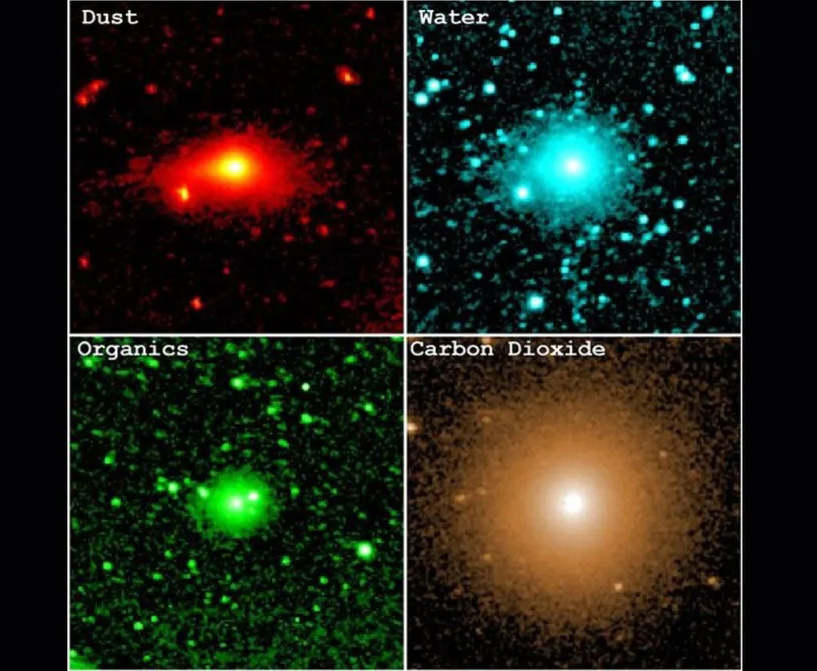
3I/ATLAS has passed its closest point to Earth, meaning we will soon lose sight of it for good. Some scientists want to send a spacecraft to chase down the alien comet — or the next interstellar object.
Interstellar object 3I/ATLAS is about to get very active Live Science - October 26, 2025
The interstellar comet 3I/ATLAS is barreling toward its closest point to the sun as perihelion looms on Oct. 29. How different will it look when it reappears on the other side?
Interstellar comet 3I/ATLAS transforms into a giant 'cosmic rainbow' in trippy new telescope image Live Science - July 17, 2025

The newly discovered interstellar visitor 31/ATLAS can be seen shining like a rainbow-colored string of cosmic pearls in a trippy new Timelapse Image captured by a telescope in Hawaii.