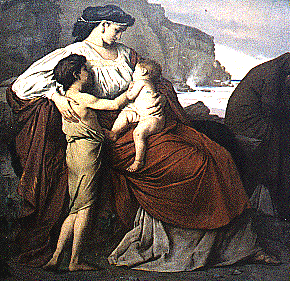
Jason is a hero of Greek mythology who lead the Argonauts in the search of the Golden Fleece. His father was Aeson, the rightful king of Iolcus.
The Early Years
Pelias (Aeson's half-brother) was power-hungry and he wished to gain dominion over all of Thessaly. Pelias was the product of a union between their shared mother Tyro ("high born Tyro") daughter of Salmoneus, and the sea god Poseidon. In a bitter feud, he overthrew Aeson (the rightful king), killing him and hopefully his descendants, who might take revenge on him.
Alcimede (wife of Aeson) already had an infant son by Aeson, Jason who she sent to the centaur (half man, half horse) Cheiron for education, for fear that Pelias would kill him - she claimed that he had been killed (circumstances unclear). Pelias, still paranoid that he would one day be overthrown, consulted an oracle which warned him to beware a man coming forth from the people with only one sandal.
Many years later, Pelias was holding games in honour of the sea god and his alleged father, Poseidon, when Jason arrived in Iolcus and lost one of his sandals in the river Anauros ("wintry Anauros"), while helping an old woman (Goddess Hera in disguise) cross. She blessed him for she knew, as goddesses do, what Pelias had up his sleeve.
When Jason entered Iolcus, he was announced as a man wearing one sandal. Paranoid, Pelias asked him what he (Jason) would do if confronted with the man who would be his downfall. Jason responded that he would send that man after the Golden Fleece. Pelias took that advice and sent Jason to retrieve the Golden Fleece as he thought it an impossible mission for this young lad that stood before him (Jason was supposed to have been in his late teens or early twenties at the time).
The quest for the Golden Fleece
Jason assembled a great group of heroes and a huge ship called the Argo. Together, the heroes were known as the Argonauts. They included the Boreads, Heracles, Peleus, Telamon, Orpheus, Castor and Polydeuces, Atalanta and Euphemus.
The Isle of Lemnos
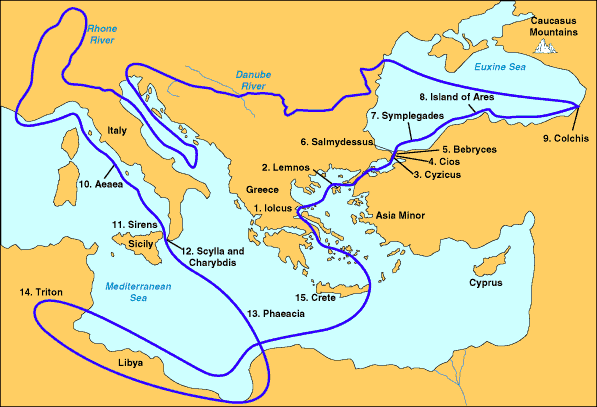
The isle of Lemnos is situated off the Western coast of Asia Minor (modern day Turkey). The island was inhabited by a race of women, who had killed their husbands. The women had neglected their worship of Aphrodite, and as a punishment the goddess made the women so foul in stench that their husbands couldn't bear to be near them.
The men then took concubines from the Thracian mainland opposite, and the spurned women, naturally angry, killed every male inhabitant. The king, Thoas, was saved by Hypsipyle, his daughter, who put him out to sea sealed in a chest from which he was later rescued. The women of Lemnos lived for a while without men, with Hypsipyle as their queen.
The Argonauts stopped off on the isle, and the women welcomed them with open arms. Jason fathered twins with the queen, and many other Argonauts fathered children with the other women, thereby reintroducing a male population to the island (the offspring were male).
Heracles pressured them to leave as he was disgusted by the antics of the Argonauts. He hadn't taken part, which is truly unusual considering the numerous affairs he had with other women. Heracles is the moral voice throughout their sojourn, and he reminds the crew of their mission.
The Argonauts resumed their hunt for the Golden Fleece after spending a considerable amount of time on the island.
The Arrival in Colchis
Jason arrived in Colchis to claim the fleece as his own. King Aeetes of Colchis promised to give it to him only if he could perform certain tasks. Presented with the tasks, Jason became discouraged and fell into depression. However, Hera had persuaded Aphrodite to strike Aeetes's daughter, Medea, with love for Jason. As a result, Medea aided Jason in his tasks. First, Jason had to plow a field with fire-breathing oxen that he had to yoke himself. Medea provided an ointment that protected him from the oxen's flames.
Then, Jason sowed the teeth of a dragon into a field. The teeth sprouted into an army of warriors. Medea had previously warned Jason of this and told him how to defeat this foe. Before they attacked him, he threw a rock into the crowd. Unable to decipher where the rock had come from, the soldiers attacked each other and defeated each other. Finally, Jason had to fight and kill the sleepless dragon that guarded the fleece, but again Medea used her magic to put the dragon to sleep. Jason then took the fleece and sailed away with Medea, who had fallen in love with him and helped him win the fleece. Medea distracted her father as they fled by killing her brother, Apsyrtus. In the fight, Atalanta was seriously wounded but healed by Medea.
Alternate versions tell of how Jason led the herd of sheep that had the golden wool to make the fleece. He was advised by Medea to lead the herd through a patch of thorned plants. The wool would then be trapped in the thorns so Jason could collect it.
The Return
On the way back to Thessaly, Medea prophesised to Euphemus, the Argo's helmsman, that one day he would rule Libya. This came true through Battus, a descendant of Euphemus.
When the Argonauts stopped on Aeaea, Circe purified them for the death of Apsyrtus.
Chiron had told Jason that without the aid of Orpheus, the Argonauts would never be able to pass the Sirens. The Sirens lived on three small, rocky islands called Sirenum scopuli and sang beautiful songs that enticed sailors to come to them. They then ate the sailors. When Orpheus heard their voices, he withdrew his lyre and played his music more beautifully than they, drowning out their music.
The Argo then came to the island of Crete, guarded by the bronze man, Talos. Talos had one blood vessel which went from his neck to his ankle, bound shut by only one bronze nail. Medea cast a spell on Talos to calm him; she removed the bronze nail and Talos bled to death. The Argo landed.
Jason Returns
Medea, using her sorcery, claimed to Pelias' daughters that she could make their father younger by chopping him up into pieces and boiling the pieces in a cauldron of water and magical herbs. She demonstrated this remarkable feat with a sheep, which leapt out of the cauldron as a lamb. The girls, rather naively, sliced and diced their father and put him in the cauldron. Medea did not add the magical herbs, and Pelias was dead.
Pelias' son, Acastus, drove Jason and Medea into exile for the murder, and the couple settled in Corinth. There he married Creusa, a daughter of the King of Corinth, to strengthen his political ties. Medea, angry at Jason for breaking his vow that he would be hers forever, got her revenge by presenting Creusa a cursed dress, as a wedding gift, that stuck to her body and burned her to death as soon as she put it on. Creusa's father, Creon, burnt to death with his daughter as he tried to save her. Medea killed the children that she bore to Jason, fearing that they would be murdered, or enslaved as a result of their mother's actions.
The story of Medea's revenge on Jason is told with devastating effect by Euripides in the tragedy of the same name.
Later Jason and Peleus (father of the hero Achilles) would attack and defeat Acastus, reclaiming the throne of Iolcus for himself once more. Jason's son, Thessalus, then became king (the parentage of Thessalus is uncertain - i.e. who was his mother, since Medea killed her children?).
Jason died a lonely and unhappy man with no friends. He was asleep under the stern of the Argo, which was rotten, and it fell on him, killing him instantly. It was said that the manner of his death was due to the gods cursing him for breaking his promise to Medea.Though some of the episodes of Jason's story draw on ancient material, the definitive telling, on which this account relies, is that of Apollonius of Rhodes in his epic poem Argonautica, written in Alexandria in the late 3rd century BC.
The mythical geography of the voyage of the Argonauts has been speculatively explicated by the historian of science and the cartography of Antiquity, Livio Catullo Stecchini, in a suggestive essay "The Voyage of the Argo" that draws upon fragments of the mythic sources Apollonius employed in constructing his poem.In the Divine Comedy Dante sees Jason in the eighth circle of Hell among the seducers.
Reference: Powell, B. The Voyage of the Argonauts In Classical Mythology Prentice Hall. 2001. pp. 477-489

Jason sent his invitation to all the adventurous young men of Greece, and soon found himself at the head of a band of bold youths, many of whom afterwards were renowned among the heroes and demigods of Greece. Hercules, Theseus, Orpheus, and Nestor were among them. They are called the Argonauts, from the name of their vessel.
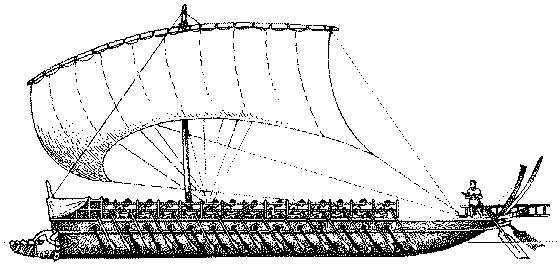
The "Argo" with her crew of heroes left Thessaly and having touched at the Island of Lemnos, thence crossed to Mysia and thence to Thrace . Here they found the sage Phineus, and from him received instruction as to their future course. It seems the entrance of the Euxine Sea was impeded by two small rocky islands, which floated on the surface, and in their tossings and heavings occasionally came together, crushing and grinding to atoms any object that might be caught between them. They were called the Symplegades, or Clashing Islands.
Phineus instructed the Argonauts how to pass this dangerous strait. When they reached the islands they let go a dove, which took her way between the rocks, and passed in safety, only losing some feathers of her tail. Jason and his men seized the favourable moment of the rebound, plied their oars with vigour, and passed safe through, though the islands closed behind them, and actually grazed their stern. They now rowed along the shore till they arrived at the eastern end of the sea, and landed at the kingdom of Colchis.
Jason made known his message to the Colchian king, AEetes, who consented to give up the golden fleece if Jason would yoke to the plough two fire-breathing bulls with brazen feet, and sow the teeth of the dragon which Cadmus had slain, and from which it was well known that a crop of armed men would spring up, who would turn their weapons against their producer.
Jason accepted the conditions, and a time was set for making the experiment. Previously, however, he found means to plead his cause to Medea, daughter of the king. He promised her marriage, and as they stood before the altar of Hecate, called the goddess to witness his oath. Medea yielded, and by her aid, for she was a potent sorceress, he was furnished with a charm, by which he could encounter safely the breath of the fire-breathing bulls and the weapons of the armed men.
At the time appointed, the people assembled at the grove of Mars (Ares), and the king assumed his royal seat, while the multitude covered the hill-sides. The brazen-footed bulls rushed in, breathing fire from their nostrils that burned up the herbage as they passed. The sound was like the roar of a furnace, and the smoke like that of water upon quick-lime.
Jason advanced boldly to meet them. His friends, the chosen heroes of Greece, trembled to behold him. Regardless of the burning breath, he soothed their rage with his voice, patted their necks with fearless hand, and adroitly slipped over them the yoke, and compelled them to drag the plough. The Colchians were amazed; the Greeks shouted for joy.
Jason next proceeded to sow the dragon's teeth and plough them in. And soon the crop of armed men sprang up, and, wonderful to relate! no sooner had they reached the surface than they began to brandish their weapons and rush upon Jason. The Greeks trembled for their hero, and even she who had provided him a way of safety and taught him how to use it, Medea herself, grew pale with fear.
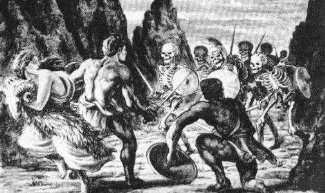
Jason for a time kept his assailants at bay with his sword and shield, till, finding their numbers overwhelming, he resorted to the charm which Medea had taught him, seized a stone and threw it in the midst of his foes. They immediately turned their arms against one another, and soon there was not one of the dragon's brood left alive. The Greeks embraced their hero, and Medea, if she dared, would have embraced him too.
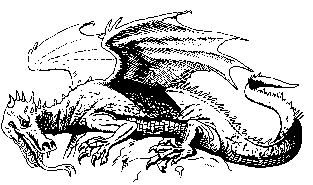
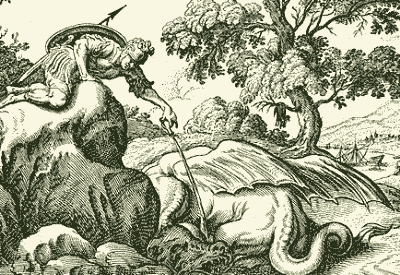
It remained to lull to sleep the dragon that guarded the fleece, and this was done by scattering over him a few drops of a preparation which Medea had supplied. At the smell he relaxed his rage, stood for a moment motionless, then shut those great round eyes, that had never been known to shut before, and turned over on his side, fast asleep.
Jason seized the fleece and with his friends and Medea accompanying, hastened to their vessel before AEetes the king could arrest their departure, and made the best of their way back to Thessaly, where they arrived safe, and Jason delivered the fleece to Pelias, and dedicated the "Argo" to Neptune (Poseidon). What became of the fleece afterwards we do not know, but perhaps it was found after all, like many other golden prizes, not worth the trouble it had cost to procure it.
- Bullfinch's Mythology
ALPHABETICAL INDEX OF ALL FILES