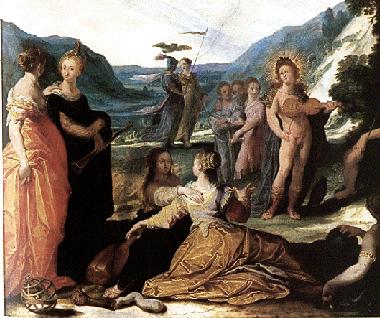
The Muses are the Greek goddesses who preside over the arts and sciences and inspire those who excel at these pursuits. Daughters of Zeus, king of the gods, and Mnemosyne ("memory"), they were born at Pieria at the foot of Mount Olympus. Their nurse, Eupheme, raised them along with her son, Crotus the hunter, who was transported into the sky as Sagittarius upon his death. Their name (akin to the Latin mens and English mind) denotes 'memory' or 'a reminder', since in the earlier times poets, having no books to read from, relied on their memories. The Romans identified the Muses with certain obscure Italian water-goddesses, the Camenae.
The original number of muses and their names varies in earlier times as their evolution blossomed in Greek mythology. At first, three muses were worshipped on Mount Helicon in Boeotia: Melete ("meditation"), Mneme ("memory"), and Aoede ("song"). Another three were worshipped at Delphi and their names represented the names of the strings of a lyre: Nete, Mese, and Hypate. Several other versions were worshipped until the Greeks finally established the nine muses in mythology as:
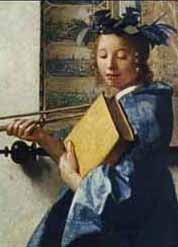
Clio (History)
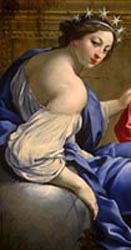
Urania (Astronomy)
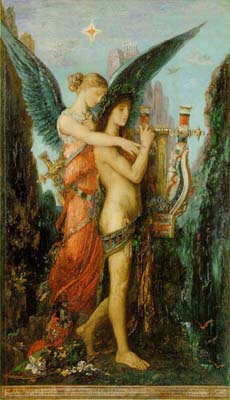
Melpomene (Tragedy)
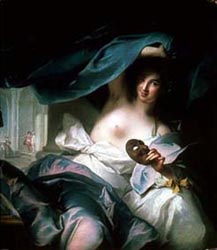
Thalia (Comedy)
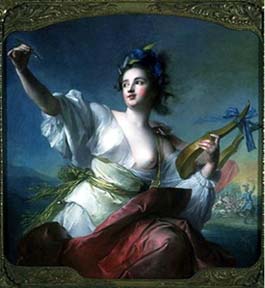
Terpsichore (Dance)
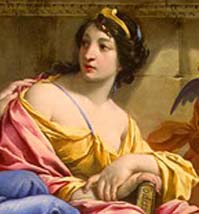
Calliope (Epic Poetry)
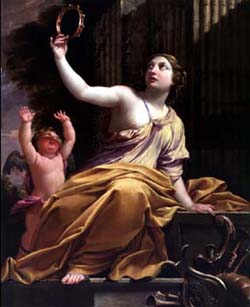
Erato (Love Poetry)
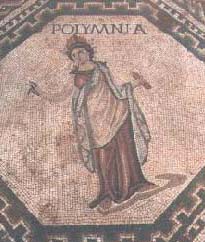
Polyhymnia (Songs to the Gods),
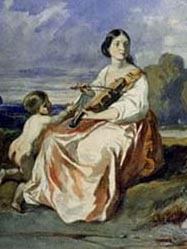
Euterpe (Lyric Poetry)
Ephialtes and Otus, who also founded Ascra, were the first to sacrifice on Helicon to the Muses and to call the mountain sacred to the Muses. Sacrifices to the Muses consisted of libations of water, milk, or honey. Their companions are the Charities, the Horae, Eros, Dionysus, Apollo, Aphrodite, Harmonia, and Himerus (Desire). Apollo is the leader of the choir of the Muses and consequently he has the surname Musagetes.
Athena caught and tamed the winged horse Pegasus and gave him to the Muses. Some of their disciples included the Sphinx who learned her riddle from the Muses, Aristaeus, who learned the arts of healing and prophecy from them, and Echo, who was taught by them to play music.
In Plato's Phaedrus, Socrates says the locusts used to be men before the birth of the Muses. When song appeared when the Muses were born, some men were so overcome with delight that they sang constantly, forgetting to eat and drink until they eventually died. These dead men became locusts with a gift from the Muses allowing them to sing continuously from their birth until death without the need of sustenance. When they die, the locust go to the Muses and report which men on earth honors each, endearing a worshipper to the Muse he follows.
The Muses could be vindictive like in the story of the contest with Thamyris. Thamyris who excelled in minstrelsy challenged the Muses to a musical contest at Dorium in Messenia, the agreement being if he won he would take pleasure from all of them. The Muses won the contest, and bereft Thamyris of his eyes and minstrelsy.
In another story, the king of Emathia (Macedonia) and his wife Euippe had nine daughters and named them after the Muses. The daughters entered a contest with the Muses, were defeated and were metamorphosed by the Muses into birds called Colymbas, Iynx, Cenchris, Cissa, Chloris, Acalanthis, Nessa, Pipo, and Dracontis. These names were taken from actual names of birds such as the wryneck, hawk, jay, duck, goldfinch, and four others with no recognizable modern equivalents.
In yet another myth, it was said Hera, queen of the gods, persuaded the Sirens, who were described in early Greek mythology as having the bodies of birds and heads of beautiful women, to enter a singing contest with the Muses. The Muses won the competition and then plucked out all of the Sirens' feathers and made crowns out of them.
Many places were dedicated to the Muses such as the famous Valley of the Muses - Thespies on the eastern slopes of Mt. Helikon began it's "Mouseai" festivals in the 6th c. B.C. It was organized every 5 years by the Thespians. Poets and musicians from all over Greece also participated in various games (epic, poetry, rapsodia, kithara, aulos, satyric poetry, tragedy and comedy). It was common for ancient schools to have a shrine to the Muses called mouseion, the source of the modern word 'museum.' The famous Museum of Alexandria, founded by Ptolemy I, was a temple dedicated to the Muses. Before poets or storytellers recited their work, it was customary for them to invoke the inspiration and protection of the Muses.
In Greek mythology, Nemesis was the goddess of divine justice and vengeance. Her anger was seen as directed chiefly toward those guilty of arrogance (Hubris), particularly human arrogance towards the gods and their laws. Nemesis pursued the insolent and the wicked with inflexible vengeance. Her cult probably originated from Smyrna. She was described by Greek writers as the daughter of Oceanus or Zeus, but according to Hesiod she was a child of Erebus and Nyx.In English the meaning of the word nemesis has changed somewhat. It now usually means an ultimate or unbeatable enemy, as in the phrase "to meet one's nemesis." The sense of nemesis being a just punishment for hubris has generally been lost.
Nyx in Hesiod's Theogony - Night is born of Chaos; her offspring are many, and telling. With her brother Erebus, Night gives birth to Aether ("atmosphere") and Hemera ("day"). Later, on her own, Night gives birth to Momus "blame", Ponos "toil", Moros "fate", Thanatos "death", Hypnos "sleep", the Oneiroi "the tribe of dreams", the Hesperides, the Keres and Fates, Nemesis, Apate "deception", Philotes "friendship", Geras "age", and Eris "strife".
In his description of Tartarus, Hesiod says further that Hemera "day", who is now Night's sister rather than daughter, left Tartarus just as Nyx entered it; when Hemera returned, Nyx left. This mirrors the portrayal of Ratri "night" in the Rig-Veda, where she works in close cooperation but also tension with her sister Ushas "dawn".
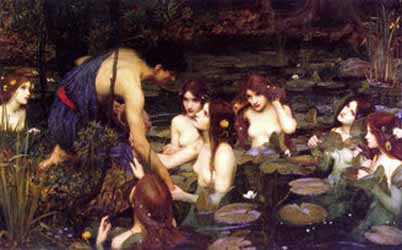
In Greek mythology, a nymph is any member of a large class of female nature entities, sometimes bound to a particular location or landform. Nymphs often accompanied various gods and goddesses, and were the frequent target of lusty satyrs. Nymphs are frequently associated with the superior divinities, the huntress Artemis, the prophetic Apollo, the reveller and god of trees Dionysus, and with rustic gods such as Pan and Hermes
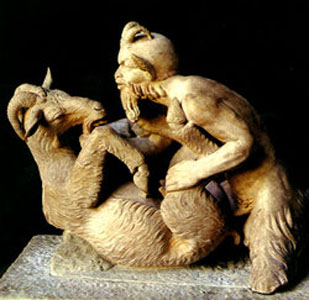
Pan is the son of Hermes. He is the god of goatherds and shepherds. He is mostly human in appearance but, with goat horns and goat feet. He is an excellent musician and plays the pipes. He is merry and playful frequently seen dancing with woodland nymphs. He is at home in any wild place but, is favorite is Arcady, where he was born. He is always in pursuit of one of the nymphs but, always rejected because he is ugly.
His name is the basis for the word "panic". There are two differing explanations for this. The first is that he was present when Zeus defeated the Titans and claimed that it has his yelling that caused the Titans to flee. However, this seems at odds with his being Hermes son. The second is that he created the noises in the woods at night the scared travelers. He fathered Crotus with Eupheme.
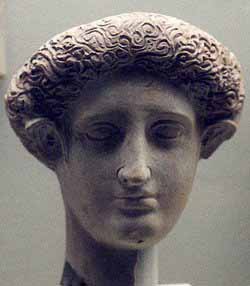
In Greek mythology, Persephone was the queen of the Underworld, the Kore or young maiden, and the daughter of Demeter. Persephone ("she who destroys the light") is her name in the Ionic Greek of epic literature. In other dialects she was known under various other names: Persephassa, Persephatta, or simply Kore. The Romans first heard of her from the Aeolian and Dorian cities of Magna Graecia, who used the dialectal variant Proserpina. ence, in Roman mythology she was called Proserpina, and as a revived Roman Proserpina she became an emblematic figure of the Renaissance.
The figure of Persephone is a well-known one today. Her story has great emotional power: an innocent maiden; a mother's grief at the abduction and the return of her daughter. It is also cited frequently as a paradigm of myths that explain natural processes, with the descent and return of the goddess bringing about the change of seasons.
But the Greeks knew another face of Persephone as well. She was also the terrible Queen of the dead, whose name was not safe to speak aloud, who was named simply "The Maiden". Her central myth, for all of its emotional familiarity, was also the back-story of the secret initiatory mystery rites of regeneration at Eleusis, which promised immortality to their awe-struck participants - an immortality in her world beneath the soil, feasting with the heroes beneath her dread gaze
The Abduction Myth
In the Olympian pantheon, Persephone is given a father: according to Hesiod's Theogony, Persephone was the daughter produced by the union of Zeus and Demeter. "And he [Zeus] came to the bed of bountiful Demeter, who bore white-armed Persephone, stolen by Hades from her mother's side".
Unlike every other offspring of an Olympian pairing, however, Persephone has no stable position at Olympus. Persephone used to live far away from the other gods, a goddess within Nature before the days of planting seeds and nurturing plants. In the Olympian telling Citation needed, the gods Hermes, Ares, Apollon and Hephaistos, had all wooed Persephone, but Demeter rejected all their gifts and hid her daughter away from the company of the gods.
Thus, Persephone lived a peaceful life before she became the goddess of the underworld, which, according to Olympian mythographers, did not occur until Hades abducted her and brought her into the underworld.
She was innocently picking flowers with some nymphs - and Athena and Artemis, the Homeric hymn says, or Leucippe, or Oceanids - in a field in Enna when he came, bursting up through a cleft in the earth; the nymphs were changed by Demeter into the Sirens for not having interfered. Life came to a standstill as the depressed Demeter (goddess of the Earth) searched for her lost daughter. Helios, the sun, who sees everything, eventually told her what had happened.
Finally, Zeus could not put up with the dying earth and forced Hades to return Persephone. But before she was released to Hermes, who had been sent to retrieve her, Hades tricked her into eating six pomegranate seeds, which forced her to return six months out of each year. (A month for each seed she had eaten.)
In some versions, Ascalaphus informed the other gods that Persephone had eaten the pomegranate seeds. When Demeter and her daughter were together, the Earth flourished with vegetation, but for six months each year, when Persephone returned to the underworld, the earth once again became a barren realm.
In an alternate version, Hecate rescued Persephone. In the earliest version the dread goddess Persephone was herself Queen of the Underworld. This myth can also be interpreted as an allegory of ancient Greek marriage rituals. The Greeks felt that marriage was a sort of abduction of the bride by the groom from the bride's family, and this myth may have explained the origins of the marriage ritual. The more popular etiological explanation of the seasons may have been a later interpretation.
Persephone, as Queen of Hades, only showed mercy once, because the music of Orpheus was so hauntingly sad. She allowed Orpheus to bring his wife Eurydice back to the land of the living as long as she walked behind him and he never tried to look at her face until they reached the surface. Orpheus agreed but failed, looking back at the very end to make sure his wife was following, and lost Eurydice forever.
Persephone also figures in the story of Adonis, the Syrian consort of Aphrodite. When Adonis was born, Aphrodite took him under her wing, seducing him with the help of Helene, her friend, and was entranced by his unearthly beauty. She gave him to Persephone to watch over, but Persephone was also amazed at his beauty and refused to give him back. The argument between the two goddesses was settled either by Zeus or Calliope, with Adonis spending four months with Aphrodite, four months with Persephone and four months of the years with whomever he chose. He always chose Aphrodite because Persephone was the cold, unfeeling goddess of the underworld.
When Hades pursued a nymph named Mintho, Persephone turned her into a mint plant.Persephone was the object of Pirithous' affections. Pirithous and Theseus, his friend, pledged to marry daughters of Zeus. Theseus chose Helen and together they kidnapped her and decided to hold onto her until she was old enough to marry. Pirithous chose Persephone. They left Helen with Theseus' mother, Aethra, and travelled to the underworld, domain of Persephone and her husband, Hades. Hades pretended to offer them hospitality and set a feast; as soon as the pair sat down, snakes coiled around their feet and held them there.
Persephone and her mother Demeter were often referred to as aspects of the same goddess, and were called "the Demeters" or simply "the goddesses." The story of Persephone's abduction was part of the initiation rites in the Eleusinian Mysteries.
Many modern scholars have argued that Persephone's cult was a continuation of Neolithic or Minoan goddess-worship. Among classicists, this thesis has been argued by Gunther Zuntz (Zuntz 1973) and cautiously included by Walter Burkert in his definitive Greek Religion.
More daringly, the mythologist Karl Kerenyi has identified Persephone with the nameless "mistress of the labyrinth" at Knossos.
On the other hand, the hypothesis of a universal cult of the Earth Mother has come under increasing criticism in recent years. For more on both sides of the controversy, see Mother Goddess.
Life-Death-RebirthInspired by James Frazer, Jane Ellen Harrison and modern mythologers, some scholars have labeled Persephone a life-death-rebirth deity.
In Greek mythology, Tartarus, or Tartaros, is both a deity and a place in the underworld - even lower than Hades. In ancient orphic sources and in the mystery schools Tartaros is also the unbounded first-existing "thing" from which the Light and the cosmos is born.
The Greek poet Hesiod asserts that a bronze anvil falling from heaven would fall 9 days before it reached the Earth. The anvil would take 9 more days to fall from Earth to Tartarus.
In The Iliad, Jove asserts that Tartarus is "as far beneath Hades as heaven is high above the Earth". As a place so far from the sun and so deep in the earth, Tartarus is hemmed in by 3 layers of night, which surrounds a bronze wall which in turn encompasses Tartarus. It is a dank and wretched pit engulfed in murky gloom. It is one of the primordial objects, along with Chaos, Earth, and Eros, that emerged into the universe.
While, according to Greek mythology, Hades is the place of the dead, Tartarus also has a number of inhabitants. When Cronus, the ruling Titan, came to power he imprisoned the Cyclopes in Tartarus. Zeus released them to aid in his conflict with the Titan giants.
The gods of Olympus eventually defeated the Titans and they were cast into Tartarus. They were guarded by giants, each with 100 enormous heads and 100 strong arms, who were called Hecatonchires. Later, when Zeus overcame the monster Typhus, the offspring of Tartarus and Gaia, he threw it, too, into the same pit.
Tartarus is also the place where the punishment fits the crime. For example Sisyphus, who was both a thief and murderer, was condemned for eternity to push a boulder up a hill only to have it roll down at the top. Also found there was Ixion, the first human to spill the blood of a relative. He caused his father in-law to fall into a pit of burning coals to avoid paying the bride-price. The fitting punishment was to spend eternity on a flaming wheel. Tantalus, who enjoyed the confidence of the gods by conversing and dining with them, shared the food and the secrets of the gods with his friends. The fitting punishment was to be immersed up to his neck in cool water, which disappeared whenever he attempted to quench his thirst, and luscious grapes above him that leapt up when he tried to take a hold.
In Roman mythology, Tartarus is the place where sinners are sent. Virgil describes it in the Aeneid as a gigantic place, surrounded by the flaming river Phlegethon and triple walls to avoid sinners escaping from it. It is guarded by a hydra with fifty black gaping jaws, which sits at a screeching gate protected by columns of solid adamant, a substance akin to diamond - so hard that nothing will cut through it.
Inside, there is a castle with wide walls, and a tall iron turret. Tisiphone, one of the Furies who represents revenge, stands guard sleepless at the top of this turret lashing a whip. There is a pit inside which is said to extend down into the earth twice as far as the distance from the lands of the living to Olympus.
At the bottom of this pit lie the Titans, the twin sons of Aloeus and many other sinners. Still more sinners are contained inside Tartarus, with punishments similar to those of Greek myth.
The author of Peter's Second Epistle alludes to this tradition, naming Tartaros as the judgement of fallen angels.
Rhadamanthus, Aeacus and Minos were the judges of the dead and chose who went to Tartarus. Rhadamanthus judged Asian souls; Aeacus judged European souls and Minos was the deciding vote and judge of the Greek.
Hesiod, Theogony; Homer, Odyssey, XI, 576 ff; Virgil, Aeneid, VI, 539-627.
Tartarus in Neopaganism
Many Neopagans today, particularly Hellenistic neopagans in the United States, have what most would consider a new-age view of Tartarus. Tartarus is seen as something of a pagan version of hell. It is believed that those cast into Tartarus are tormented by Furies and other horrid entities and burn in all consuming fire as they are forced into prostration to Cronus. It is interesting to note that Cronus takes a role commonly associated with Satan in Christian mythology. Most modern neopagans believe that Hades acts as judge, making the final decision regarding who is cast into Tartarus. Whether or not such beliefs are grounded in actual mythology often seems to be unimportant to modern neopagan sects.
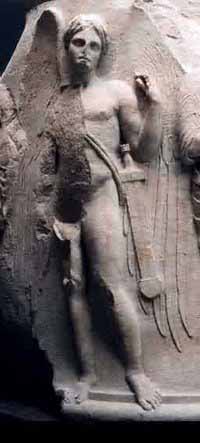
In Greek mythology, Thanatos was the personification of death (Roman equivalent: Mors). He was a creature of bone-chilling darkness. He was a son of Nyx and twin of Hypnos. He plays little role in the myths. He became rather overshadowed by Hades the lord of death. Night, the destructive, brought forth a horde of villainous immortals. Thanatos was one of that wretched lot. Night's offspring are described as "horrible, painful, cruel, brooding, mocking and malignant." (The one exception is "loving Affection" who is placed between Deception and Old Age.) Thanatos might be poetically called the brother of Sleep and the son of Night. In art, Thanatos was depicted as a young man carrying a butterfly, wreath or inverted torch in his hands. He sometimes has two wings and a sword attached to his belt.
Uranus is the Latinized form of Ouranos, Greek name of the sky. In Greek mythology Uranus is personified as the son and husband of Gaia, Mother Earth. Ouranos and Gaia were ancestors of most of the Greek gods.
Other sources claim a different parentage of Ouranos. Cicero, in his work De Natura Deorum claims that he was the offspring of the ancient gods Aether and Hemera. According to the Orphic Hymns, Ouranos was the son of the personification of night, Nyx.
His equivalent in Roman mythology was Coelus.
In the Olympian creation myth, Uranus came every night to cover the earth and mate with Gaia, but he hated the children she bore him and imprisoned Gaia's youngest children in Tartarus. The one-hundred-armed giants (Hecatonchires) and the one-eyed giants, the Cyclopes, caused pain to Gaia.
She shaped a great flint sickle and asked her sons Cronus and his brothers to castrate Uranus. Only Cronus was willing: he ambushed his father and castrated him, casting that which was severed into the sea. From that which spilled from Uranus onto the Earth came forth the Gigantes, the three avenging Furies - the Erinyes - and Meliae, the ash-nymphs.
From that which was cast into the sea came forth Aphrodite. For this, Uranus called his sons Titanes Theoi, or "Straining Gods" for their fearful deed. After Uranus was deposed, Cronus re-imprisoned the Hecatonchires and Cyclopes in Tartarus.These ancient myths of distant origins were not expressed in cult among the Hellenes.
The function of Uranus is as the vanquished god of an elder time, before real time began. After his castration, the Sky came no more to cover the Earth at night, but held to its place.The detail of the sickle's being flint rather than bronze or even iron was retained by Greek mythographers (though neglected by Roman ones). Knapped flints as cutting edges were set in wooden or bone sickles in the late Neolithic, before the onset of the Bronze Age. Such sickles may have survived latest in ritual contexts where metal was taboo, but the detail, which was retained by classical Greeks, suggests the antiquity of the mytheme.
Robert Graves' and others' identification of the name Ouranos with the Hindu Varuna is widely rejected. The most probably etymology is from Proto-Greek 'vorsanos,' from a PIE root 'vers' -- 'to moisten".
GREEK GODS AND GODDESSES INDEX
ALPHABETICAL INDEX OF ALL FILES