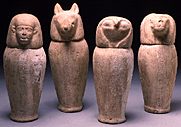
Canopic Jars
Egyptians had an elaborate and complex belief in the afterlife.
Life was dominated by Ma'at, or the concept of justice and order. Egyptians believed there were different levels of goodness and evil. Egyptians believed that part of the personality, called the Ka, remained in the tomb. Thus elaborate and complex burial practices developed.
The removed internal organs were separately treated and, during much of Egyptian history, placed in jars of clay or stone. These so-called Canopic Jars were closed with stoppers fashioned in the shape of four heads -- human, baboon, falcon, and jackal -- representing the four protective spirits called the Four Sons of Horus.
Canopic Jars
The heart was removed to be weighed against a feather representing Ma'at to determine moral righteousness. The brain was sucked out of the cranial cavity and thrown away because the Egyptian's thought it was useless. Personal belongings were usually placed in the tomb to make the Ka more at home and to assist the dead in their journey into the afterlife.
Text was read from the "Book of the Dead" and the ritual of "opening the mouth" was performed before the tomb was sealed.
THE EGYPTIAN BOOK OF THE DEAD: 1240 BC
THE PAPYRUS OF ANI
Translated by E.A. Wallis Budge
After judgement, the dead either went to a life not unlike that on earth or were cast to the "Eater of the dead" (Seth).
In addition to the decorations on the tomb walls, in some periods, models for the use of the spirit were included in the funerary arrangements. A model boat was transportation on the waters of eternity. Likewise, models of granaries, butcher shops, and kitchens would guarantee the continued well-being of the deceased in the life after death.
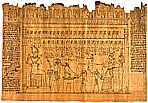
Papyrus with Funeral Arrangements

EGYPTIAN FUNERARY ARCHAEOLOGY


ANCIENT EGYPT INDEX

ANCIENT AND LOST CIVILIZATIONS

ALPHABETICAL INDEX  OF ALL FILES

CRYSTALINKS MAIN PAGE
