Labyrinth Exercise
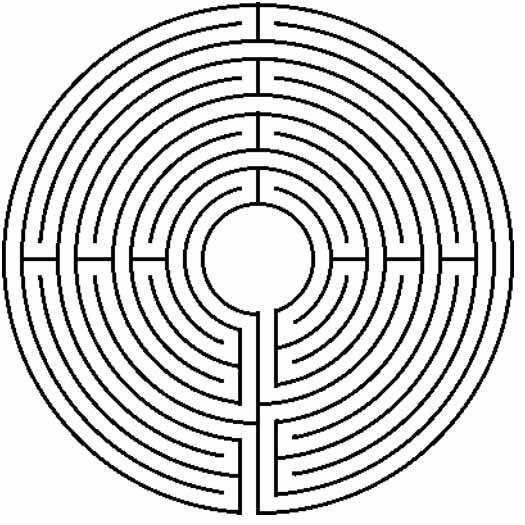
The image above is a finger labyrinth. You can "walk" it on screen with your finger or mouse. Tracing the path in the labyrinth can be relaxing. It also can be balancing as you journey back and forth to the center. Repeat several times in succession to get the most benefit. Try it with your non-dominant hand for more of a challenge. It can help you to give up control and.or break out of your routine response patterns.
Maintain a relaxed pace and allow adequate time for meditation/relaxation while at the center. (MP3 file - 7 minutes).
Each movement entering and departing should be controlled, focused, and done in silence. Allow your other senses (sight, hearing, smell, touch) to be heightened throughout each stage of the exercise. At the conclusion of the walk of the labyrinth, you should experience a sense of being centered, having a strong chi flow, and consciously aware of a clear and relaxed mental state.
The entrance can be a place to stop, reflect, make prayer or intention for the spiritual walk you are about to take. The walk around the design to the center can be a "letting go" - a quieting of the thoughts, worries, lists of tasks to do, a letting go unto the experience of being present in the body.
Arrival at the center rosette - a place of prayer/meditation - "letting in" Gods guidance, the divine into our lives. When ready, the walk out "letting out" takes us back into our lives, empowered by spirit to transform our lives and actions.
In many ways, the journey through the labyrinth can be a transformation tool for people. It can aid healing, help in releasing grief, (people often shed tears during the "letting go"), help guide through troubled times, aid in decision making, illuminate our purpose in life, and act as a tool of celebration and thanks. It is important to recognize it as a spiritual practice, not a magical tool. Its work is our commitment to enter into the sacred spiritual walk, not merely once, but to use it as part of an ongoing spiritual practice.
Labyrinth walkers follow the labyrinth path from a specified beginning to a well-defined central area and back through the same path to the exit. They might pray, reflect on life, consider a particular problem, let the mind wander, or seek spiritual guidance and unity as they move along the curving trail. Their aim is not to reach the finish, but to become immersed in all aspects of the walk, and potentially to experience some degree of personal transformation. Lap or finger labyrinths are generally used for the same purposes. The person can sit down with the portable labyrinth in front of him or her. The eyes may be open or closed as the grooved path is followed with the finger.

ALPHABETICAL INDEX OF ALL FILES