History
Jerusalem, by virtue of the number and diversity of people who have held it sacred, may be considered the most holy city in the world. To the Jewish people it is the Biblical Zion, the City of David, the site of Solomon's Temple and the eternal capital of the Israelite nation.
To Christians it is where the young Jesus impressed the sages at the Jewish Temple, where he spent the last days of his ministry and where the Last Supper, the Crucifixion and the Resurrection took place. Also greatly venerated by the Moslems, it is where the prophet Mohammed ascended to heaven. While highly charged with intense religious devotion and visited by countless pilgrims and sages, Jerusalem has also been ravaged by thirty centuries of warfare and strife. It is a place of beauty and divinity, mystery and paradox; a sacred site which no modern spiritual seeker should fail to experience.
The earliest traces of human settlement in the Jerusalem area are from the late Chalcolithic and Early Bronze Age (3000 BC). Excavations have shown that a town existed on the south side of Mount Moriah, also called Temple Mount.
The name of this town was Urusalim, a word probably of Semitic origin that apparently means 'Foundation of Shalem' or 'Foundation of God'. On the frontier of Benjamin and Judah, the town was inhabited by a mixed population known as Jebusites.
About 1000 BC, Urusalim was captured by David, founder of the joint kingdom of Israel and Judah, and became the Jewish kingdom's capital. In the earlier wandering years of the Israelites, their most sacred object, the Ark of the Covenant, was periodically moved about among several sanctuaries, but following David's capture of Urusalim, the Ark was moved to that city around 955 BC. The Ark was a portable shrine containing the two stone Tablets of the Law which the prophet Moses had received upon Mt. Sinai. David renamed his city Jerusalem, meaning 'City of Peace' in Hebrew, and chose Mt. Moriah as the site of his future temple.
Mt. Moriah was already considered highly sacred for two reasons. An ancient Semitic tradition stated that the bare rock atop the mount was held in the mouth of the serpent Tahum, and that this place was the intersection of the underworld and the upperworld. It was also considered to be the site where Abraham had built an altar on which he prepared to sacrifice his son Isaac.
The First Temple of the Jews was constructed during the reign of David's son, King Solomon, and completed in 957 BC. Soon thereafter, Nebuchadrezzar II of Babylon forced the Jews into exile, removed their temple treasures in 604 BC and 597 BC and completely destroyed the temple in 586 BC. In 539 BC, Cyrus of Persia conquered Babylon and allowed the Jews to return to Jerusalem. Reconstruction began and the Second Temple was completed by 515 BC. This temple however, did not enshrine the Ark of the Covenant as that sacred object had disappeared sometime before the plundering of Nebuchadrezzar.
(The date of the Arc's disappearance and its subsequent whereabouts - long a mystery to archaeologists, historians and biblical scholars - have recently been discovered by the British researcher Graham Hancock. In his richly detailed book, The Sign and the Seal, Hancock presents compelling evidence that the Arc was removed by Jewish priests from Solomon's temple during the rule of the apostate King Manasseh (687-642 BC). The Arc was then hidden for two hundred years in a Jewish temple on the Egyptian sacred island of Elephantine in the Nile. Next it was taken to Ethiopia, to the island of Tana Kirkos in Lake Tana, where it remained for over 800 years until being brought to the city of Axum, capital of the Axumite Jewish kingdom. When that kingdom was converted to Christianity sometime around 330 AD, the Arc of the Covenant was placed in a church of St.Mary of Zion where it remains to this day.)
Over the next five centuries Jerusalem was captured by Alexander the Great, controlled by Hellenistic, Egyptian, and Seleucid empires as well as experiencing occasional and all too short periods of Jewish freedom. In 64 BC, the Roman general Pompey captured Jerusalem, ushering in several centuries of Roman rule. During this period Herod the Great (ruled 37-4 BC) rebuilt and enlarged the Second Temple and created the famous Western Wall (also called the Wailing Wall) as part of the supporting structure for the enlarged Temple Mount. In 6AD the Romans turned the governance of Jerusalem over to a series of administrators known as procurators, the fifth of whom, Pontius Pilate, ordered the execution of Jesus. During the next two centuries the Jews twice revolted against their Roman oppressors, the city of Jerusalem suffered greatly and the Second Temple was demolished in 70 AD. In the year 135 AD, the Roman Emperor Hadrain began construction of a new city, called Aelia Capitolina, upon the ruins of old Jerusalem. Upon the site of the destroyed Jewish temple, Hadrian built a temple to the god Jupiter, but this temple was itself demolished by the Byzantines after the empire became Christian.
The conversion to Christianity of the Byzantine Emperor Constantine (306-337) and the pilgrimage of his mother, Empress Helena to Jerusalem in 326 inaugurated one of the city's most peaceful and prosperous epochs. According to Christian legends, Empress Helena discovered the relics of the 'True Cross of the Crucifixion' at the place of the Resurrection upon Mt. Calvary. Scholars however, believe this so-called 'finding' of the relics to be a story fabricated for political reasons by Constantine and his mother, and that the cross relics were most probably manufactured, as were so many other relics during early and medieval Christian times.
Whatever the case, Helena's pilgrimage and Constantine's royal support made possible the building of many Christian shrines in the city. Foremost among these was

which marked the site of the Resurrection and soon became the supremely sacred place in all of Christendom. Finished in 335 AD., the great basilica was apparently built upon the foundations of an earlier Roman shrine dedicated to the goddess Aphrodite.
It was during this splendid era that the tradition of Christian pilgrimages to Jerusalem began. The most visited pilgrimage sites were Bethlehem, were Jesus was born; Golgatha, the site of his death; the Church of the Holy Sepulchre; and the Mount of Olives, where he ascended into heaven. The Christian glorification of Jerusalem was carried on until 614 AD when the Persians invaded the city, massacred the inhabitants and destroyed all the churches and monasteries.
Following a brief period of Persian rule, Jerusalem was captured in 638, six years after the death of Mohammed, by the Muslim Caliph Umar I. Soon after his occupation of the city, Umar cleansed the Temple Mount, known in Arabic as Haram al Sharif, built a small mosque and dedicated the site to Moslem worship.
The most imposing structure the Moslems found in Jerusalem was the Church of the Holy Sepulchre, and the Arab conquerors undertook to build a more spectacular edifice, not only to proclaim the supremacy of Islam, but also to ensure that the followers of Islam would not be tempted by Christianity.
The site chosen was the very same rock where previously had stood the Jupiter temple of the Romans and before that, the two temples of the Jews. But there was another reason, and one more fundamental to the Moslems than the mere political expediency of usurping another religions sacred site. A certain passage in the Koran was interpreted by the faithful as linking the prophet Mohammed with Jerusalem and the Temple Mount. That passage, the seventeenth Sura, entitled 'The Night Journey', relates that in a dream or a vision Mohammed was carried by night 'from the sacred temple to the temple that is most remote, whose precinct we have blessed, that we might show him our signs...' Moslem belief identifies the two temples mentioned in this verse as being in Mecca and Jerusalem.
According to tradition, Mohammed's mystic night journey was in the company of the Archangel Gabriel, and they rode on a winged steed called El Burak, meaning lightning, which had the face of a woman and the tail of a peacock. Stopping briefly at Mt. Sinai and Bethlehem, they finally alighted at Temple Mount in Jerusalem, and there encountered Abraham, Moses, Jesus and other prophets, whom Mohammed led in prayers. Gabriel then led Mohammed to the pinnacle of the rock, which the Arabs call as-Sakhra, where a ladder of golden light materialized. On this glittering shaft, Mohammed ascended through the seven heavens into the presence of Allah, from whom he received instructions for himself and his followers. Following his divine meeting, Mohammed was flown back to Mecca by Gabriel and the winged horse, arriving there before dawn.
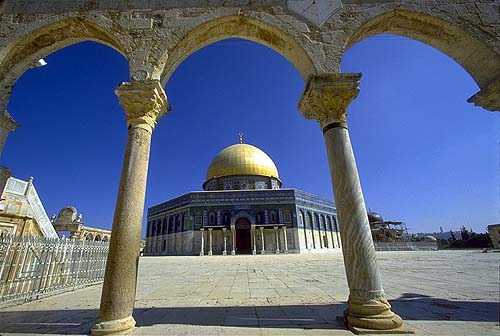
At this hallowed site, Omar's successor, the 10th Caliph, 'Abd al-Malik ibn Marwan, built the great Dome of the Rock between 687 and 691. Often incorrectly referred to as the Mosque of Omar, the Dome, known in Arabic as Qubbat As-Sakhrah, is not a mosque for public worship but rather a mashhad, a shrine for pilgrims (adjacent to the Dome is the Al-Aqsa Mosque wherein Moslem make their prayers).
Designed by Byzantine architects engaged by the Caliph, the Dome of the Rock was the greatest monumental building in early Islamic history and remains today one of the most sublime examples of artistic genius that humanity has ever produced. The dome is 20 meters high, 10 meters in diameter, and its lead supporting structure was originally covered in pure gold (the real gold was removed over the centuries and the dome is now made of anodized aluminum). Writing of the sublimely beautiful structure with its heavenly dome, its columns of rare marble and its brilliant mosaics, the British authority on Moslem architecture, K.A.C. Creswell, exclaimed:
Under a scheme whereby the size of every part is related to every other part in some definite proportion....the building instead of being a collection of odd notes becomes a harmonious chord in stones, a sort of living crystal; and after all it really is not strange that harmonies of this sort should appeal to us through our sight, just as chords in music appeal to our hearing. Some of the ratios involved are fundamental in time and space, they go right down to the very basis of our nature, and of the physical universe in which we live and move.
The holy rock of Sakhrah in Jerusalem was for a few years the primary sacred site of Islam. When Mohammed had fled to Medina he thought for a time of abandoning Mecca altogether. At that stage he told his followers to make Jerusalem the kiblah (the direction to be faced during prayers) as was the Jewish tradition. Following a quarrel with the Jews in Medina (the second sacred city of Islam), Mohammed insisted on changing the kiblah from Jerusalem to Mecca, where it has since remained.
The Moslems in power before and during the Dome's construction period had tolerated Christianity and Judaism, allowing pilgrims of both religions to visit the Holy City. This era of coexistence ended in 969 however, when control of the city passed to the Fatimid caliphs of Egypt who systematically destroyed all synagogues and churches. In 1071 the Seljuk Turks defeated the Byzantines, displaced the Egyptians as masters of the Holy Land, and closed the long established pilgrimage routes.
The prohibition of Christian pilgrimage by these less tolerant Moslem rulers enraged Western Europe and prompted the Crusades, a series of invasions that culminated in the capture of Jerusalem in 1099.
The Christian Kingdom lasted almost 90 years, during which time the Dome of the Rock was converted to a Christian shrine and named Templum Domini (meaning Temple of the Lord), the Church of the Holy Sepulchre was rebuilt, and hospices and monasteries were founded.
The city was recaptured by the Muslims again in 1187, was ruled by the Mamlukes from the 13th to 15th centuries (except for the brief periods of Christian control in 1229-1239 and 1240-1244) and the Turks until the 19th century. The Jews, who had been barred by the Christian crusaders, returned from the 13th century onward, by the middle of the 19th century half the city's population was Jewish, and in 1980 Jerusalem was officially made the capital of Israel.
The entire area of the Old City of Jerusalem has been charged since antiquity with the powerful energies of holiness, devotion and spiritual love. Over more than three millennia the control of the city's primary sacred places has shifted frequently between the religions of Judaism, Christianity and Islam. It must be understood however, that the energy or presence of the sacred is not monopolized by any of these faiths but rather gives rise to each of them. And this sacred presence, besides knowing no limitations of dogma, philosophy or politics, has the wonderful quality of accumulating, or increasing in intensity, over time.
The holy rock of Mt. Moriah was first a Jebusite place of worship, then the site of the Jewish Temples, next the sanctuary of the Roman god Jupiter, later capped by the Moslem's Dome of the Rock, next taken over by the Christians, and still later a Moslem shrine again.
This same continuity of sacred use also occurred at the site of the Church of the Holy Sepulchre which, prior to its Christian utilization, was the location of a temple of Aphrodite. We may thus speak about these two sites, and the many other pilgrimage destinations in Jerusalem, as containers of the accumulated spirit of holiness. That spiritual energy has been enriched over thirty centuries, like fine wine in a wooden cask, and it radiates today throughout the city of Old Jerusalem with a magnificent power.
Besides the sites discussed above, the following places are also much visited by pilgrims in the Holy City. For the Jews, the most venerable locations are Mt Zion, the traditional site of King David's tomb, and the Western Wall, where stands the only remaining part of the original temple of King Solomon. Devout Christian pilgrims will visit the fourteen stations of the Via Dolorosa, or 'Way of Sorrows'. Walking this route, the holiest Christian thoroughfare in the world, the pilgrim symbolically relives the events of Jesus' passion.
Additionally, there are the shrine of the Ascension on the summit of the Mount of Olives, the garden of Gethsemane, and Mt. Zion, the site of the Last Supper. In the Dome of the Rock, beneath the ancient sacred stone, is a cave-like crypt known to the Muslims as Bir el- Arweh, the Well of Souls. Here, according to the faithful, the voices of the dead may sometimes be heard along with the sounds of the rivers of paradise. - From Martin Gray
MEDITATION IN THE TEMPLE Please study this image . . . Find a quiet place . . . free of distractions. . . Adjust the lighting and room temperature. . . Adjust clothing . . . footwear . . . eyeglasses. Sit down or lie down . . . Find a position that is comfortable for you . . . Quiet your mind . . . Still your thoughts . . . Relax your body. . . Your face . . . your jaw . . . relaxing . . . Your shoulders . . . your neck . . . relaxed Your arms . . . your hands . . . feel at peace . . . Your torso . . . your hips . . . letting go . . . Your legs . . . your feet . . . totally relaxed . . . Focus on your breathing . . . Inhale slowly and deeply through your nose . . . Retain the breath as long as is comfortable . . . Exhale through the mouth slowly and completely . . . Repeat for two more breaths . . . or as is comfortable. Close your eyes. See yourself standing within the Temple. You walk to the center and look around. You notice the walls . . . the floors . . . you feel the energies in the room. Suddenly you begin to spiral within the Temple . . . slowly moving backwards in time. You find yourself in the timeline of the original Temple Mount. You look around . . . History is being made as you watch events of that timeline . . . You see the Ark of the Covenant.
It is being taken somewhere. You watch carefully . . . to see where it has been placed. If you are able . . . move to that place in our timelime to see if the Ark is still there. If you can find it . . . its energies of light belong to you. Connect with this creational force . . . and see what happens.
JERUSALEM ALPHABETICAL INDEX OF ALL FILES