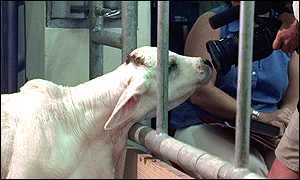
Sept. 3, 1999 - BBC Online
A calf has been cloned from a 21-year-old celebrity bull, the oldest animal yet reproduced using this technology.
Chance, a Brahman bull, died earlier this year, but scientists at Texas A&M University, US, have created a clone using skin cells taken shortly before he died. The floppy-eared calf is called Second Chance.
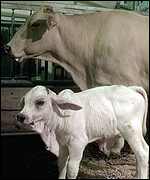
The feat could indicate that cloning can be done using cells of any age and could have important implications for livestock breeding. However, it took 189 attempts at transferring Chance's DNA into eggs to produce Second Chance.
"What is the limit?" asked researcher Mark Westhusin. "Do the cells reach a certain age where you can't clone them anymore or does that ever happen?"
Old age bull
Professor Westhusin said Chance was chronologically equivalent to an 88-year-old human when he died of old age. He was owned by Ralph and Sandra Fisher of La Grange, Texas who used him in their photography and television business, allowing people to be pictured riding bulls.
On seeing Second Chance, Mr Fisher said: "The hair stood up on the back of my neck - he has the same markings as Chance."
Another team member, Jonathan Hill said: "The Fishers wanted to have their prized bull cloned because of his unusually gentle nature, and they considered the cloning effort a good opportunity to see if an identical copy of Chance might also have such an easy going disposition."
Chance was unable to reproduce naturally because of the removal of both diseased testicles two years ago.
Old timer
Second Chance, born three weeks ago, will stay at Texas A&M until he is weaned in another six months and then go join the Fishers' photography business. However, scientists will continue to keep a close watch for any signs of premature ageing.
Last spring, scientists revealed that the DNA of Dolly, the first cloned sheep, had some characteristics of the older cells that were used to generate her.
"The chromosomes, which package the animal's DNA, have some special DNA at their tips called telomeres," Dr Hill explained. "These small pieces of DNA help to protect chromosomes from damage. "Very young animals have long telomeres, but as the animal ages, the telomeres are worn away. We should know in a month or so if the telomeres of Second Chance are like those of the 21-year-old bull used as the source of the cells for the cloning process, or if they are more like those of a normal new-born calf."
Second Chance, like previously cloned calves, displayed some early symptoms similar to those seen in premature human babies. However, Second Chance is now in good health, Dr Hill said.
Dog clone
Professor Westhusin also leads the Missyplicity Project which is attempting to produce the first cloned dog. The anonymous sponsors of the project have invested $2.3 million to produce a clone of their pet dog, Missy, a mixed-breed border collie.
The cloning of Second Chance was funded by the Texas Co-ordinating Board of Higher Education's Advanced Research Program and by Ultimate Genetics in Franklin, Texas.

June 22, 1999 - BBC Online
Giant pandas are notoriously reluctant to reproduce
Chinese scientists say they have successfully cloned an embryo of a giant panda, and are hoping that it will now develop to maturity.
They are hailing it as a possible breakthrough in their efforts to save one of the world's most endangered species.
Only about 1,000 pandas live in the wild, with another 100 in zoos. They are notoriously reluctant to reproduce, and experts have warned that the animal could be extinct within 25 years. The state-run Xinhua news agency said researchers from the Chinese Academy of Sciences introduced cells from a dead female panda into the egg cells of a white rabbit.
The embryo was nurtured over 10 months and scientists are now trying to implant it in a host animal's uterus.
Dolly-inspired programme
For many years the Chinese authorities have been seeking ways of saving the species, but pandas produced through artificial insemination have often died young.
The successful cloning of Dolly the sheep in Britain in 1996, using cells from an adult animal, prompted China's Academy of Sciences to launch an official project to clone a giant panda.
The man in charge of the project, Professor Chen Dayuan, told the BBC at the time that he was hopeful of success within three to five years.
The Xinhua news agency quotes Prof. Chen as saying his team now believed they would not need so long.
Human embryos
Last Thursday, further details were announced in the US of the first cloned human embryos.
The intention behind the work, say researchers at Advanced Cell Technology, is not to make identical people but to create embryonic stem cells.
These cells have the potential to become any tissue in the body and scientists believe they will eventually lead to powerful new treatments for a host of medical conditions, including diabetes and Parkinson's Disease.
June 17, 1999 - Agence France-Press - Lomdon
American scientists have cloned the first human embryos, the London Daily Mail reported on Thursday.
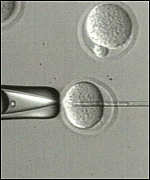
Using methods similar to those which produce Dolly the cloned sheep at Edinburgh's Roslin Institute, they produced a male embryo comprising nearly 400 cells, according to the British tabloid.
The scientists at the Massachusetts-based Advanced Cell Technology then incinerated it after two days.
They want to produce human body tissue which can be used to treat patients with various conditions, including nerve damage, diabetes and Parkinson's disease.
A DNA-loaded nucleus of a human cell was extracted from a skin sample from a man's leg and then inserted into the outer protein of a hollowed out cow's egg under laboratory conditions, said the Mail. The egg was then placed in a laboratory dish and soaked in a chemical solution which fooled it into thinking it was a newly conceived embryo. The cells then began to develop into an embryo, according to the Daily Mail.
Since the first embryo was cloned last November, the company is thought to have made many more, incinerating them all, in line with U.S. research lines, before they reached the age of 14 days, said the newspaper.
May 31, 1999 - AP - Wash.
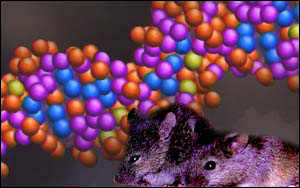
The small club of clones, restricted until now to females like Dolly the sheep and Cumulina the mouse, has gone co-ed with the cloning of a male mouse, researchers said on Monday.
"Fibro" is also the first documented, live mammal cloned from adult cells that do not originate in the reproductive system, which suggests that adult animals can be cloned from any cell in the body at all.
Ryuzo Yanagimachi and Teruhiko Wakayama at the University of Hawaii say the technique is still tricky -- they only got one living mouse out of 274 tries -- but Fibro seems healthy and normal.
"He fathered two perfectly normal litters as of Monday (Thursday)," Yanagimachi said in an interview conducted by e-mail. "He is active and healthy."
Male animals have been cloned before, but only using fetal cells, which are much easier to clone because of their early stage of development.
A Japanese agricultural research institute also said it cloned a calf from the ear of an adult, but the research was not published in a peer-reviewed scientific journal -- the standard for science.
It is much harder to clone animals from adult cells -- Dolly, some Japanese heifers and Cumulina, the cloned mouse presented to the world by Yanagimachi and Wakayama last year, are rare examples.
They were made using cells related to reproduction -- Dolly from the mammary gland cell of a ewe and Cumulina from so-called cumulus cells, which nurture developing eggs inside the ovaries.
So many scientists had believed that there might be something unique about females, or perhaps even female reproductive cells, that made them amenable to cloning.
Wakayama and Yanagimachi, writing in the journal Nature Genetics, said it is now clear this is not the case. "Our results demonstrate that cloning using adult somatic cells is not restricted to female or reproductive cells," they wrote.
Using their "Honolulu technique", which differs slightly from the method that scientists in Scotland used to make Dolly, they created 274 mouse embryos using skin clipped from the tail of a male mouse and implanted them into surrogate mother mice.
"Only three of 274 transferred embryos reached full term," they wrote. "Three mice from tail-tip cells were born alive, all of them males with black eyes." Two died but one lived to adulthood and was the same reddish-brown color as the mouse whose tail was clipped.
The experiment means it might be possible to store an animal's complete genome, its collection of genes, using a tail snip or other cell instead of having to freeze an embryo, the researchers said. "Moreover, precious animals of either sex, for example endangered species and transgenic animals, can be propagated by cloning irrespective of their fertility status."
Much of the cloning research going on is part of commercial and scientific programs to create genetically engineered, or transgenic, animals. Mice are bred to carry human genes, for example, so that drugs can be tested on them.
PPL Therapeutics, the commercial arm of the Scottish laboratory where Dolly was made, breed animals that produce human proteins in their blood or milk and has teamed up with Geron to try to breed transgenic pigs whose organs contain human proteins for use in transplants.
Genetic engineering is hit-and-miss but researchers say they can create an animal that carries and expresses the genes just the way they want, and then clone it to get exact copies.
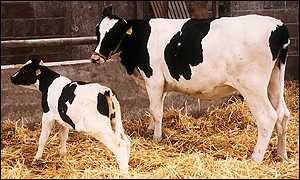
This cloned calf died just seven weeks after birth
By Helen Briggs of BBC Science - May 1999
Animal cloning is being hailed as one of the century's great scientific breakthroughs. Doctors hope that it will revolutionise medicine, providing an endless supply of organs for transplant and a cure for major killers like heart disease.
But as scientists learn more about the techniques used to manipulate genes and cells, it is becoming clear that cloning may have serious health risks for both the cloned animal and the surrogate mother that is used to bring it into the world.
Many of the clones have developmental abnormalities and die late in pregnancy or soon after being born. For those that do survive the early stages of life, many of them may be at higher risk of premature ageing and cancer.
Dolly the Sheep, the world's first mammal cloned from an adult cell, appears perfectly normal. But Dr Harry Griffin, from the Roslin Institute, knows there is still much to learn about the technology that created her.
"In our experiments, we produced 20 live lambs of which six have died soon after birth and a high rate of neonatal death is common in all the experiments to clone both sheep and calves.
"The reason? In cloning from an adult animal you're trying to re-programme a specialised cell, trying to persuade it to start off its life all over again, become a whole animal - it's surprising it works at all."
Dolly was cloned from genetic material taken from the udder of an adult sheep. Adult cells, like those in the udder, have become specialised to perform a particular role in the body - in this case milk production. Once cells become adapted to a specific task, they tend to be set in their ways, unlike embryonic cells.
Dr Wolf Reik from the Babraham Institute in eastern England says the secret of cloning is persuading an adult cell to return to its childhood. "Imagine that you take a cell from a breast cell, in the case of Dolly that was the case," he says. "Then all the genes that are active to make that a mammary cell, a breast cell, need to be switched off when this nucleus goes back into the egg recipient. Then all the genes that are required for normal development need to be switched on again as development proceeds. That is a very, very complex process."
James Robl from the University of Massachusetts has been looking at a problem that affects cloned calves. The off-spring can become large with an accumulation of fluid in the placenta. "We know that as you manipulate embryos that the percentage of the calves that have the defect goes up," he says. "If we produce an embryo in culture, the rate of the defect goes up to maybe 15%, compared to 1% in the normal population. If we actually produce the embryos through cloning, the rate of the defect goes up to about 50%." It is likely to be years before cloning can be made safer. And, although the cloning of humans is still in the realms of science fiction, most agree that the potential health risks of cloning must be taken into account in debates on human cloning.
In the publically-funded labs in the US, and throughout Australia, China, Israel, and most European countries, scientists are prevented by law from carrying out research into human cloning. And many experts agree that although in theory human cloning might be possible, morally it is unacceptable. "I think there is a general awareness now that this technology is risky, that it would be wholly unsafe to use in humans," says Dr Griffin. "It would be fundamentally wrong to use the technique in young women and I think that there is now more sanity coming into the debate about human cloning. "We remain firmly opposed to the copying of individuals, the so-called reproductive cloning."
If scientists really can crack the problems associated with cloning, the potential benefits to humankind are immense. Already animals have been engineered to produce human proteins, such as clotting factors, in their milk. And cloned animals may one day provide organ banks for transplant, tailored to a patient's specific tissue type.
The fact that Dolly, like a host of other cloned animals, is alive and well shows the technology works. But understanding how cloning works and making it safer will be the challenge of the future.
BBC Online - May 14, 1999
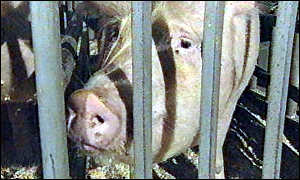
The world's first cloned pig should be born within months, say scientists in Scotland. Researchers at Geron Bio-Med believe the piglet will arrive by early 2000 at the latest. They hope eventually to modify the technology to make other pig clones whose organs can be transplanted into humans. There are many more patients needing a transplant than there are donor organs available.
Scientists believe pigs could fill this tissue gap, provided the problems of rejection can be overcome and the dangers of transferring animal viruses to humans are eliminated.
Geron Bio-Med thinks its cloning technology is the key to producing animal tissue that is safe to use in humans.
Deactivating genes
"What you want to be able to do for xenotransplantation - for production of organs - is to remove or deactivate genes that cause immunological problems," said Simon Best, the company's Managing Director. "Cloning is the first technology that allows you to take away genes as opposed to adding them."
The genes that code for chemicals which trigger rejection in humans would need to be knocked out. And, crucially, the genes that code for pig retroviruses would also have to be removed.
However, the company, a commercial off-shoot of the Roslin Institute which produced Dolly the Sheep, says it still has some way to go before it perfects the basic cloning technology that will allow it to make a living copy of a pig.
Although the cloning research has got as far as producing embryos, none of these have survived to term in their surrogate mothers. Pigs give birth in litters of four or more and it seems the normal embryos will not accept an implanted clone.
Human stem cells
But chief scientific officer Professor Ian Wilmut, who helped to develop the cloning technology known as nuclear transfer, is hopeful of seeing cloned piglets "later this year or early in the new millennium".
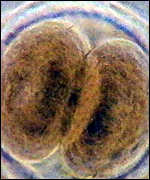
He said: "We've recently got to the stage where we can produce embryos by nuclear transfer for the first time. "We are transferring them into recipients in order to monitor their development for the first week, but it is clear we have a lot more research still to carry out."
Geron Bio-Med is a joint venture between the scientists who cloned Dolly the Sheep and the big American biotech company Geron,which has done pioneering work in the field of stem cell technology.
Stem cells are the "master" cells for all the tissues in the body. If scientists can control the way these cells develop, they could, theoretically, grow any type of tissue they desired in the lab. And combined with cloning, it would then be possible to create perfect-match tissue to treat people with diseases such as leukaemia. "What we have to do is to be able to take a skin cell from a sufferer of such a disease and re-programme it so that it becomes bone marrow cells - so you can use it for your own transplant," said Best.
Toronto - CP - April 28, 1999
Montreal scientists have cloned triplet goats in what is believed to be a world first. The goats -- Danny, Clint and Arnold -- are a month old and living on a farm west of Montreal run by Nexia Biotechnologies Inc., the company announced today. The goats were produced using nuclear transfer, a technique similar to the one used to produce Dolly the sheep, the first cloned animal. Dolly, born in early 1997 in Scotland, originated from a cell extracted from an adult sheep, making her a replica of a sheep six years older. Work to produce the identical goats started eight months ago, said Jeffrey Turner, Nexia's president and a former genetics professor at McGill University.
The goats originated from cells transferred from the body of one goat into another goat's mature fertilized eggs. The eggs had their original nuclei, or DNA, removed and replaced by DNA derived from cells grown in the laboratory. The research involving the goats will be used to develop man-made spider silk for medical uses, said Turner. After tracking the health of the goats for a few months, scientists plan to use the cloning process again. Next time, they will inject the silk gene from spiders into the cells that will produce new cloned goats, said Turner.
July 22, 1998
In what could be a big boost for all sorts of biomedical research, scientists in Hawaii have turned out more than 50 carbon-copy mice using what is believed to be a more reliable cloning technique than the one used to create Dolly the sheep. The scientific potential could be broad because mice are the best-understood and most commonly used animals in biomedical experiments. Having genetically identical copies of the same animal could speed research in fundamental biology and virtually every branch of medicine and drug development.
The University of Hawaii scientists, reporting in Thursday's issue of the journal Nature, describe their work as "the first reproducible cloning of a mammal from adult cells" extending at least three generations. They said it is a marked improvement over the method used to make Dolly, which other laboratories so far have failed to duplicate.
Biologists in the United States and Europe hailed the mice-cloning effort as having much greater potential than the cloning of more complex creatures such as Dolly or a pair of calves that were born earlier this month in Japan.
Researchers said that with the Hawaii cloning method, cattle and pigs could be reprogrammed with human genes to mass-produce proteins essential to treat illnesses such as diabetes and Parkinson's disease. Animals could custom-grow organs for transplantation. And because mice give birth three times a year, experiments employing identical rodents could progress more rapidly than those relying on slower-reproducing barnyard animals. The Hawaii scientists would not discuss whether their technique might make human cloning more feasible.
Researchers introduced four of the cloned mice -- all females -- Wednesday in New York. The original clone was named Cumulina after the type of cell used in its creation; she remained in Hawaii. Working in a windowless lab for 16 hours a day, the Hawaii group used an injection method dubbed the "Honolulu technique" to transfer genetic material from adult mice to an empty egg. In each of four experiments beginning in 1997, the team transferred up to 800 eggs containing adult genes into surrogate mice mothers.
Three survivors from the original group, including Cumulina, grew to adulthood. Those clones eventually yielded cells that by this week had generated more than 50 offspring. DNA testing by an independent laboratoryconfirmed that none of the rodents are carrying stray DNA from other mice.
The Hawaii group's emphasis on repeating the clones is an indirect rebuke of geneticist Ian Wilmut and his colleagues in Scotland who created Dolly in one out of 277 attempts in the lab. Repeating an experiment to verify a discovery is central to scientific research. But at least three other laboratories have failed to duplicate the sheep experiment using Wilmut's method over the past 18 months, prompting scientists to question whether Dolly is truly a clone.
In Thursday's issue of Nature, Wilmut and 17 other researchers in Britain reported that an exhaustive examination of Dolly's genes show that it is "extraordinarily unlikely" that the sheep is anything but a clone. Dolly was created by a technique known as electrofusion, in which the membrane of an egg was breached, the chromosomes were removed and the nucleus of an adult sheep cell with different genetic material was merged inside.
In the Honolulu technique, the nucleus of a cell from one mouse was injected through a tiny needle into an egg donated by a second mouse. The egg's original genetic package was removed. The donor nucleus came from cumulus cells, which surround the developing eggs in the ovaries of female mice. Up to 3 percent of the manipulated eggs developed into surviving clones, a much higher success rate than the electrofusion method had.
 CLONING


 BIOLOGY INDEX

 ALPHABETICAL INDEX OF ALL FILES

 PHYSICAL SCIENCES INDEX

 CRYSTALINKS MAIN PAGE