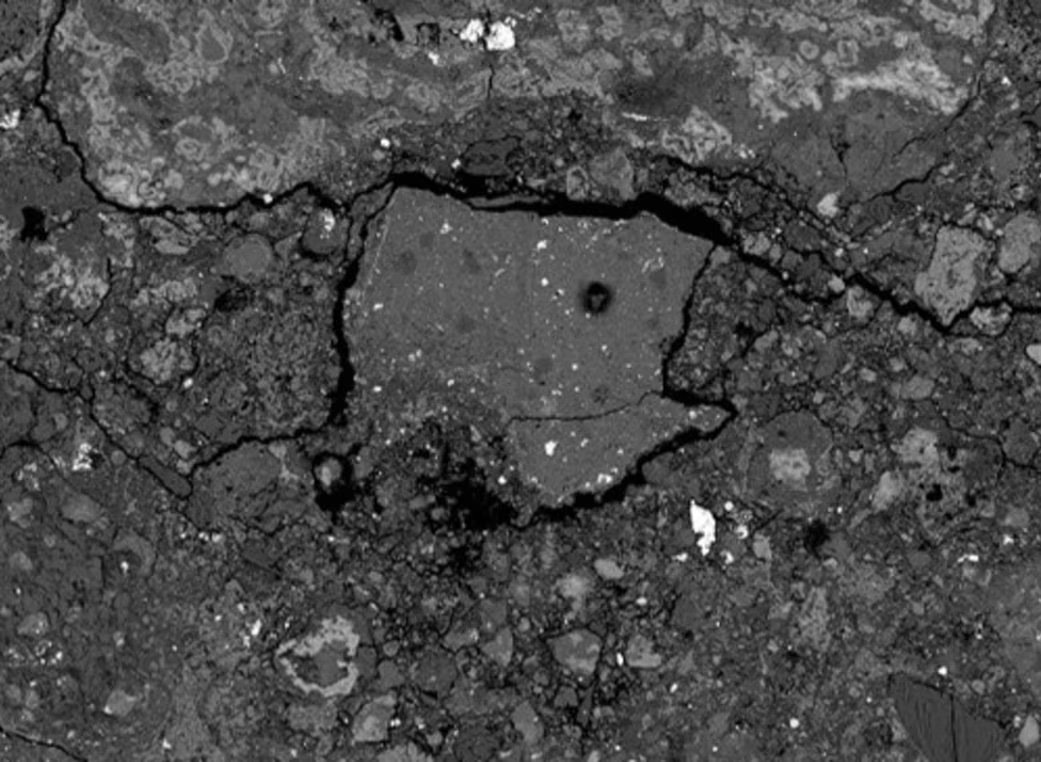
Meteorite that crashed into a New Jersey home contains extraterrestrial amino acids CNN - July 16, 2026
Alien world chemistry found inside meteorite that struck New Jersey home PhysOrg - July 16, 2026
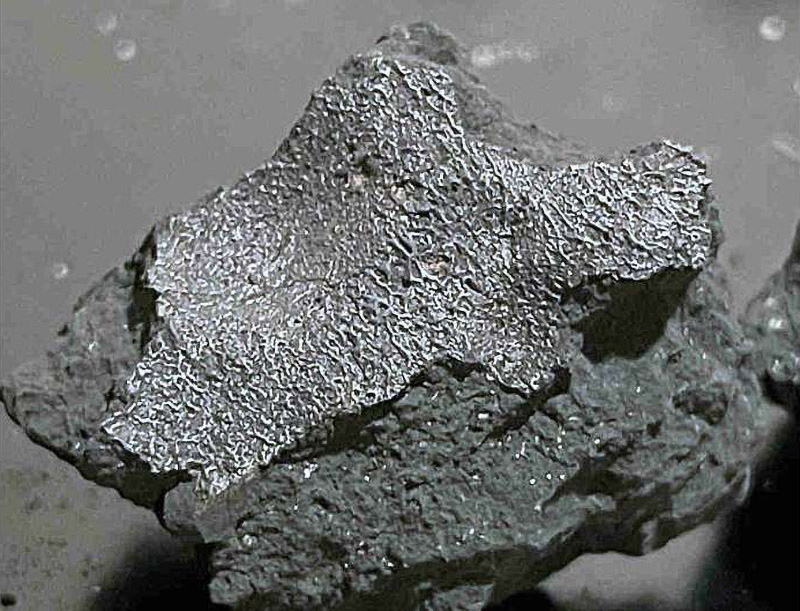
On July 16, 2024, a daytime meteor shook New York City with a sonic boom as it passed just south of the Statue of Liberty. Now, an international team of researchers reports in the journal Science Advances that a short time later, a meteorite weighing more than 2 pounds crashed through the roof of a house in the town of Hillsborough, New Jersey.
A forensic study of the fragments revealed that they contained preserved bits from near the surface of a primitive asteroid, where it experienced concentrated salty fluids - a process not previously known from this type of protoplanet world. The rock, the size of a heavy airline bag entered Earth's atmosphere at a speed of 32,000 miles/h (14.4 kilometers per second). Sixty observers from New York, New Jersey, Connecticut, Rhode Island and Pennsylvania reported seeing the meteor to the American Meteor Society, while 16 in New York and New Jersey felt the shock wave.
They are working to identify the salt minerals for comparison with similar phases found among samples returned to Earth from asteroids Ryugu and Bennu. The high concentration of salt in briny fluids can potentially create molecules crucial to life on Earth. Brines allow phosphate to remain in solution and can catalyze chemical reactions between organics and precipitate minerals.
First-Ever Close-Up Revealed of Earth's Rare 'Minimoon' Science Alert - July 7, 2026
It's known as Asteroid 2016HO3, or Kamo'oalewa
Evidence of Ancient Life Found Buried Under an Asteroid Crater Science Alert - May 25, 2026
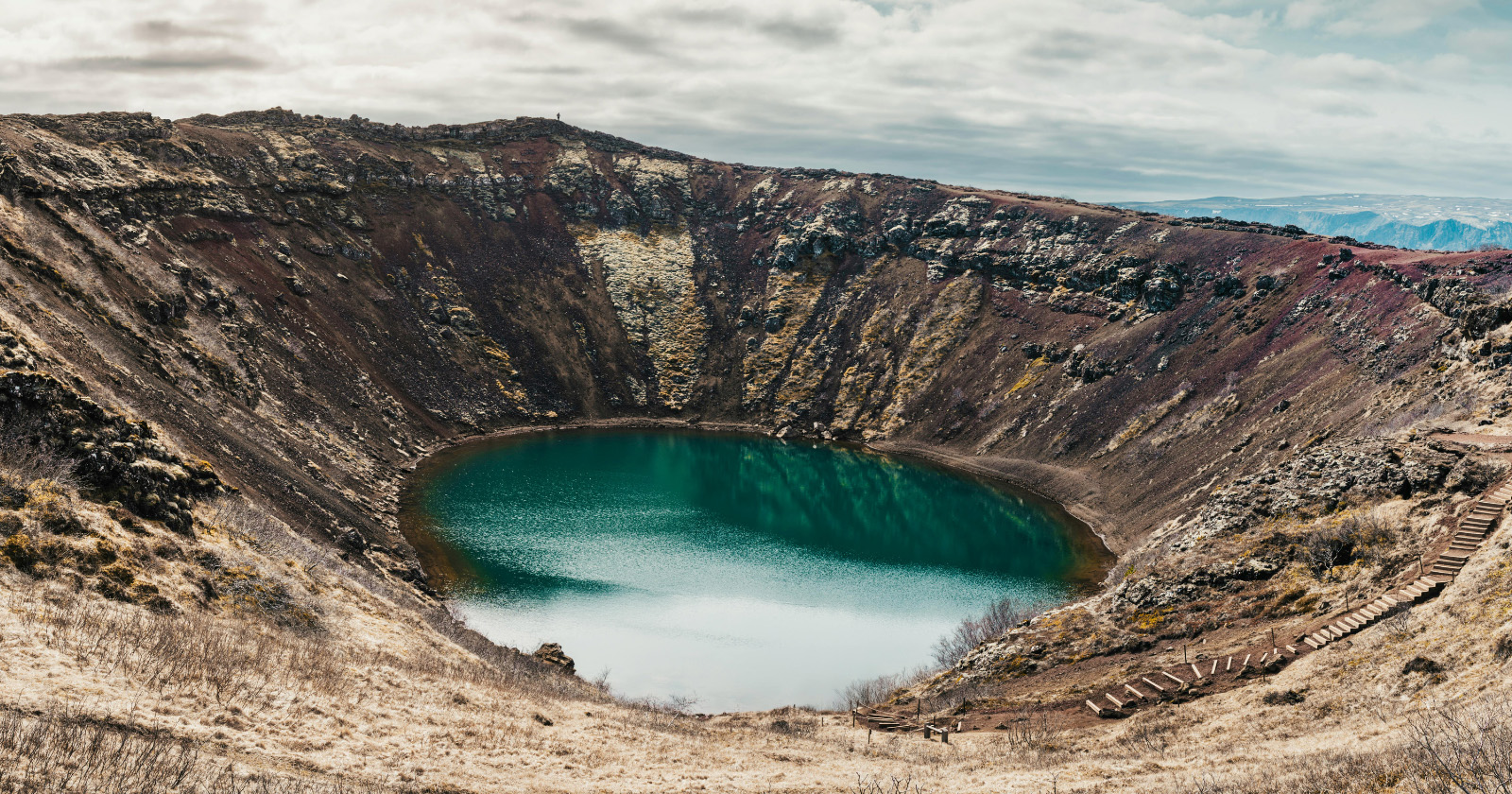
A new discovery in South Korea suggests that the asteroid effect may have been even more complex than we realized. Beneath a crater gouged by a massive impact around 42,000 years ago, has identified several stromatolites. Stromatolites are layered structures built by microbial mats, similar to some of the oldest known evidence of life on Earth.
Scientists Just Found Evidence That Asteroids May Have Helped Create Life on Earth SciTech Daily - May 25, 2026
Scientists in South Korea have uncovered evidence suggesting that asteroid impact craters may have played an important role in the rise of oxygen-producing life on early Earth.
A fireball is an exceptionally bright meteor, at least as bright as the planet Venus, that appears when a small piece of cometary or asteroidal material enters Earth's atmosphere at high speed. These objects, often called "space rocks," burn up due to intense frictional heating, creating a brilliant light streak
A rare fireball bright enough to be seen during broad daylight dazzled skies and triggered a sonic boom in parts of the eastern United States on Tuesday morning. CNN - March 19, 2026
According to NASA, the meteor was 6 feet in size, and weighed roughly 7 tons. As it fell, it was seen by eyewitnesses from at least 10 states, plus the District of Columbia and the Canadian province of Ontario. When it broke apart, it unleashed energy equivalent to 250 tons of TNT.
Dust from asteroid Bennu is revealing a surprising origin story for life's building blocks Science Daily - February 13, 2026
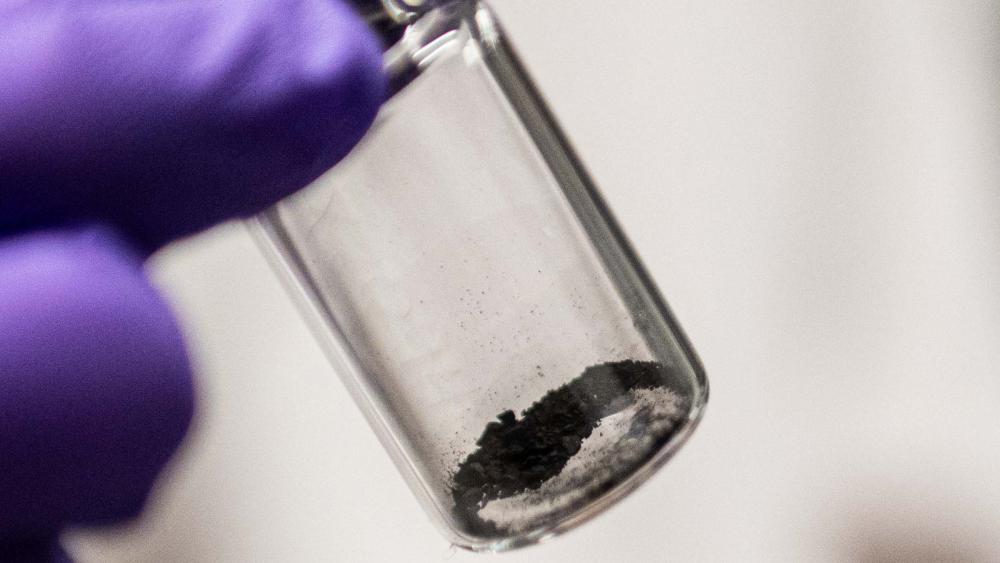
New research suggests some amino acids formed in frozen ice exposed to radiation, not warm liquid water as scientists long believed. Isotopic clues show Bennu's chemistry differs sharply from well-studied meteorites, pointing to multiple pathways for creating life's ingredients.
Asteroid Ryugu's Billion-Year-Old Secret Is a Genuine Surprise to Scientists SciTech Daily - October 2, 2025
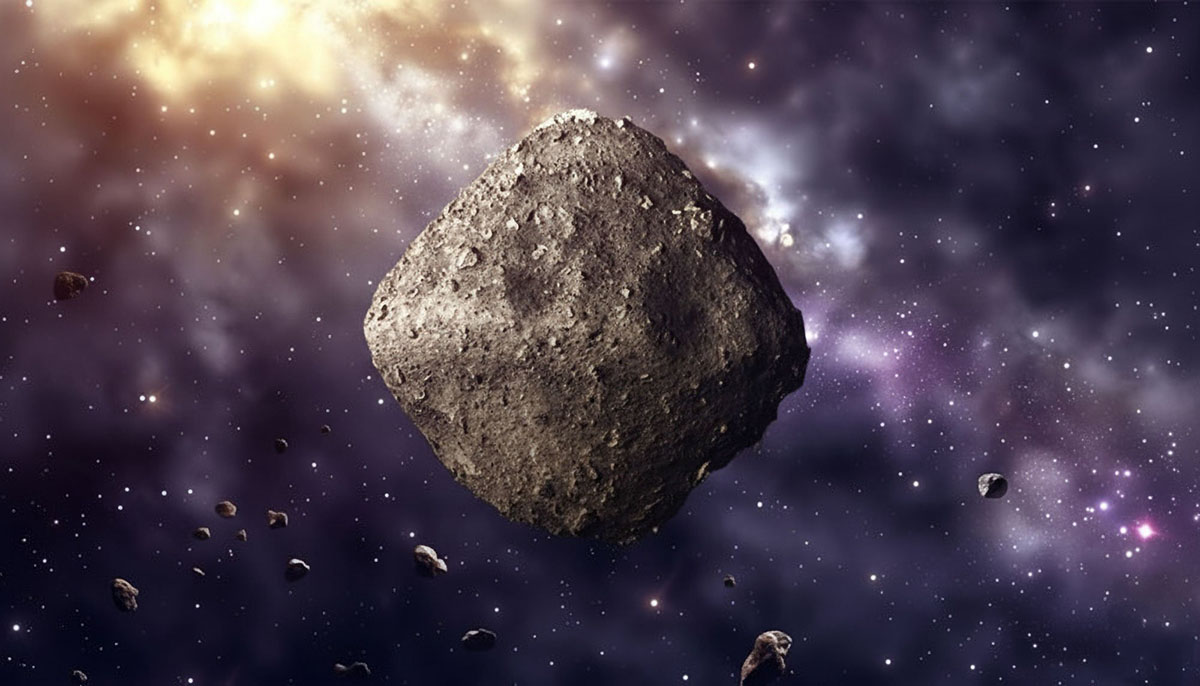
A group of scientists has found evidence that liquid water once moved through the body of the asteroid that eventually gave rise to the near-Earth asteroid Ryugu. Remarkably, this activity occurred more than a billion years after the asteroid originally formed. The results challenge the long-standing belief that water-related processes on asteroids happened only during the earliest stages of solar system history. This new understanding could influence models of how Earth itself was formed.
78 Million Years Ago, an Asteroid Hit Earth. Then Life Grew in The Crater Science Alert - September 18, 2025
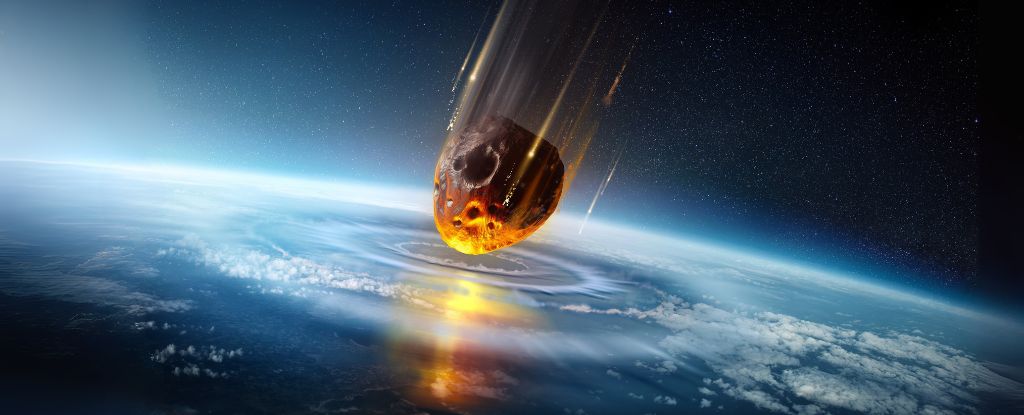
78 million years ago, a 1.6 km asteroid slammed into what is now Finland, creating a crater 23 km (14 mi) wide and 750 km deep. The catastrophic impact created a fractured hydrothermal system in the shattered bedrock under the crater. There's evidence from other impact structures that in the aftermath of a collision, life colonized the shattered rock and heated water that flowed through it. But determining when the colonization happened is challenging. New research shows for the first time exactly when that colonization happened. A team of researchers has zeroed in on the date that microbial life populated the hydrothermal system under the 78 million year old Lappajarvi impact structure.
Surprise: Near-Earth asteroid Ryugu once had 'flowing water' that transformed its insides Live Science - September 16, 2025
Scientists in Japan now believe that liquid water once flowed through the heart of the near-Earth asteroid Ryugu, after researchers detected something unusual in the samples of the space rock that were returned to our planet five years ago. The surprising findings also have potential implications for how Earth acquired its own water, the researchers say.
Ryugu asteroid research reveals mineral history predating any on Earth PhysOrg - August 25, 2025
NASA Reveals Stunning Closeup of Bizarre-Looking Asteroid Science Alert - April 22, 2025

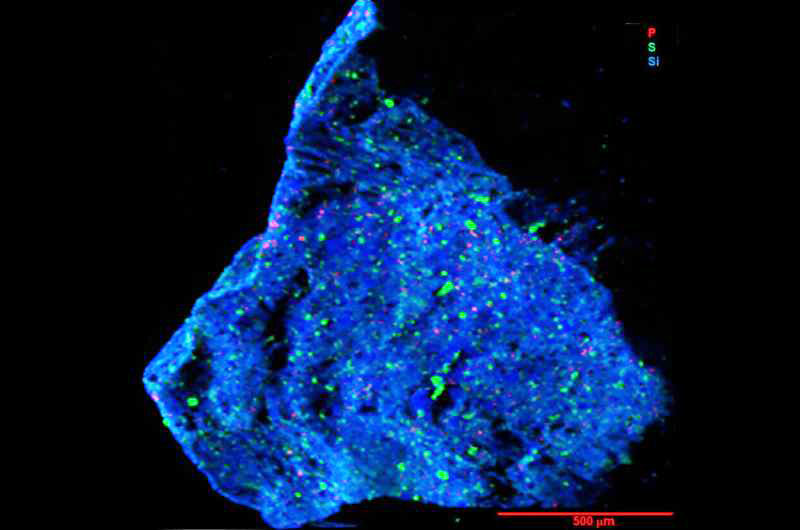
NASA's Lucy spacecraft made a successful flyby of the second asteroid on its must-see list over the weekend, and sent back imagery documenting the elongated object's bizarre double-lobed shape. It turns out that asteroid Donaldjohanson - which was named after the anthropologist who discovered the fossils of a human ancestor called Lucy - is what's known as a contact binary, with a couple of ridges in its narrow neck. In today's image advisory, NASA compares the ridged structure to a pair of nested ice cream cones.
Are we all aliens? NASA's Osiris-Rex spacecraft returned asteroid samples hold the ingredients of life from a watery world in the near-Earth asteroid Bennu PhysOrg - February 1, 2025

Asteroid samples fetched by NASA hold not only the pristine building blocks for life but also the salty remains of an ancient water world. The findings provide the strongest evidence yet that asteroids may have planted the seeds of life on Earth and that these ingredients were mingling with water almost right from the start.
This takes us to the Theory of Panspermia - Life from outer space seeded human evolution
Skyscraper-sized asteroid and 4 others speed past Earth on the same day CBS - October 24, 2024
9-Kilometer Impact Crater Beneath Atlantic Reveals Dino-Killing Asteroid Had A Friend. The crater lies deep beneath the Atlantic Ocean and was formed around 66 million years ago - making it a contemporary of Chicxulub IFL Science - October 4, 2024
The Chicxulub impactor, as it is called, famously wiped out the non-avian dinosaurs and left a huge crater at the edge of the Yucat‡n peninsula - but it may not have acted alone. New research has revealed that a second, smaller space rock smashed into our planet during the same era, creating a 9.2-kilometer (5.7-mile) crater deep below the Atlantic.
Asteroid 2024 PT5 is an Earth mini-moon orbiting the planet from Sept. 29 - Nov. 25, 2024 Wikipedia
JWST Discovers Asteroid Psyche Is Rusting, Suggesting A Complex History IFL Science - August 21, 2024
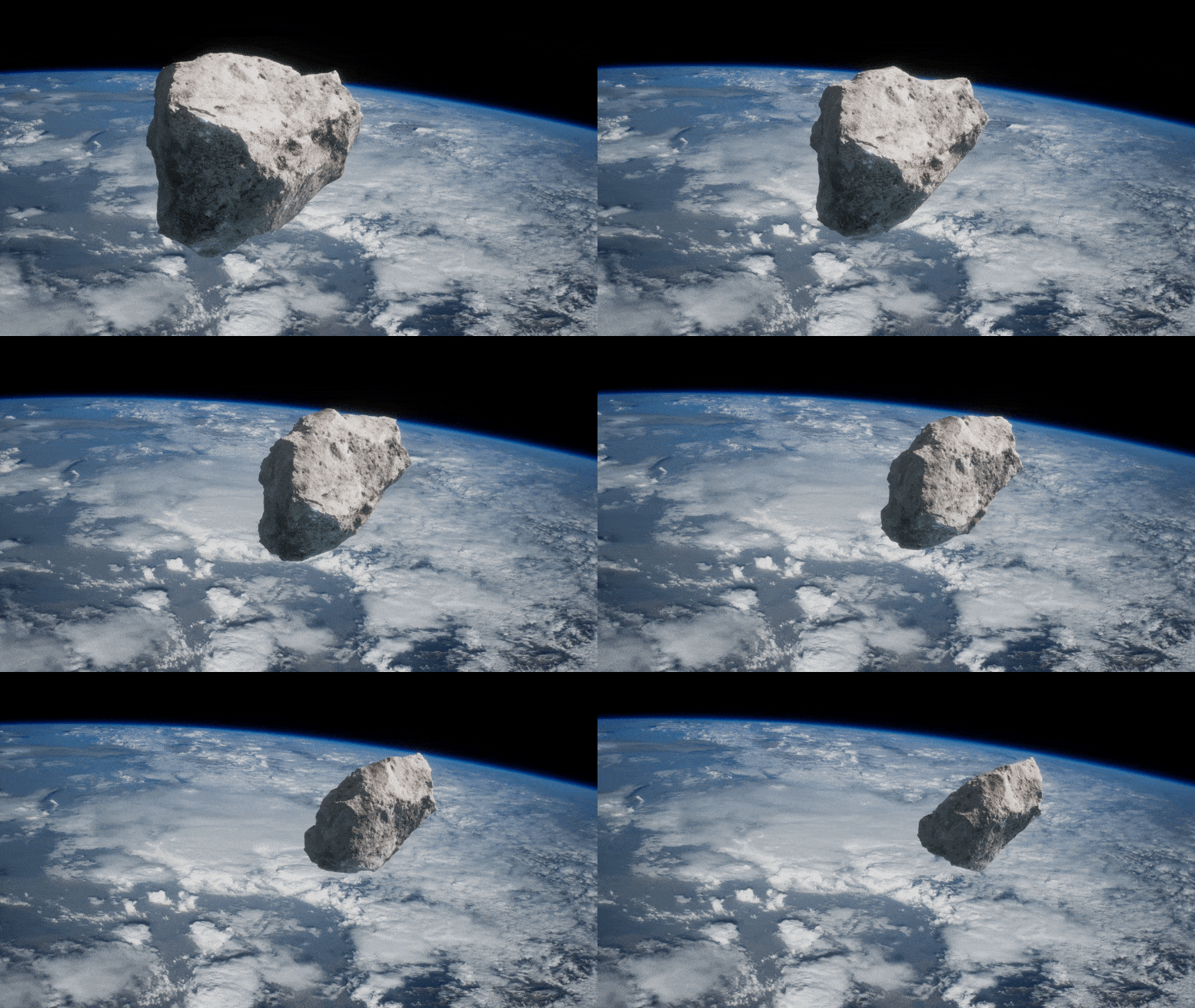
Hydrated metals have been detected on the surface of the asteroid Psyche. The observations, made with JWST, raise some big questions for the mission named after the asteroid, which hopefully will be settled when the spacecraft reaches its target.
Study highlights role of dark comets and active asteroids in delivering water to Earth NDTV - July 17, 2024
There is a new class of space objects known as "dark comets" that astronomers have discovered that may provide information on the origins of Earth's water. These enigmatic objects could account for as much as 60% of all near-Earth objects; they seem to be asteroids with ice hidden beneath their surface. Dark comets are not blurry like regular comets' coma and tail. On the other hand, they show an inexplicable acceleration, suggesting the existence of unobserved emissions, most likely due to sublimating ice. Researchers believe these dark comets originate from the asteroid belt between Mars and Jupiter. Through computer simulations, they were able to mimic the dark comets' orbits and trace them back to the inner part of the asteroid belt. This finding supports the long-held theory that icy materials are common within the asteroid belt.
The discovery of dark comets strengthens the possibility that icy objects delivered water to Earth early in its formation. This idea is further bolstered by the existence of "active asteroids"-objects t that display comet-like behavior within the asteroid belt. While the exact connection between dark comets and active asteroids remains unclear, both types of objects could be key players in the story of Earth's water. Future studies will likely shed more light on these intriguing celestial bodies.
Tantalizingly Beautiful Rocks Yield More Evidence That Asteroid Bennu Came From A Wet World IFL Science - June 27, 2024
Asteroid Struck by a Spacecraft Might Be 'Healing' as Its Surface Reforms Science Alert - February 27, 2024
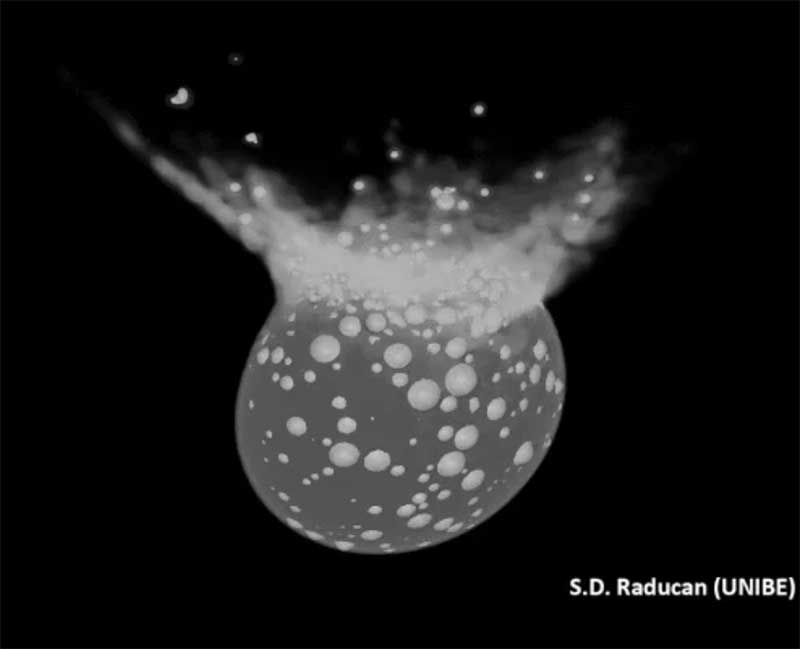
Smacking a spacecraft into an asteroid may have had some interesting side effects. According to an analysis of a collision between NASA's DART probe and the asteroid Dimorphos back in September 2022, the tiny asteroid's shape could have changed significantly as a direct result of the impact.
Scientists identify water molecules on asteroids for the first time PhysOrg - February 12, 2024
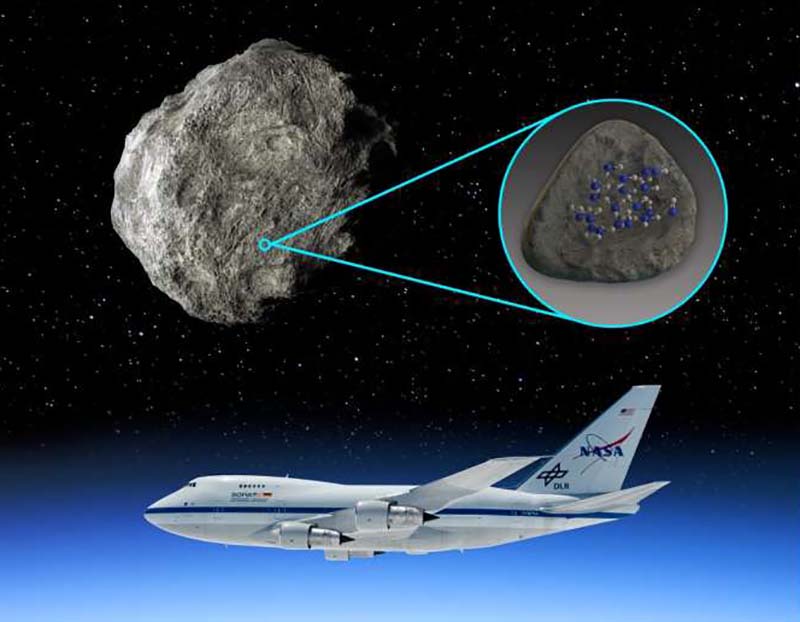
Scientists looked at four silicate-rich asteroids using the FORCAST instrument to isolate the mid-infrared spectral signatures indicative of molecular water on two of them. Asteroids are leftovers from the planetary formation process, so their compositions vary depending on where they formed in the solar nebula.
First Look at Asteroid Bennu Hints It's a Fragment of a Lost Ocean World Science Alert - February 12, 2024
That assumption is based on the phosphate crust detected on the asteroid. The calcium and magnesium-rich phosphate mineral has never been seen before on meteorites - those small space rocks that make it through our atmosphere and down to Earth. The mineral's chemistry bears an eerie resemblance to that found in vapor shooting from beneath the icy crust of Saturn's moon, Enceladus.
Scientists found signs of organic molecules in the first samples of potentially hazardous asteroid Bennu, as well as a 'head scratching' material that has yet to be identified Live Science - December 13, 2023
Tasked with finding clues about origins of life on Earth, NASA's OSIRIS-REx spacecraft scooped up pieces of a rugged, rubble-pile asteroid named Bennu in late 2020 and delivered them to Earth about two months ago. On Monday (Dec. 11), scientists got their first detailed description of some of that extraterrestrial collection.
Unprecedented asteroid sample contains crucial elements for life, NASA says in historic reveal CNN - October 12, 2023
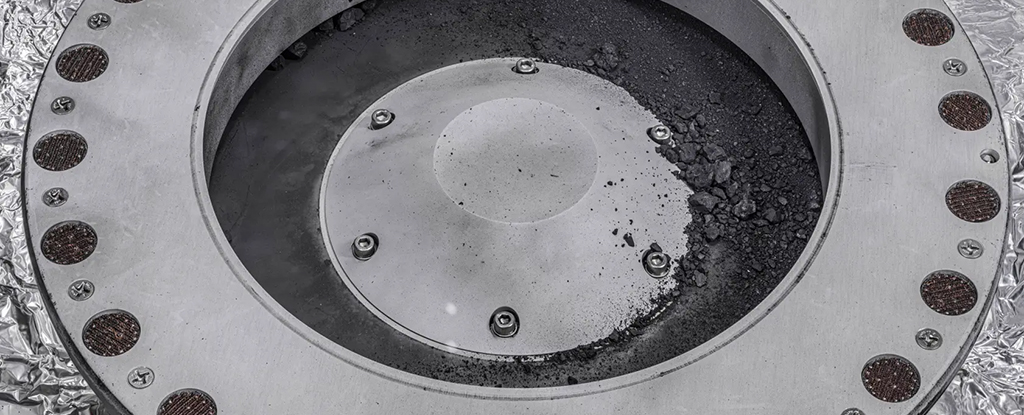
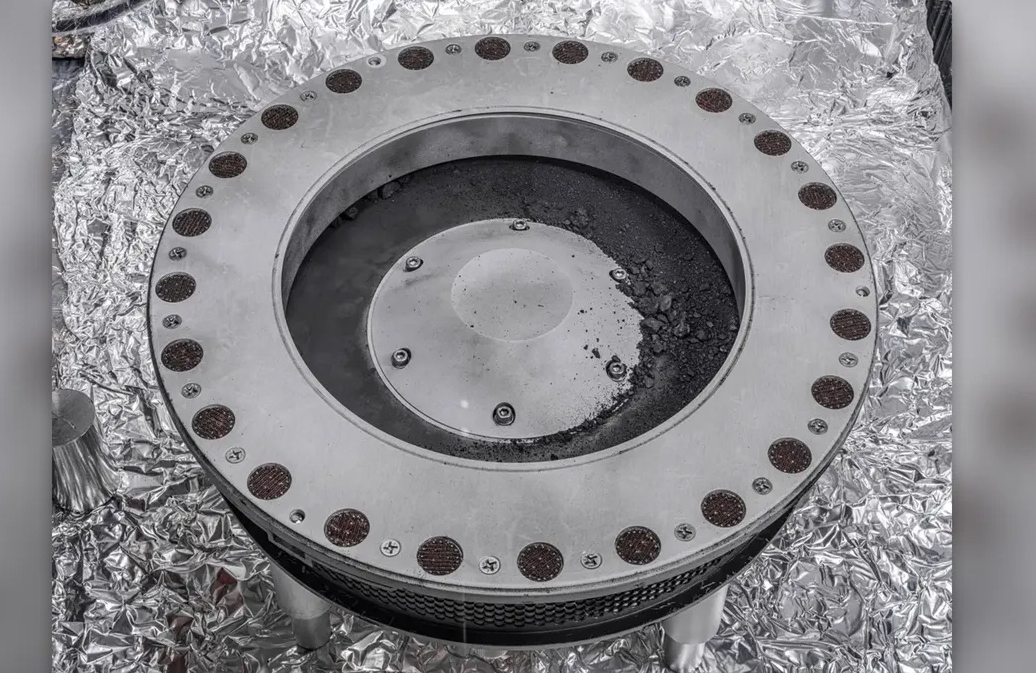
A view of the outside of the OSIRIS-REx sample collector shows material from asteroid Bennu that can be seen on the middle right. Scientists have found evidence of both carbon and water in initial analysis of this material. The bulk of the sample is located inside. There was so much bonus material when the scientists opened the canister that the team has yet to open the bulk sample.
The reason that Earth is a habitable world, that we have oceans and lakes and rivers and rain, is because these clay minerals landed on Earth 4 billion years ago to 4 and a half billion years ago, making our world habitable. So we're seeing the way that water got incorporated into the solid material.
NASA's first asteroid samples land on Earth after release from spacecraft PhysOrg - September 24, 2023
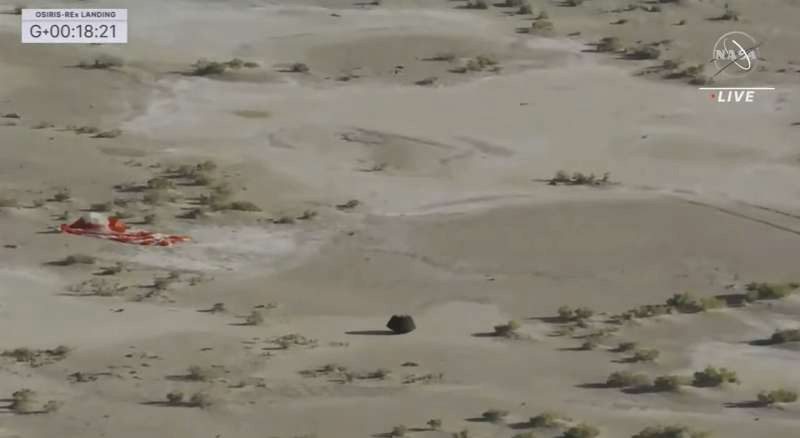
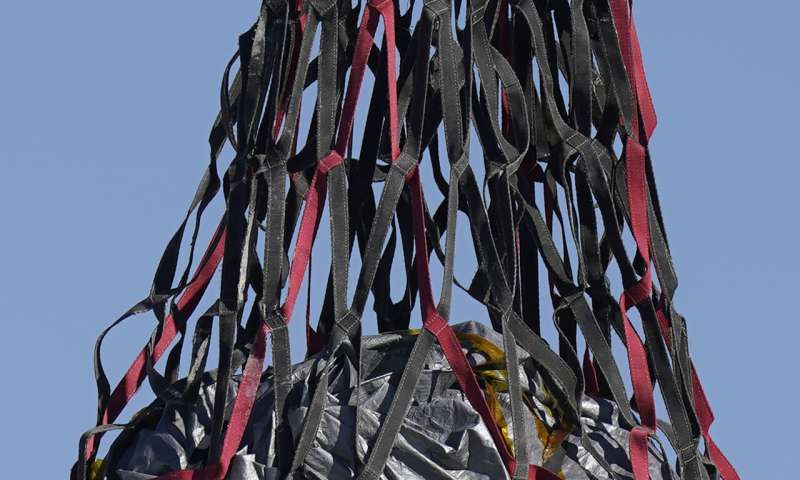
In a flyby of Earth, the Osiris-Rex spacecraft released the sample capsule from 63,000 miles (100,000 kilometers) out. The small capsule landed four hours later on a remote expanse of military land, as the mothership set off after another asteroid.
This Strange Metal Object Could Unlock Secrets Buried Inside Earth Science Alert - August 18, 2023
NASA's robotic mission to a metal world is scheduled for liftoff on October 5, 2023. That mission, the spacecraft traveling there, and the world it will explore all have the same name - Psyche - considered an iron giant of asteroids.
Scientist Unveils a Bold Plan to Turn an Asteroid Into a Space Station Science Alert - August 9, 2023
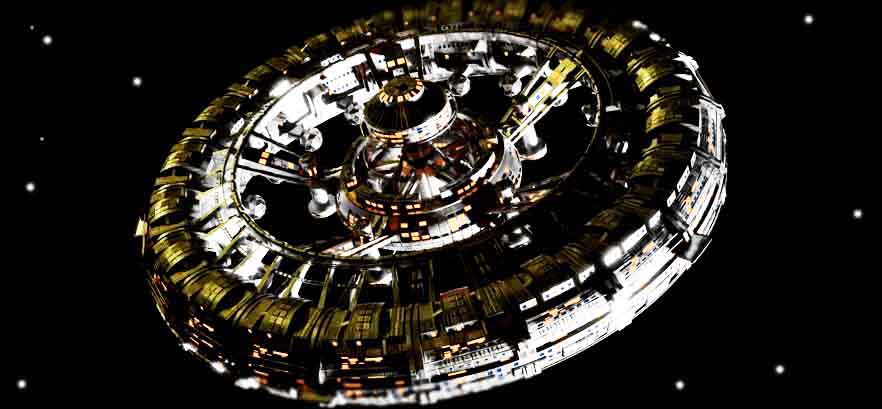
The basic idea of turning an asteroid into a rotating space habitat has existed for a while. Despite that, it's always seemed relatively far off regarding technologies, so the concept hasn't received much attention over the years. That is precisely what David W. Jensen, a retired Technical Fellow at Rockwell Collins, recently did. He released a 65-page paper that details an easy-to-understand, relatively inexpensive, and feasible plan to turn an asteroid into a space habitat.
A 'quasi-moon' - asteroid - has been following Earth around the sun since 100 BC, and astronomers just noticed it Yahoo News - June 3, 2023
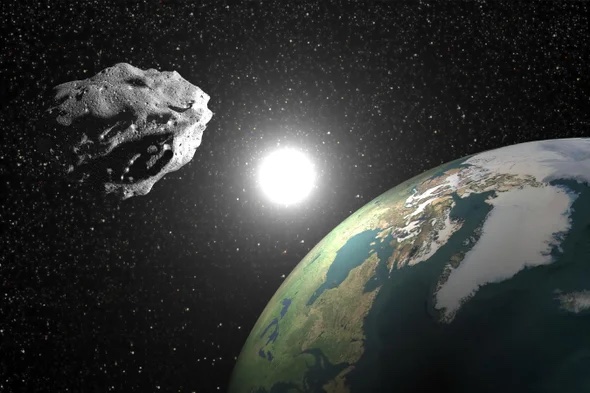
Scientists recently discovered an asteroid that tags along with Earth during its yearly journey around the sun. Dubbed 2023 FW13, the space rock is considered a "quasi-moon" or "quasi-satellite," meaning it orbits the sun in a similar time frame as Earth does, but is only slightly influenced by our planet's gravitational pull. It is estimated to be 50 feet (15 meters) in diameter - roughly equivalent to three large SUVs parked bumper to bumper.
During its orbit of the sun, 2023 FW13 also circles Earth, coming within 9 million miles (14 million kilometers) of our planet. For comparison, the moon has a diameter of 2,159 miles (3,474 km) and comes within 226,000 miles (364,000 km) of Earth at the closest point of its orbit, according to NASA.
Some estimates suggest that 2023 FW13 has been Earth's cosmic neighbor since at least 100 B.C. and that the space rock will continue to follow this orbital path until around A.D. 3700, Adrien Coffinet, an astronomer and journalist who first categorized the asteroid as a quasi-moon after modeling its orbit.
'Building blocks of life' recovered from asteroid Ryugu are older than the solar system itself Live Science - February 28, 2023
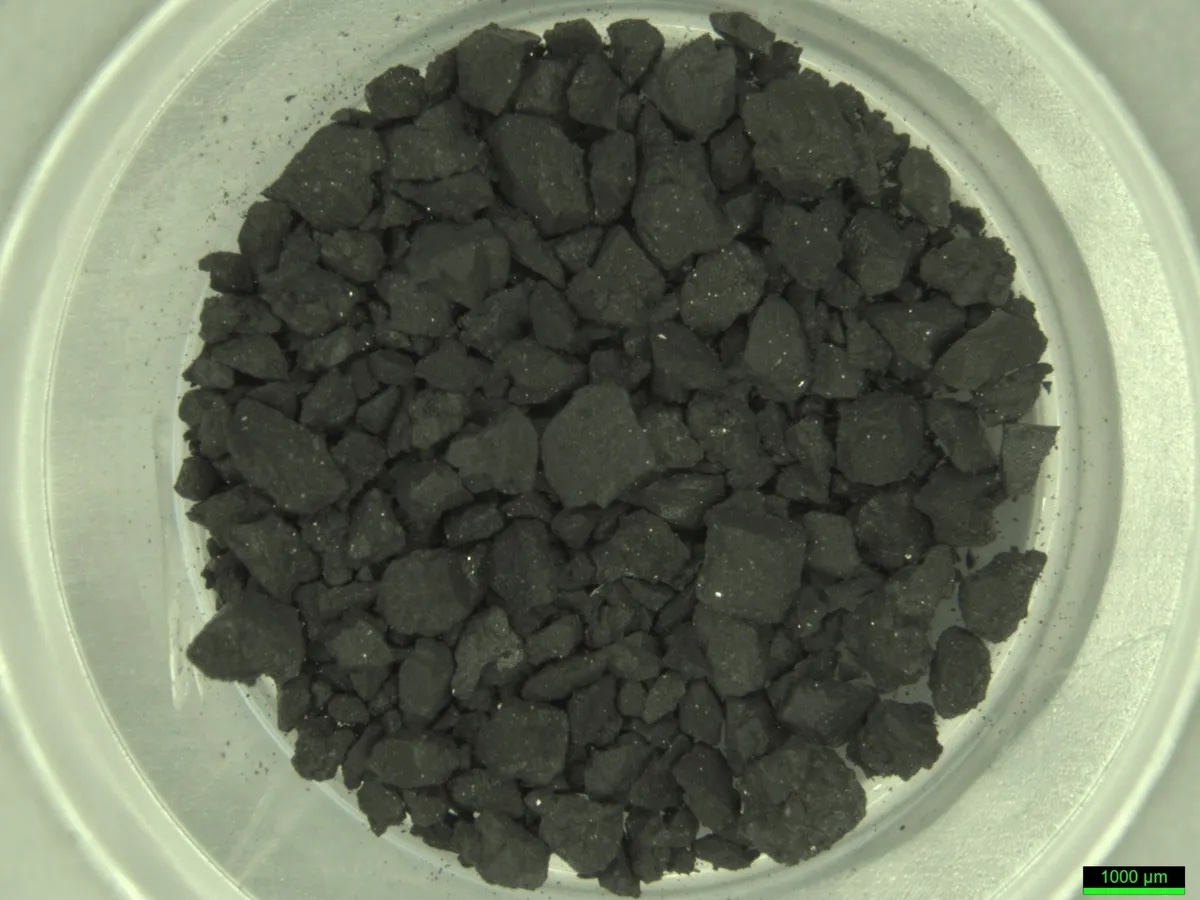
An analysis of a tiny portion of this sample revealed that the carbon-rich asteroid also contains molecules that are crucial to all known life, including 15 amino acids, the building blocks of proteins. These molecules themselves are not alive, but because they are found in all life, scientists call them "prebiotic."
New astronomical measurements in the infrared range have led to the identification of a heretofore unknown class of water-rich asteroids
PhysOrg - February 21, 2023
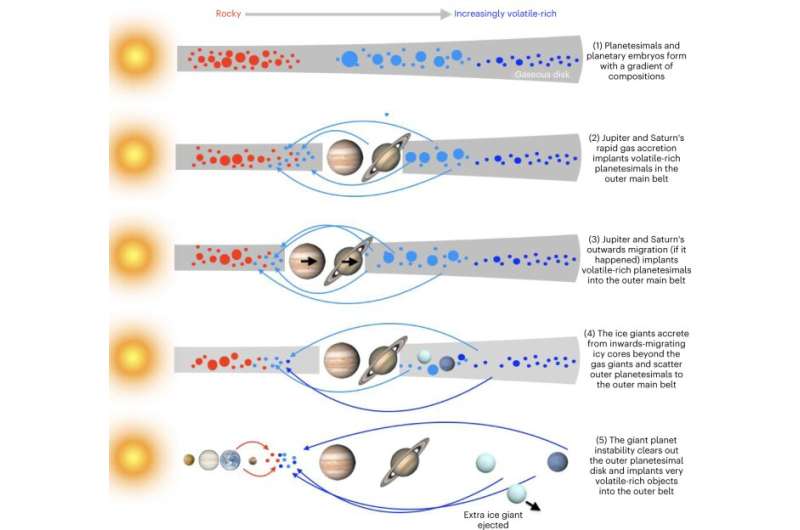
They are located in the asteroid belt between Mars and Jupiter and are similar to the dwarf planet Ceres rich in water. According to computer models, complex dynamic processes shifted these asteroids from the outer regions of our solar system into today's asteroid belt shortly after their creation.
Nasa's Dart spacecraft 'changed path of asteroid' BBC - October 11, 2022
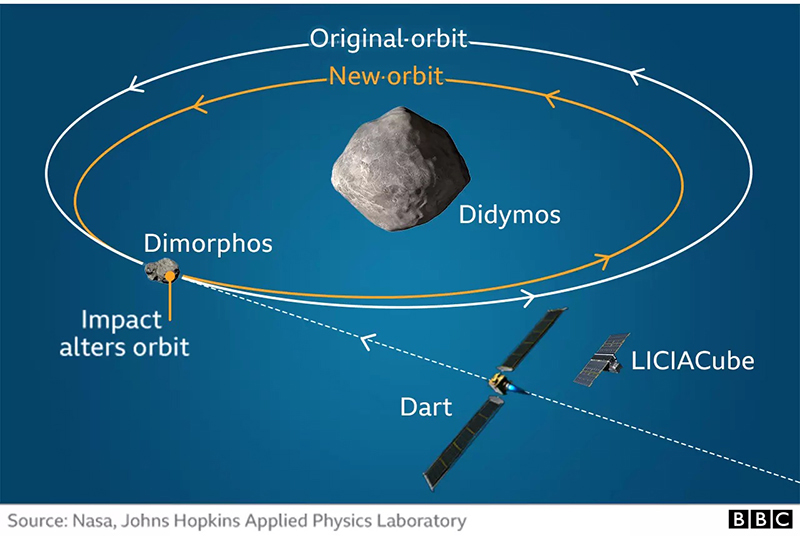
The American space agency says its recent attempt to deflect the path of an asteroid was successful. Scientists have now confirmed the orbit of a 160m-wide (520ft) space rock known as Dimorphos was altered when the Dart probe struck it head on last month. Researchers came to the conclusion after making measurements using a range of space and Earth-based telescopes. The mission was conceived to test a potential strategy to defend the Earth against threatening objects.
Astronomers Unveil The Most Detailed Map of The Metal Asteroid Psyche Yet Science Alert - June 19, 2022
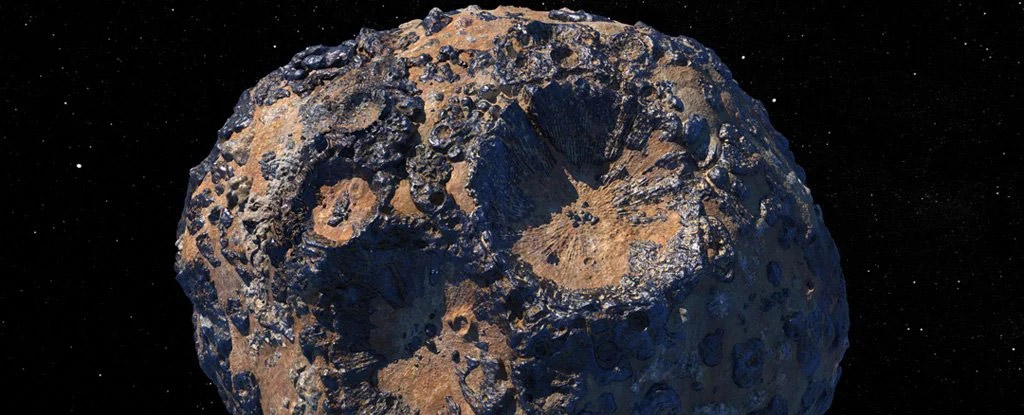
If you wanted to do a forensic study of the Solar System, you might head for the main asteroid belt between Mars and Jupiter. That's where you can find ancient rocks from the Solar System's early days. Out there in the cold vacuum of space, far from the Sun, asteroids are largely untouched by space weathering.
Asteroid Ryugu contains material older than the planets, among the most primitive ever studied on Earth Space.com - June 10, 2022

The asteroid Ryugu contains some of the most primitive material ever studied in a laboratory on Earth, dating back to just 5 million years after the formation of the solar system, according to an analysis of samples retrieved by Japan's Hayabusa2 mission. Because it is so old, it is made of the same stuff that formed the planets. Ryugu is one of the building blocks of Earth.
What happened before, during and after solar system formation? Asteroid Ryugu study holds the answers Space.com - June 10 , 2022
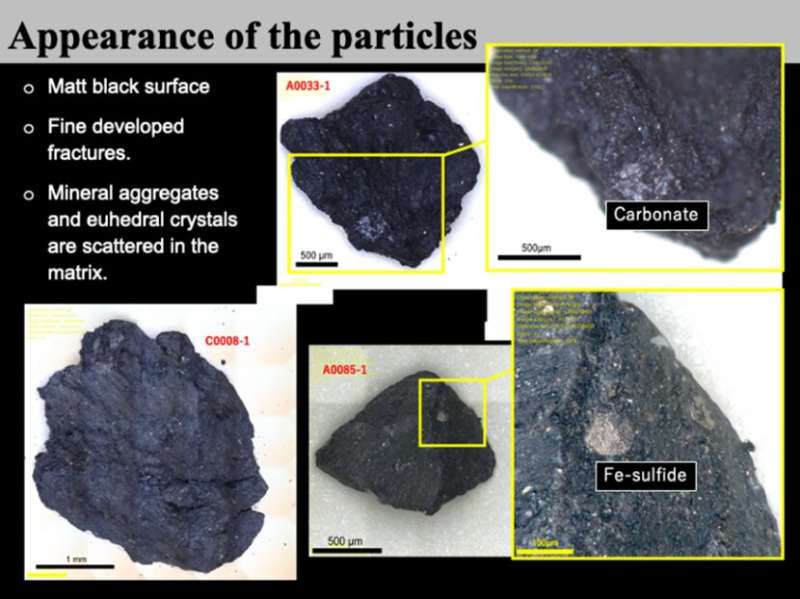
The Japan Aerospace Exploration Agency's (JAXA) Hayabusa2 mission returned uncontaminated primitive asteroid samples to Earth. A comprehensive analysis of 16 particles from the asteroid Ryugu revealed many insights into the processes that operated before, during and after the formation of the solar system, with some still shaping the surface of the present-day asteroid.
'Rubber-ducky' asteroid 200 million miles away holds building blocks of life Live Science - June 9, 2022
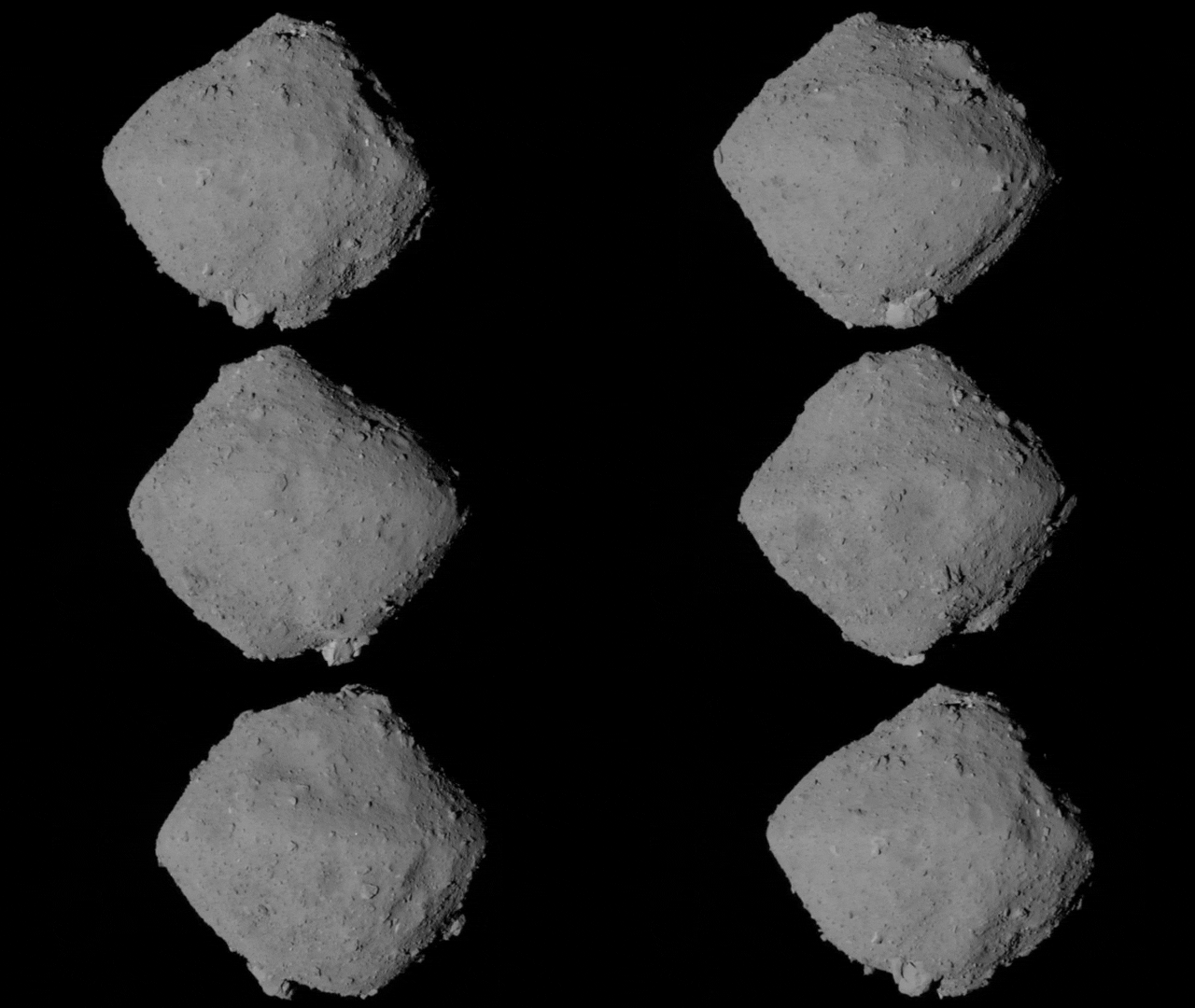
For the first time, scientists have found the building blocks for life on an asteroid in space. Japanese researchers have discovered more than 20 amino acids on the space rock Ryugu, which is more than 200 million miles from Earth. Scientists made the first-of-its-kind detection by studying samples retrieved from the near-Earth asteroid by the Japan Aerospace Exploration Agency's (JAXA) Hayabusa2 spacecraft, which landed on Ryugu in 2018. In 2019, the spacecraft collected 0.2 ounce (5.4 grams) from the asteroid's surface and subsurface, stowed it in an airtight container and launched it back to Earth on a fine-tuned trajectory.
First quadruple asteroid system detected PhysOrg - February 19, 2022
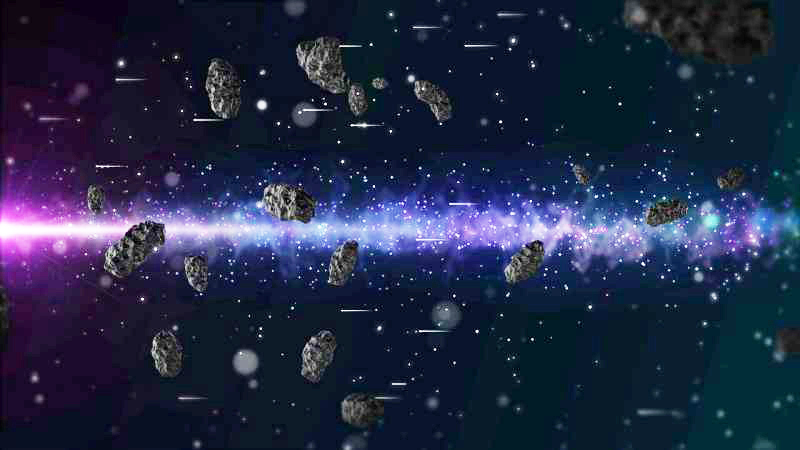
It's a a quadruple asteroid system meaning an asteroid with three moons orbiting around it. The asteroid Elektra was first seen back in 1873, by astronomer Christian Peters. Since that time, the outer main-belt asteroid has been classified as a G-type - it measures approximately 260 kilometers across and is believed to have a Ceres-like composition. Back in 2003, researchers found that it had a companion moon and then in 2014, a second moon was found. In this new effort, a third moon has been discovered, earning the system a quadruple designation - the first ever observed.
Behold, This Is The First Asteroid Ever Discovered to Have Three Moons Science Alert - February 19, 2022
It's Official! A New Trojan Asteroid Has Been Discovered Sharing Earth's Orbit Science Alert - February 1, 2022
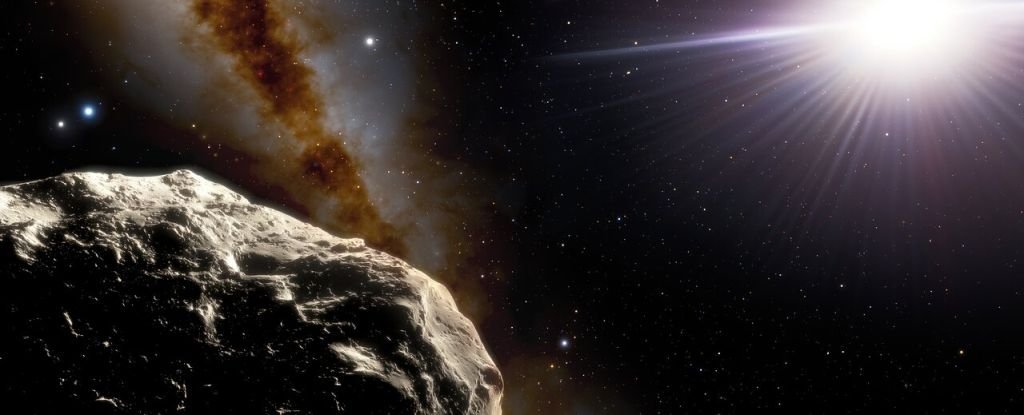
Earth has officially been joined in its orbit around the Sun by a new trojan asteroid. Named 2020 XL5, this chunk of rock is only the second object of its type ever to have been conclusively identified. Its discovery suggests that perhaps Earth trojans may be more common than we knew, and offers new insights into these mysterious rocks.
We Finally Have The First-Ever Analysis of Stardust Retrieved From The Ryugu Asteroid Science Alert - December 22, 2021
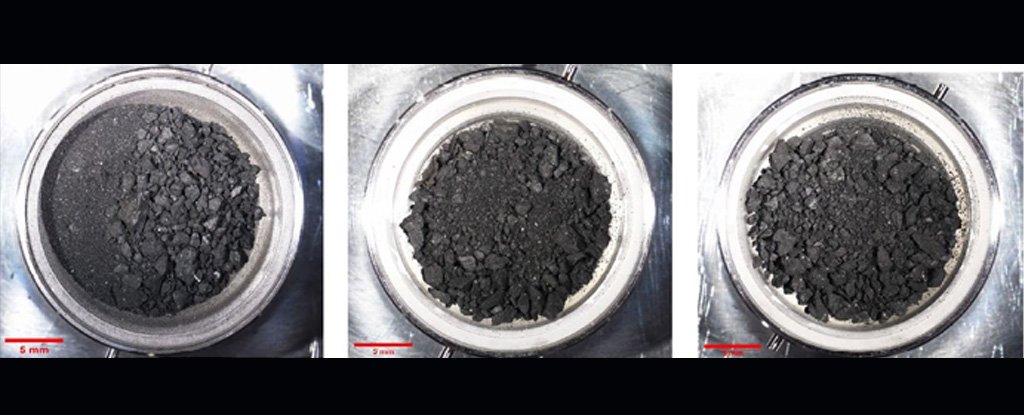
It's been over a year since the Hayabusa2 probe delivered its precious cargo of dust from an alien space rock, and we're finally getting a more detailed glimpse of what makes up asteroid Ryugu. It is very dark, very porous, and some of the most primitive Solar System material we've ever had access to here on Earth.
The Very Real Effort to Track Killer Asteroids and Comets Smithsonian - December 13, 2021
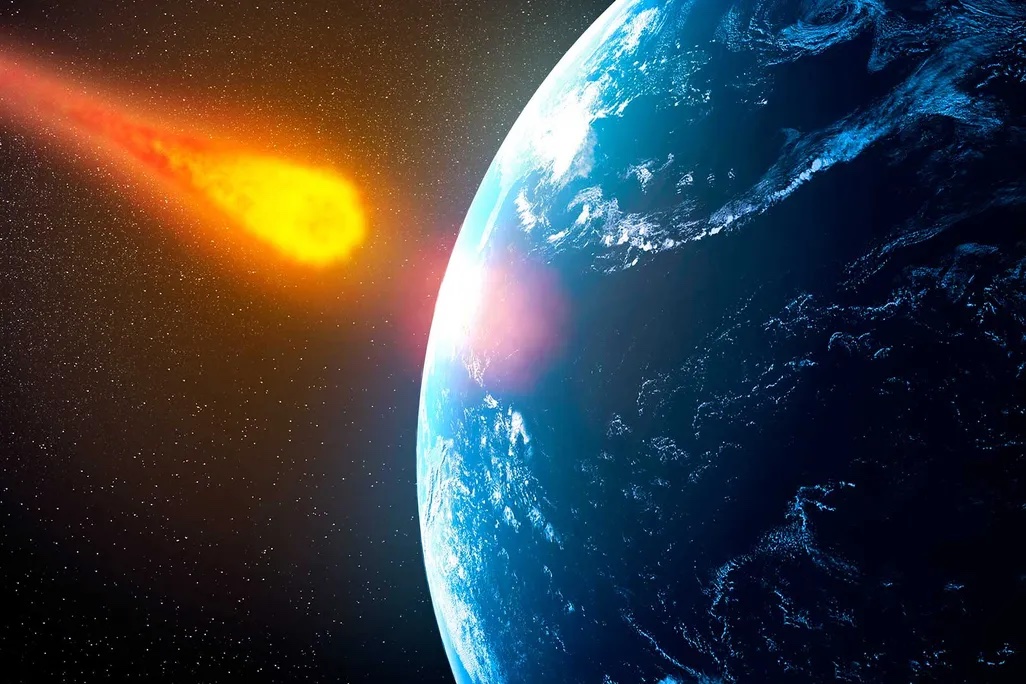
It's not a question of if but when: Eventually, astronomers will discover a celestial object on an Earth-bound trajectory. It might be an asteroid-a big chunk of rock, orbiting the sun in the inner part of the solar system-or it might be a comet, containing ice as well as rock, and typically moving in a slower, more oval-shaped orbit. To be very clear, no asteroids or comets are currently known to present any danger. Nonetheless, it pays to be prepared, given the devastation that such an impact would bring.
Highly porous rocks are responsible for asteroid Bennu's surprisingly craggy surface PhysOrg - October 8, 2021

Scientists thought asteroid Bennu's surface would be like a sandy beach, abundant in fine sand and pebbles, which would have been perfect for collecting samples. Past telescope observations from Earth's orbit had suggested the presence of large swaths of fine-grain material called fine regolith that's smaller than a few centimeters.
Weird Space Rock Confirmed as Super-Rare Hybrid of Comet And Asteroid Science Alert - October 5, 2021
Comets and asteroids are both types of rocks that hang out in space, but their differences are pretty pronounced. Comets typically hail from the outer Solar System and have long, elliptical orbits. They're filled with ices that start to sublimate when the comet gets close to the Sun, generating a dusty, misty atmosphere (called a coma) and the famous cometary tails.
52-foot-tall 'megaripples' from dinosaur-killing asteroid are hiding under Louisiana Live Science - July 20, 2021

These are the largest known megaripples on Earth.. The 52-foot-tall (16 meters) megaripples are about 5,000 feet (1,500 m) under the Iatt Lake area, in north central Louisiana, and date to the end of the Cretaceous period 66 million years ago, when that part of the state was underwater, the researchers said.
The megaripples' size and orientation suggest that they formed after the giant space rock, known as the Chicxulub asteroid, slammed into the Yucatan Peninsula, leading to the Chicxulub impact tsunami, whose waves then rushed into shallower waters and created the megaripple marks on the seafloor, the researchers said.
The occurrence of "ripples of that size means something very big had to disturb the water column," study lead researcher Gary Kinsland, a professor in the School of Geosciences at the University of Louisiana at Lafayette, told Live Science. "This is just further evidence that the Chicxulub impact ended the Cretaceous period."
Planetary defense experts use infamous asteroid Apophis to practice spotting dangerous space rocks Live Science - March 5, 2021
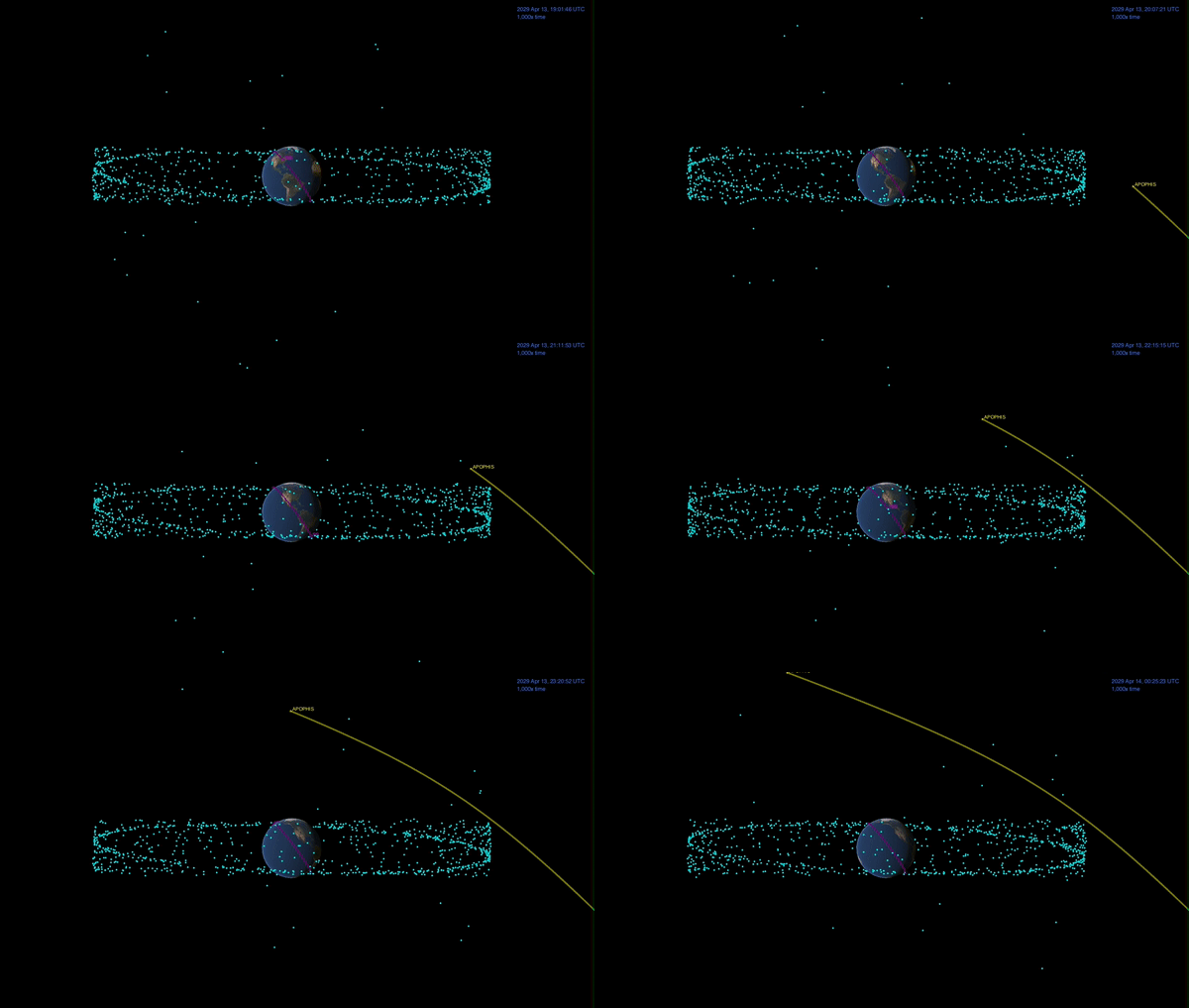
Earth's most recent brush with asteroid danger was eight years ago, when a space rock the size of a six-story building came seemingly out of nowhere, injuring 1,200 people when it exploded over Chelyabinsk, Russia. Now, scientists are using this month's flyby of the infamous asteroid Apophis to test their responses to potentially hazardous space rocks, honing the fine art of planetary defense. Planetary defense focuses on identifying asteroids and comets that hang out around Earth, mapping their precise paths and seeing how their orbits compare with Earth's.
For The First Time, Organic Matter Crucial For Life Has Been Found on an Asteroid's Surface Science Alert - March 5, 2021
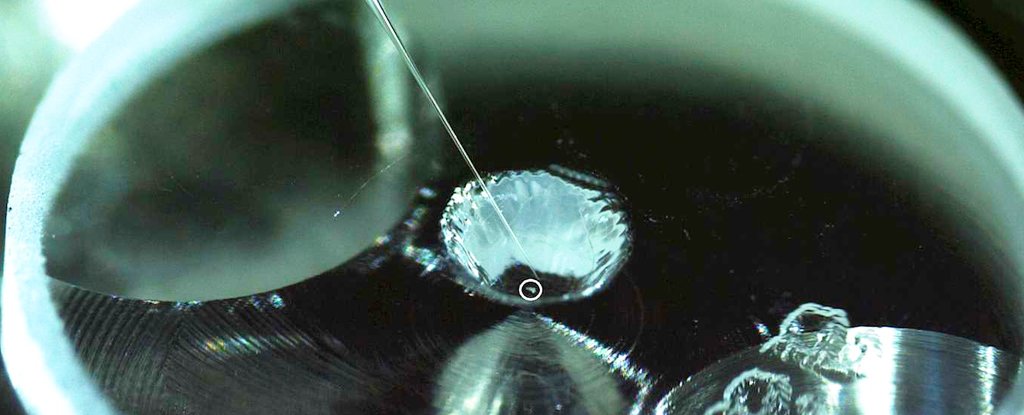
Researchers have found the first evidence of organic materials essential to life on Earth on the surface of an S-type asteroid. An international team of researchers recently conducted an in-depth analysis on one of the particles brought back from the asteroid Itokawa by the Japanese Space Agency's (JAXA) original Hayabusa mission back in 2010.
Giant Asteroid Survivor of Failed Planet Discovered to Be Slowly Rusting in Space Science Alert - October 28, 2020
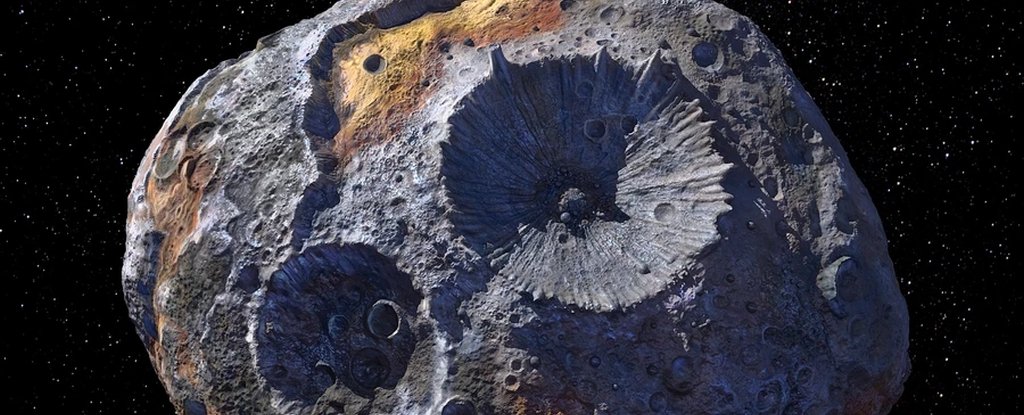
Roughly two to three times Earth's distance from the Sun, in the Asteroid Belt that lies between Mars and Jupiter, 16 Psyche makes its home. This giant metal asteroid is one of the most massive objects in the Asteroid Belt, categorized as a minor planet. Astronomers think that 16 Psyche is the exposed core of a full planet that didn't make it all the way, and we're itching to know more about it. NASA will be sending a probe to check it out in the next few years, and in the meantime, scientists are working to glean what they can from Earth. Now, for the first time, 16 Psyche has been studied in ultraviolet wavelengths using the Hubble Space Telescope, revealing that, just as we thought, the dense chunk of space rock is remarkably metallic.
A collection chamber that could contain more than 2 pounds of samples gathered from an asteroid in deep space last week has been sealed inside of a return capsule on NASA's OSIRIS-REx spacecraft to bring the extraterrestrial specimens back to Earth in 2023 Space Flight - October 29, 2020
Mission managers accelerated plans to stow the sample inside the return capsule after finding that asteroid particles were escaping from the collection chamber last week. The OSIRIS-REx spacecraft descended to a precise touch-and-go landing on asteroid Bennu Oct. 20 to gather the surface specimens.
A Handful of Asteroid Could Help Decipher Our Entire Existence The Atlantic - October 22, 2020
Asteroid shower on the Earth-Moon system 800 million years ago revealed by lunar craters PhysOrg - July 21, 2020
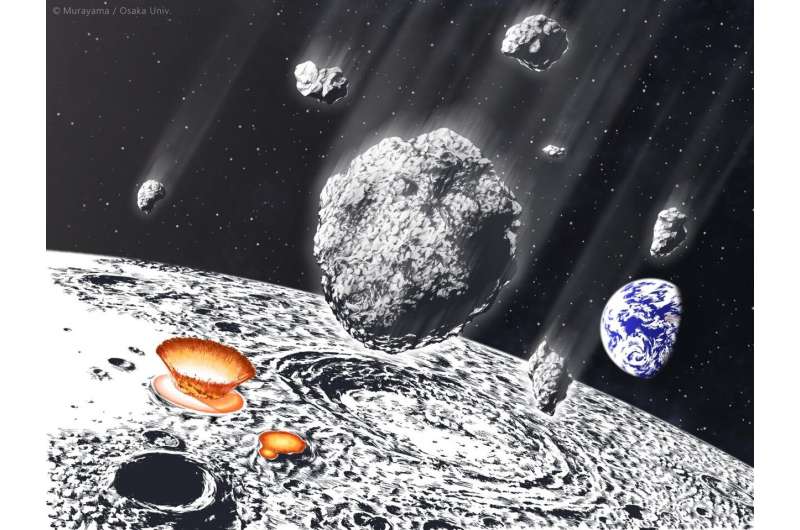
Since a thin layer of iridium (Ir) enrichment (a rare earth element) 65.5 Ma had been detected worldwide, it is thought that an asteroid of 10-15 km in diameter hit the Earth and caused or greatly contributed to the Cretaceous mass extinction. The probability of an asteroid of this size striking Earth is thought to be once in 100 million years. It is known that impact craters on Earth created before 600 Ma have been erased over the years by erosion, volcanism, and other geologic processes. Thus, to find out about ancient meteoroid impacts on Earth, they investigated the Moon, which has almost no erosion.
OSIRIS-REx mission explains Bennu's mysterious particle events PhysOrg - December 5, 2019
Touchdown! Incredible Photos Show 2nd Asteroid Landing by Japan's Hayabusa2 Space.com - July 11, 2019
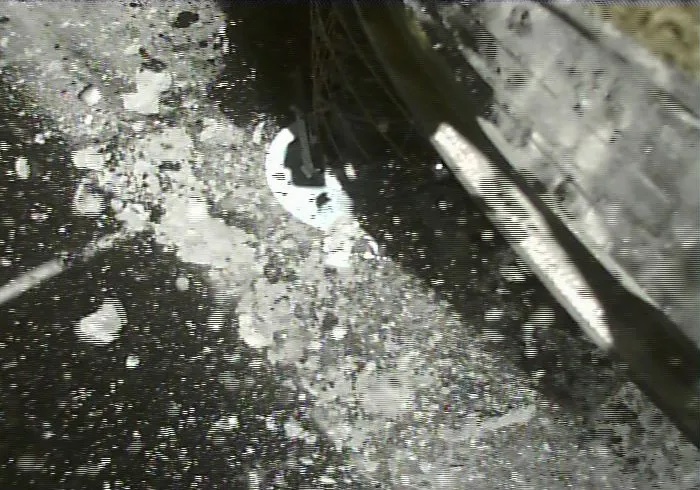
he Japanese spacecraft Hayabusa2 made a carefully choreographed second touchdown on an asteroid called Ryugu last night (July 10) - and the photos are incredible. The images beamed back to Earth show the perspective of two different cameras on board the spacecraft: the main navigation camera and a publicly funded camera pointed past the sampling mechanism. Photos from the first camera show views of Ryugu's surface at touchdown; the second shows the nearby rock before and after the sampling itself.
Comet Ingredients Swallowed by an Asteroid, Found Sealed Inside a Meteorite Live Science - April 15, 2019
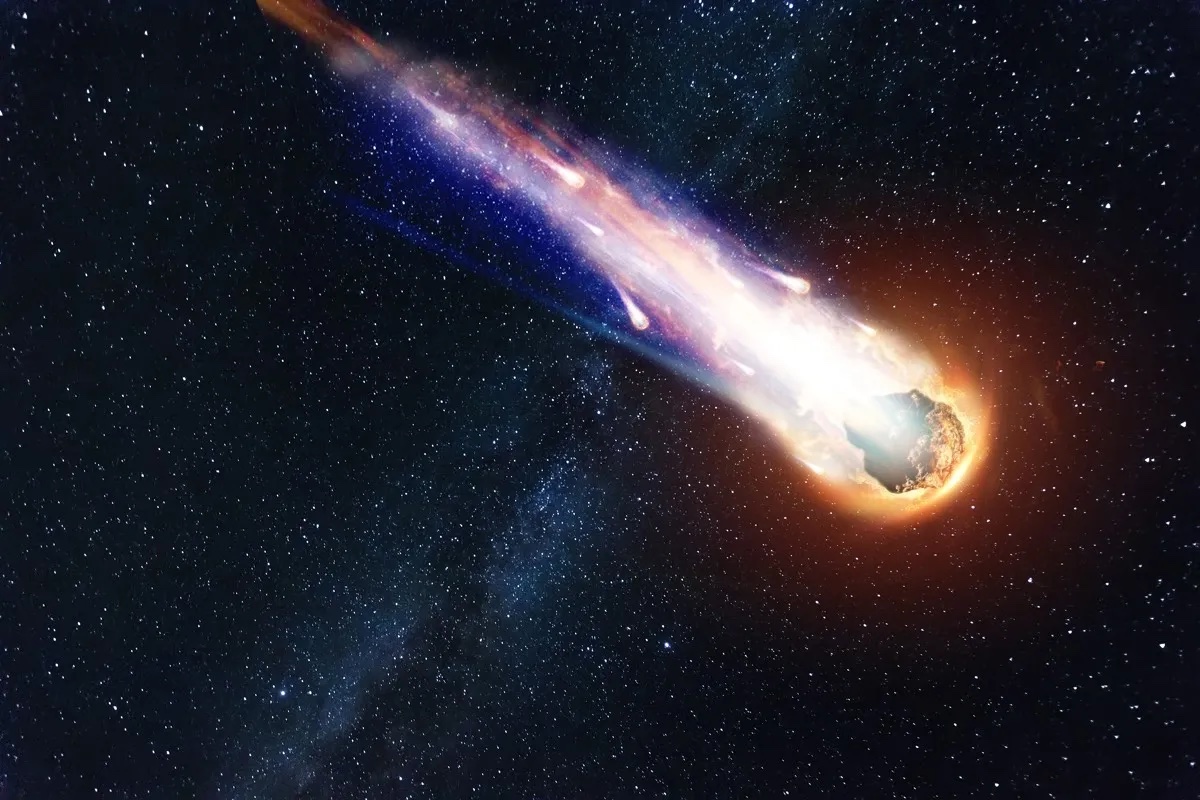
The raw materials from a comet have been found sealed inside a pristine, primitive meteorite. The meteorite was found in the LaPaz icefield of Antarctica and has weathered very little since the time it crashed to Earth. Researchers found that this sample of space rock contains something strange: bits of the building blocks of a comet that became trapped in the meteorite's parent asteroid just 3 million years after the solar system formed. Because this sample of cometary building block material was swallowed by an asteroid and preserved inside this meteorite, it was protected from the ravages of entering Earth's atmosphere.
'Rare species' of asteroid spotted in our solar system CNN - February 9, 2019
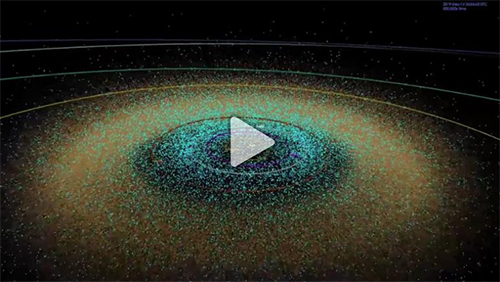
An odd kind of asteroid has been hiding out in our solar system, close to Venus, and it took a new state-of-the-art surveying camera to detect it. The Zwicky Transient Facility, known as ZTF, was installed on the Samuel Oschin Telescope at the California Institute of Technology's Palomar Observatory in March. Since then, it has observed over a thousand supernovae outside our galaxy, extreme cosmic events and more than a billion Milky Way stars.
Asteroid impacts on Earth make structurally bizarre diamonds PhysOrg - November 21, 2014
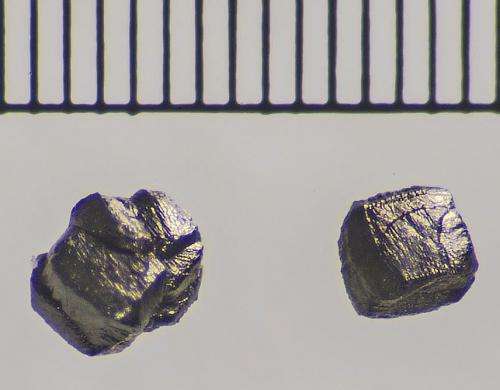
Scientists have argued for half a century about the existence of a form of diamond called lonsdaleite, which is associated with impacts by meteorites and asteroids. A group of scientists based mostly at Arizona State University now show that what has been called lonsdaleite is in fact a structurally disordered form of ordinary diamond.
Two Rings for Asteroid Chariklo NASA - April 9, 2014

Asteroids can have rings. In a surprising discovery announced two weeks ago, the distant asteroid 10199 Chariklo was found to have at least two orbiting rings. Chariklo's diameter of about 250 kilometers makes it the largest of the measured centaur asteroids, but now the smallest known object to have rings. The centaur-class minor planet orbits the Sun between Saturn and Uranus. The video on the page gives an artist's illustration of how the rings were discovered.
As Chariklo passed in 2013 in front of a faint star, unexpected but symmetric dips in the brightness of the star revealed the rings. Planetary astronomers are now running computer simulations designed to investigate how Chariklo's unexpected ring system might have formed, how it survives, and given the asteroid's low mass and close passes of other small asteroids and the planet Uranus, how long it may last.
Chariklo Wikipedia