
In a series of experiments, the team found that people felt significantly more emotionally "moved" by abstract paintings when the images spontaneously triggered autobiographical memories from their lives. Medical Express - June 30, 2026
The research brings together psychology and philosophy to better understand how people experience art. Finding suggests that spontaneous memories may play a unique role in aesthetic experience. In daily life, a lot of autobiographical memories simply pop into mind. When you deliberately try to retrieve one, the process is different. It becomes more like completing a task. That difference may shape how people interpret their emotional reactions. When a memory surfaces naturally while looking at a painting, viewers may attribute that emotional response to the artwork itself.
Frida Kahlo's self-portrait "The Dream" sells for record-breaking $55m BBC - November 21, 2025

A surrealist painting by famed Mexican artist Frida Kahlo has sold for $54.7million - shattering the auction record for an artwork by a woman. The painting, from the 1940s, went for more than 1,000 times its original auction price in 1980, after a tense bidding battle between two collectors, according to the auction house Sotheby's.The work depicts Kahlo asleep in a canopy bed beneath a skeleton entwined with dynamite.

Frida Kahlo - [July 6, 1907 - July 13, 1954] - Videos - Symbolism - Surrealism

I never paint dreams or nightmares. I paint my own reality. It helps me solve my problems and survive.
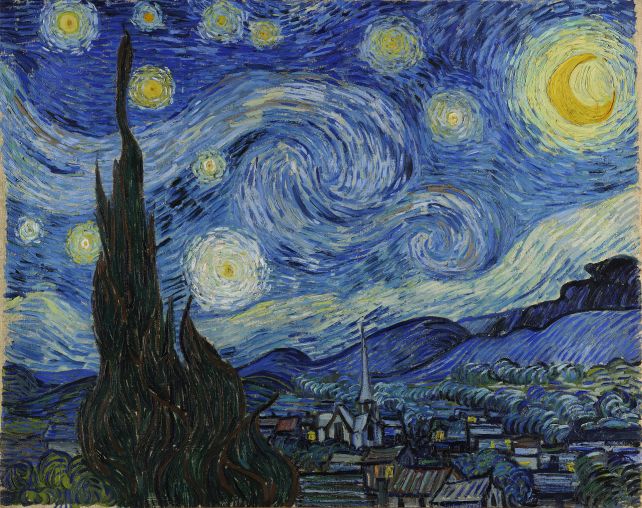
Ellie's Blog September 19, 2024 - The Starry Night
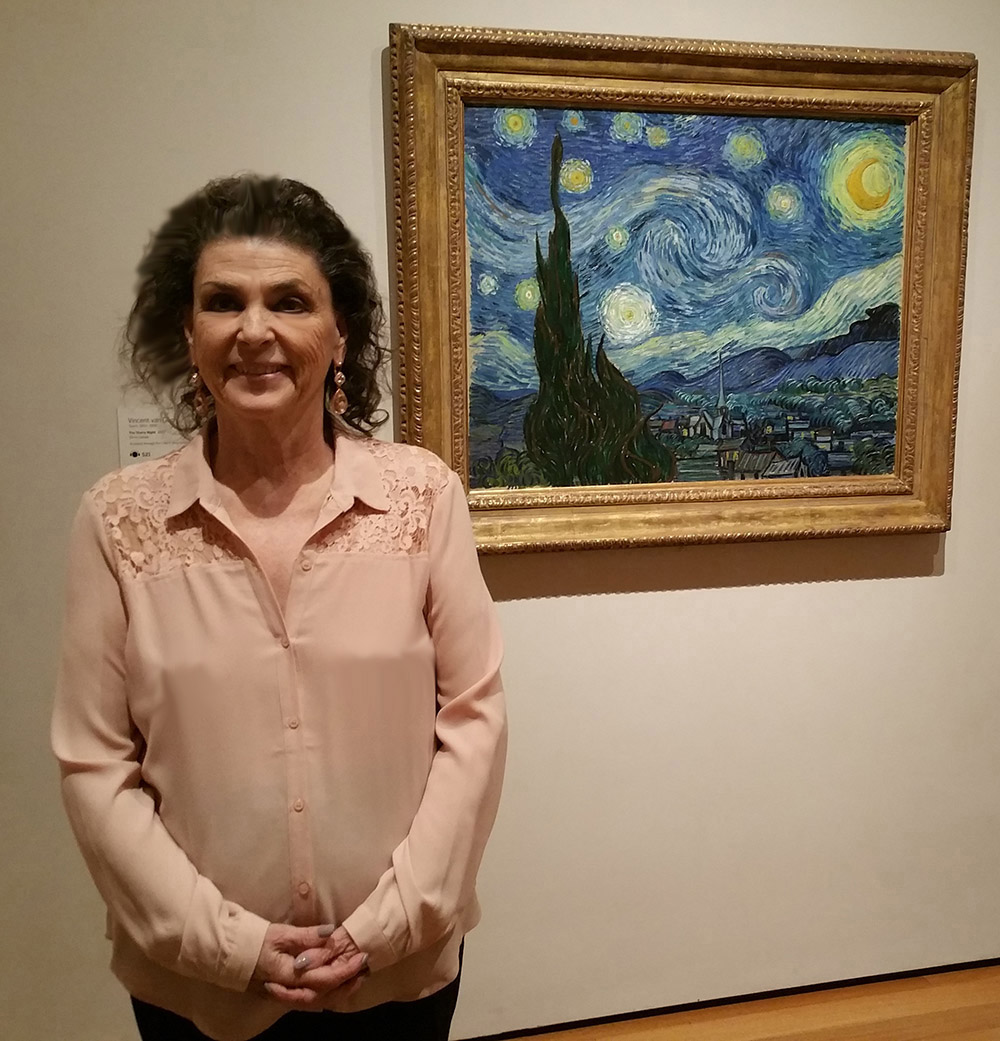
The brushstrokes in the van Gogh masterwork are consistent with the fluid dynamics of Earth's atmosphere - and, possibly, the broader Universe. PhysOrg - September 18, 2024
Vincent van Gogh's painting "The Starry Night" depicts a swirling blue sky with yellow moon and stars. The sky is an explosion of colors and shapes, each star encapsulated in ripples of yellow, gleaming with light like reflections on water. Van Gogh's brushstrokes create an illusion of sky movement so convincing it led atmospheric scientists to wonder how closely it aligns with the physics of real skies. While the atmospheric motion in the painting cannot be measured, the brushstrokes can. Researchers specializing in marine sciences and fluid dynamics iuncover what they call the hidden turbulence in the painter's depiction of the sky.
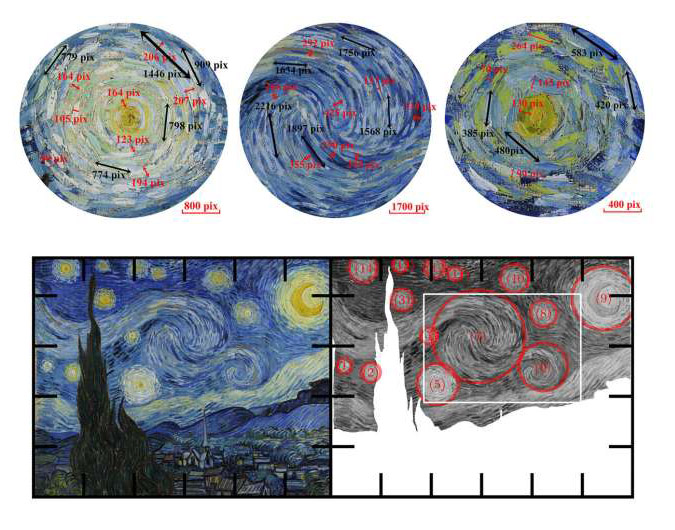
This Famous Van Gogh Painting from 1889 - The Starry Night - Features Astonishingly Accurate Physics Science Alert - September 18, 2024
Created by Dutch painter Vincent van Gogh in 1889, The Starry Night is one of the most intriguing works the art world has produced. Not only is it breathtakingly evocative, the roiling, swirling sky seems to suggest a detailed understanding of the physics of turbulence. Now, a new, in-depth analysis confirms it. The brushstrokes in the van Gogh masterwork are consistent with the fluid dynamics of Earth's atmosphere - and, possibly, the broader Universe.
One Of The Earliest Depictions Of Jesus Shows Him With A Donkey Head IFL Science - August 14, 2024
Alexamenos Graffito is a piece of Roman graffito scratched in plaster on the wall of a room near the Palatine Hill in Rome, Italy, which has now been removed and is in the Palatine Museum. Often called the earliest depiction of Jesus, the graffito is difficult to date, but has been estimated to have been made around the year 200 AD. The image seems to show a young man worshipping a crucified, donkey-headed figure. The Greek inscription approximately translates to "Alexamenos worships his god," indicating that the graffito was apparently meant to mock a Christian named Alexamenos.
Some scholars have argued the inscription is actually a depiction of the jackal-headed Egyptian god Anubis. For example, in his book on early Christian history published in 1876, Rev. John P. Lundy identifies the inscription as the "Gnostic Anubis." He writes that the inscription depicts the "head of Anubis, or Thoth, the Egyptian Mercury and custodian of the dead".
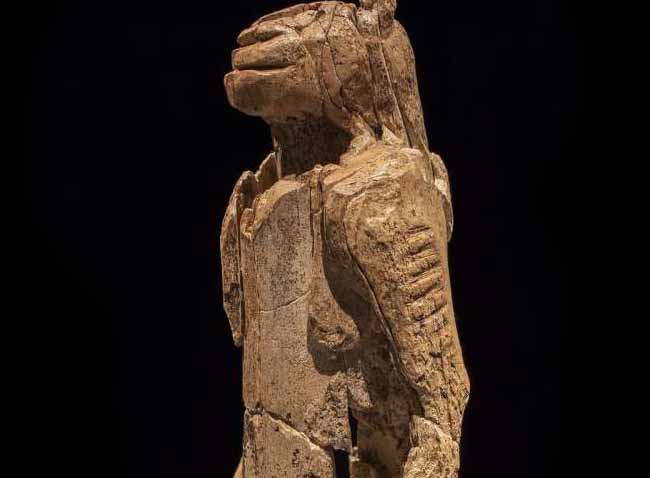
Did art exist before modern humans? New discoveries raise big questions Live Science - February 3, 2024
Scientists are finding ever-earlier examples of artistic expression in the archaeological record that reshape what we know about the cognitive abilities of our archaic human relatives, such as Neanderthals. For centuries, the "Unicorn Cave," or "Einhornhohle," in central Germany has been famous for its many thousands of bones. In medieval times, people thought the bones came from unicorns.
But a few years ago, archaeologists excavating the cave unearthed an unusual object: a toe bone from a giant deer. The material itself was noteworthy: Although giant deer were once prey for Europe's prehistoric hunters, the animals usually roamed much farther north, indicating this bone had been brought from afar. And it was clearly different from others in the cave: Several large grooves had been carved at angles into the bone's upper surface, creating a prominent chevron-like pattern. Even more extraordinary was its age: Radiocarbon dating of the bone showed that the deer lived around 51,000 years ago, when the Unicorn Cave was occupied by Neanderthals, our extinct human relatives.
The Mona Lisa reveals a toxic secret hidden Inside the painting - the rare compound plumbonacrite Science Alert - October 19, 2023
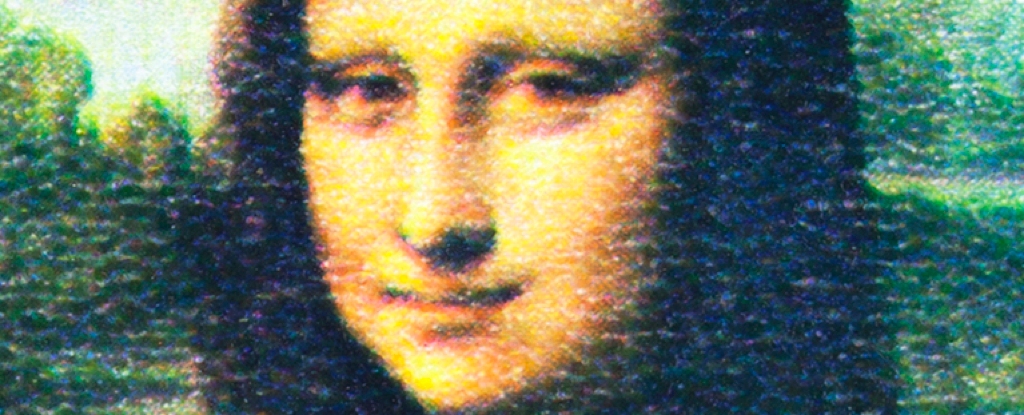
Leonardo da Vinci is well known for having used less conventional painting methods and substances in his work, and we're still making new discoveries about them - the latest being a mix of toxic pigments underlying the brushwork on the Mona Lisa. Researchers from France and the UK looked at a tiny microsample taken from a hidden corner of the Mona Lisa, deploying a variety of X-ray diffraction and infrared spectroscopy imaging techniques to identify the substances used. The team found not only oil and lead white – as expected - but also the rare compound plumbonacrite.
Scientists identify secret ingredient in Leonardo da Vinci paintings - egg yolks CNN - March 29, 2023
"Old Masters" such as Leonardo da Vinci, Sandro Botticelli and Rembrandt may have used proteins, especially egg yolk, in their oil paintings, according to a new study. Trace quantities of protein residue have long been detected in classic oil paintings, though they were often ascribed to contamination. A new study found the inclusion was likely intentional - and sheds light on the technical knowledge of the Old Masters, the most skilled European painters of the 16th, 17th, or early 18th century, and the way they prepared their paints.
Hidden Van Gogh self-portrait found behind another painting CNN - July 15, 2022
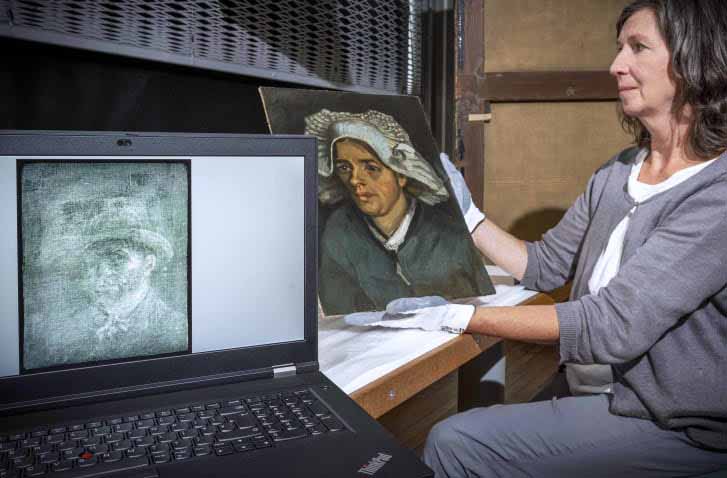
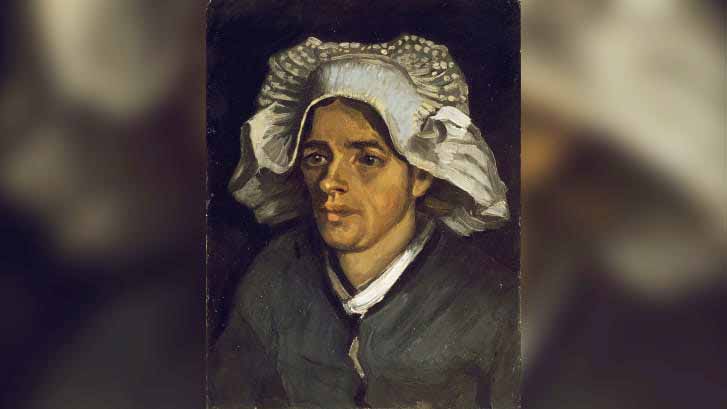
A hidden self-portrait by Vincent van Gogh has been discovered behind one of his paintings, covered by layers of glue and cardboard for more than a century. The image was found when art conservators took an X-ray of Van Gogh's 1885 "Head of a Peasant Woman" painting ahead of a forthcoming exhibition. They discovered the concealed image at the back of its canvas hidden by a sheet of cardboard. Experts say the revealed artwork is believed to have been unknown until now.
What Secrets Lie Beneath the Surface of Picasso's Blue Period Paintings? Smithsonian - April 13, 2022
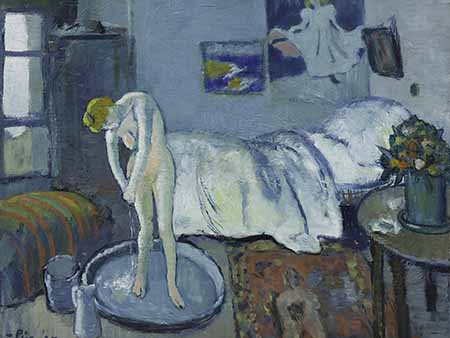
Over the past two decades, researchers have discovered hidden under paintings in multiple works from Pablo Picasso’s Blue Period. Most famously, examinations at the turn of the millennium uncovered a woman’s face under The Old Guitarist (1903–1904). More recently, conservation has revealed painted-over elements in The Blue Room (1901), Crouching Beggarwoman (1902) and The Soup (1903).
A new artificial intelligence (A.I.) tool may be able to foil fraud and help art historians determine the original creator behind particular paintings. The system analyzes tiny sections of paintings, some as small as half a millimeter, for telltale differences in brushwork Smithsonian - January 13, 2022

While previous projects used a form of machine learning to identify artists based on the analysis of high-resolution images of the paintings, the new system uses topographical scans of the canvasses. They can accurately predict who painted it from an individual patch
Hidden baby Jesus revealed under Leonardo da Vinci's 'Virgin of the Rocks' Live Science - February 6, 2020
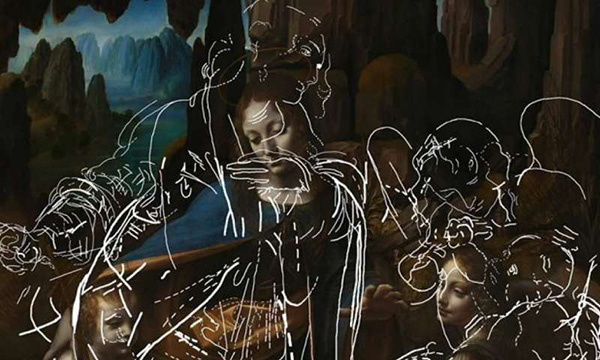
This isn't the first signal that the "Virgin of the Rocks" hid older sketches that might have led to a different masterpiece. A similar effort, using infrared light in August 2019, revealed a sketch of a different Virgin Mary posed higher in the frame, as Live Science previously reported. But this new scan of the painting using a technique called macro X-ray fluorescence (MA-XRF) - as well as a new algorithm to interpret the data - revealed the head and wings of this unseen baby Jesus.
New algorithm helps uncover forgotten figures beneath Da Vinci painting Virgin of the Rocks PhysOrg - February 4, 2020
In doing so they revealed, more clearly than ever before, the hidden figures that Leonardo first drew before changing his design to the one that he eventually painted. These included abandoned images of an angel and the Infant Christ.
Artists Who Paint With Their Feet Have Unique Brain Patterns Smithsonian - January 30, 2020
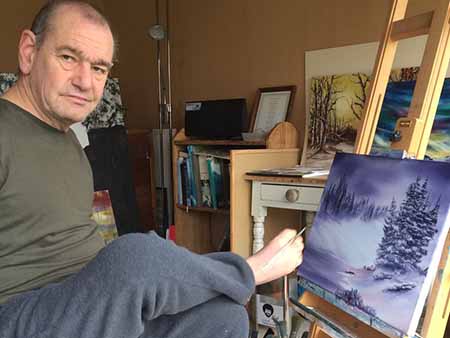
Neuroscientists determined that certain sensory maps in the brain become more refined when people use their feet like hands
Ghent Altarpiece: Lamb's 'alarmingly humanoid' face surprises art world BBC - January 23, 2020
The restoration of a prized 15th Century painting has revealed the "human-like face of a lamb", surprising art critics and spurring debate. The Ghent Altarpiece, completed by Hubert and Jan Van Eyck in 1432, has captivated the art world for centuries. Housed at St Bavo's Cathedral in Ghent, Belgium, it is seen as the first major oil painting to gain global fame. Since 2012, a 2.2m euro (£1.8m; $2.4m) project to restore the artwork has been taking place at a museum in Belgium. In the second phase of the project, which ended last month, restorers made some unexpected discoveries.
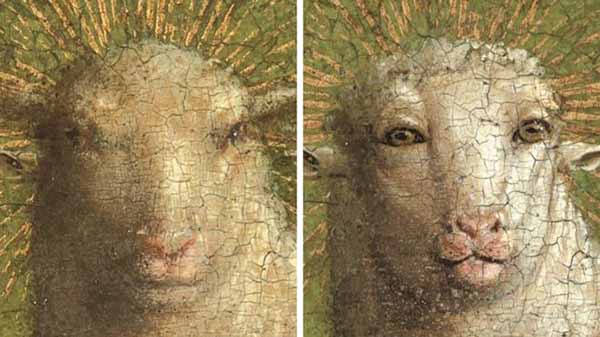
Why this restored 15th-century 'Jesus-lamb' painting
by Jan and Hubert Van Eyck is creeping people out Live Science - January 23, 2020
Hubert van Eyck and Jan van Eyck
Earliest Depiction of Jesus Christ in Israel Discovered Live Science - November 27, 2018
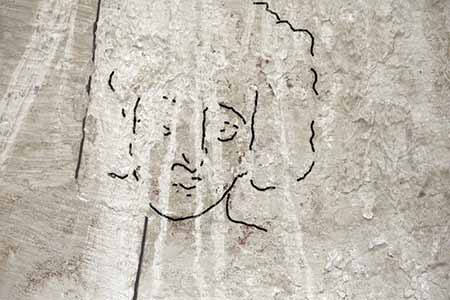
The iconography of Christ with short hair was common throughout the east of the Byzantine Empire, Maayan-Fanar explained, especially in Egypt and the Syria-Palestine region. But it was eventually displaced by Byzantine images of Christ with long hair, which remains a common portrayal today. Christ was also shown as a very young man, she said, because his baptism in the Jordan symbolized a "new birth." For the same reason, the painting shows a larger figure of John the Baptist, who is said to have presided at Christ's baptism, according to the Christian Gospels.
Prehistoric cave art reveals ancient use of complex astronomy Live Science - November 27, 2018
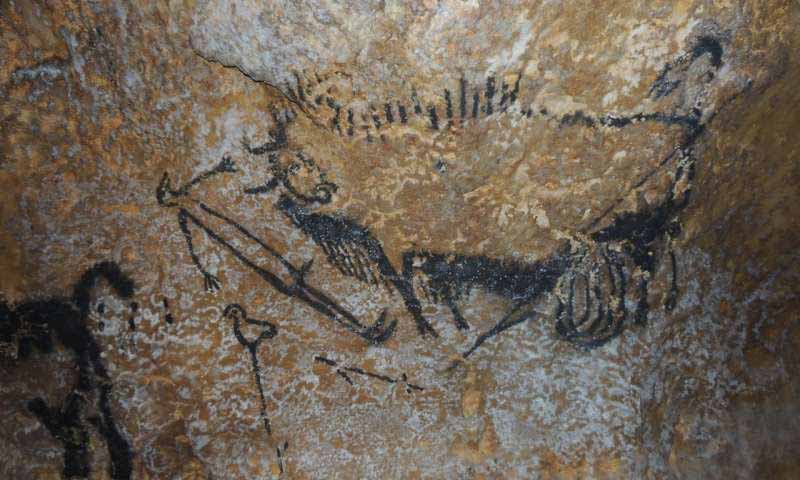
Some of the world's oldest cave paintings have revealed how ancient people had relatively advanced knowledge of astronomy. The artworks, at sites across Europe, are not simply depictions of wild animals, as was previously thought. Instead, the animal symbols represent star constellations in the night sky, and are used to represent dates and mark events such as comet strikes, analysis suggests. They reveal that, perhaps as far back as 40,000 years ago, humans kept track of time using knowledge of how the position of the stars slowly changes over thousands of years.
The findings suggest that ancient people understood an effect caused by the gradual shift of Earth's rotational axis. Discovery of this phenomenon, called precession of the equinoxes, was previously credited to the ancient Greeks. Around the time that Neanderthals became extinct, and perhaps before mankind settled in Western Europe, people could define dates to within 250 years, the study shows. The findings indicate that the astronomical insights of ancient people were far greater than previously believed. Their knowledge may have aided navigation of the open seas, with implications for our understanding of prehistoric human migration.
Researchers studied details of Paleolithic and Neolithic art featuring animal symbols at sites in Turkey, Spain, France and Germany. They found all the sites used the same method of date-keeping based on sophisticated astronomy, even though the art was separated in time by tens of thousands of years. They clarified earlier findings from a study of stone carvings at one of these sites - Gobekli Tepe in modern-day Turkey - which is interpreted as a memorial to a devastating comet strike around 11,000 BC. This strike was thought to have initiated a mini ice-age known as the Younger Dryas period.
They also decoded what is probably the best known ancient artwork - the Lascaux Shaft Scene in France. The work, which features a dying man and several animals, may commemorate another comet strike around 15,200 BC, researchers suggest. The team confirmed their findings by comparing the age of many examples of cave art - known from chemically dating the paints used - with the positions of stars in ancient times as predicted by sophisticated software.
The earliest known painting of an animal has been identified in a cave on the island of Borneo. BBC - November 7, 2018
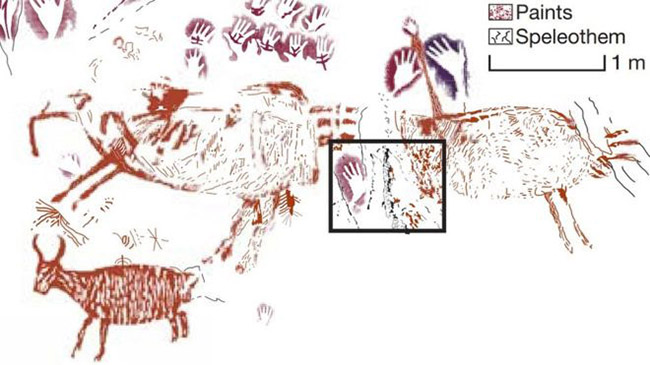
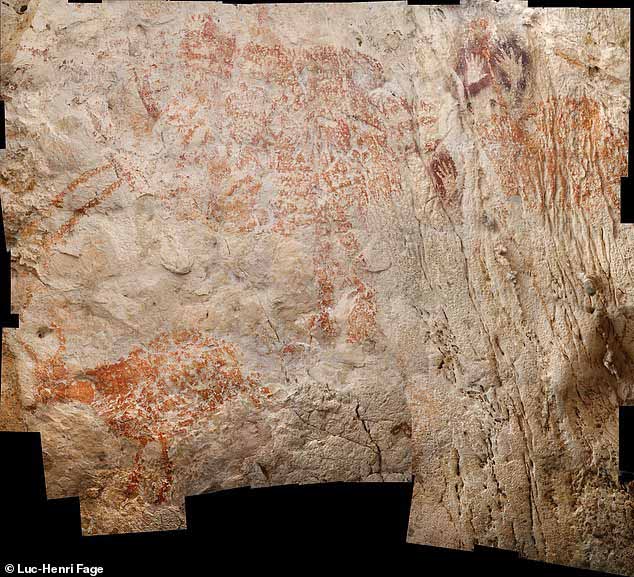
The artwork, which is at least 40,000 years old, is thought to be the oldest example of figurative painting - where real objects are depicted rather than abstract shapes. The researchers aren't certain what animal it represents, but their hunch is that it's a banteng, a type of wild cow that lives in the area today. The painting was found in a system of caves in the remote and rugged mountains of East Kalimantan, an Indonesian province on Borneo. The caves contain thousands of other prehistoric paintings, drawings and other imagery, including hand stencils, animals, abstract signs and symbols.
World's Oldest Animal Drawing, Discovered in Borneo Cave, Is a Weird Cow Beast Live Science - November 7, 2018
A VERY old master: Cave art created in Borneo 40,000 years ago is the world's oldest figurative art, scientists reveal Daily Mail - November 7, 2018

Who is Bansky? Wikipedia
Banksy publishes video detailing auction stunt plan The Guardian - October 8, 2018
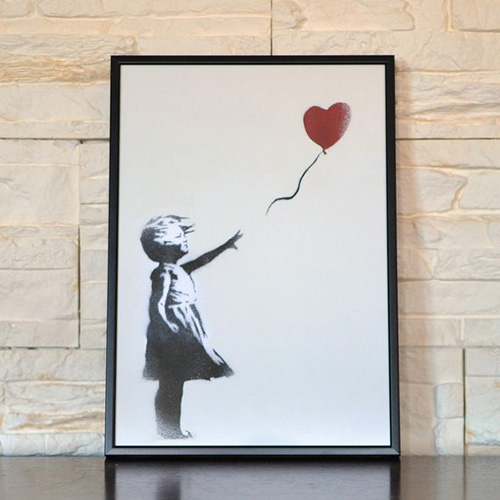
Banksy artwork Girl With a Balloon self-destructs. After selling at auction - the canvas passed through a shredder installed in the bottom of the frame The Guardian - October 8, 2018
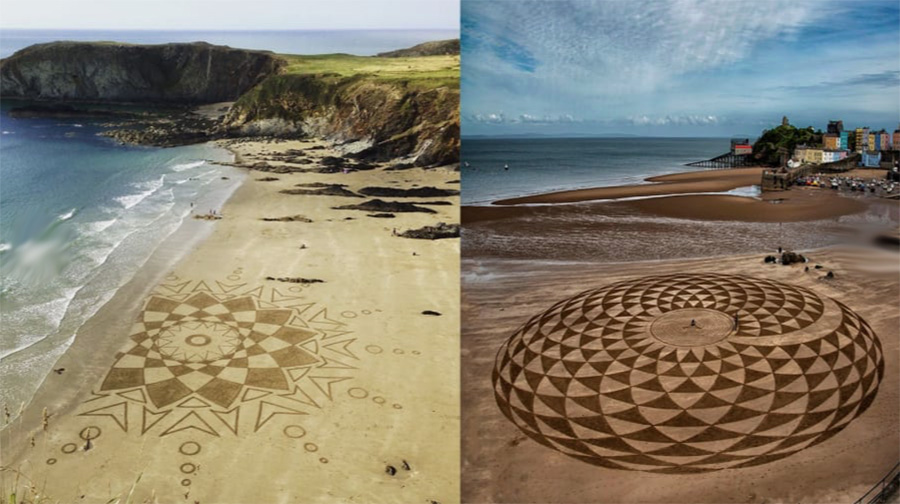
The story behind these mysterious sand murals on Britain's beaches CNN - October 8, 2018
If you've been frequenting the sandy beaches along the rugged, Welsh Pembrokeshire Coast in Britain, you might have noticed some mysterious shapes appearing in the sand. These intricate murals are beach-based works of art created by local sand muralist Marc Treanor.
Inspired by crop circles, the enigmatic formations that occasionally appear in corn and wheat fields, Treanor forges stunningly intricate patterns and pictures by raking wet sand.
When he's done, Treanor watches as his hard work is consumed by the crashing waves, but he says that's all part of the experience.
It's completely part of it, it's totally integral to the work and the fact it is impermanent and it is temporary. That said, he usually has chance to capture his creations on camera for posterity. These intricate murals are beach-based works of art created by local sand muralist Marc Treanor. Inspired by crop circles, the enigmatic formations that occasionally appear in corn and wheat fields, Treanor forges stunningly intricate patterns and pictures by raking wet sand. When he's done, Treanor watches as his hard work is consumed by the crashing waves, but he says that's all part of the experience.
Treanor says there are three key steps to creating the perfect sand mural.
Phase 1: sketching out the pattern at home, on paper.
Phase 2: Heading down to the beach, rake in hand, and getting started on the creation process.
Phase 3: This is the sort of contemplative side, so ideally there's a nice viewpoint and whoever's been involved, we can all go up to the clifftop and gaze down upon the beach and watch the creation being reabsorbed by the sea ...
The World's Oldest Known Drawing Is a 73,000-Year-Old Hashtag Live Science - September 13, 2018
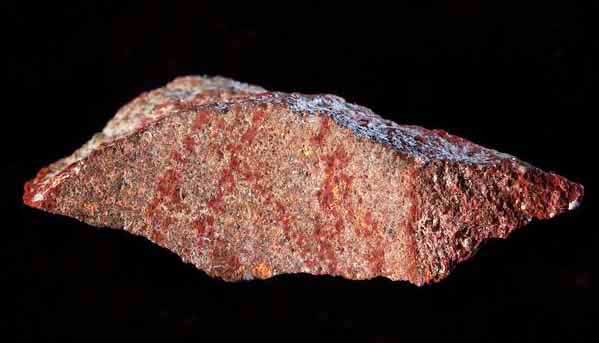
A small rock flake no larger than a house key is covered with a colossal surprise: the first known drawing ever made by a human. Some human or humans (Homo sapiens) used a red-ochre crayon to draw a hashtag-like design on a rock flake in what is now South Africa about 73,000 years ago, said the researchers who analyzed the doodle.
Drawing on a piece of silcrete found in Blombos Cave predates previous human-made drawings by at least 30,000 years PhysOrg - September 12, 2018

The drawing, which consists of three red lines cross-hatched with six separate lines, was intentionally drawn on a smooth silcrete flake about 73 000 years ago. This predates previous drawing from Africa, Europe and Southeast Asia by at least 30 000 years. The drawing on the silcrete flake was a surprising find by archaeologist Dr. Luca Pollarolo, an honorary research fellow at the University of the Witwatersrand (Wits), while he painstakingly sifted through thousands of similar flakes that were excavated from Blombos Cave at the Wits University satellite laboratory in Cape Town. Blombos The cave contains material dating from 100,000 - 70,000 years ago, a time period referred to as the Middle Stone Age. Later Stone Age material dating from 2,000-300 years ago.
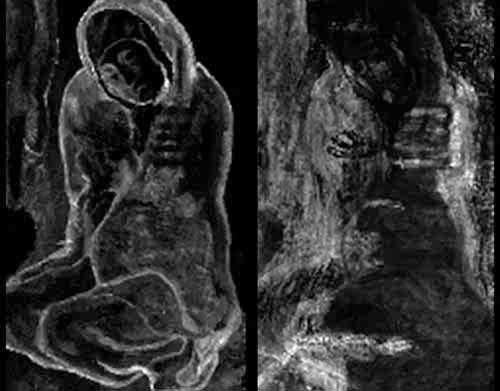
Hidden Artwork Found Beneath Picasso 'Blue Period' Masterpiece Live Science - February 17, 2018
Hidden painting under Picasso masterpiece BBC - February 17, 2018
Unprecedented study of Picasso's bronzes uncovers new details PhysOrg - February 18, 2018
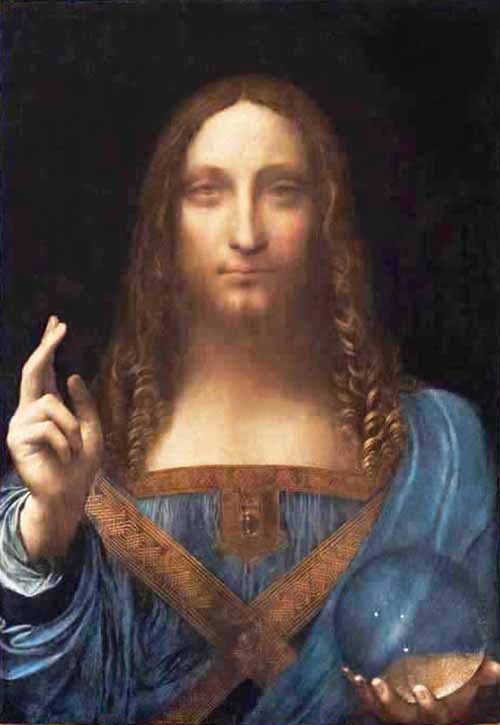
Note that Jesus is holding a crystal ball. There is also a strong feminine energy here.
'Leonardo da Vinci artwork' sells for record $450m BBC - November 16, 2017
A 500-year-old painting of Christ believed to have been painted by Leonardo da Vinci has been sold in New York for a record $450m (£341m). The painting is known as Salvator Mundi (Saviour of the World). It is the highest auction price for any work of art and brought cheers and applause at the packed Christie's auction room. Leonardo da Vinci died in 1519 and there are fewer than 20 of his paintings in existence.
38,000 year-old engravings confirm ancient origins of technique used by Seurat, Van Gogh PhysOrg - February 24, 2017 <9>
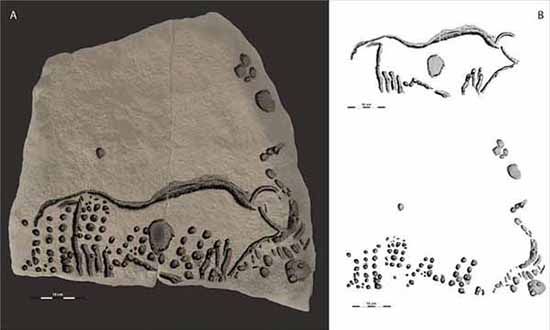
A newly discovered trove of 16 engraved and otherwise modified limestone blocks, created 38,000 years ago, confirms the ancient origins of the pointillist techniques later adopted by 19th and 20th century artists such as Georges Seurat, Vincent Van Gogh, Camille Pissarro, and Roy Lichtenstein. Pointillism, a painting technique in which small dots are used to create the illusion of a larger image, was developed in the 1880s. However, archaeologists have now found evidence of this technique thousands of years earlier - dating back more than 35,000 years.
Neuroscience study supports 200-year old art theory Medical Express - September 19, 2016
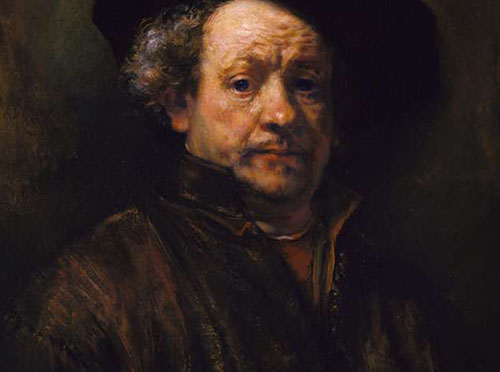
A pilot study from a group of Dutch scientists implies that being told that an image is an artwork automatically changes our response, both on a neural and behavioral level. This may mean that our brains automatically up- or down-regulate emotional response according to the whether a work should be understood at face value, or whether it should be interpreted as art. This tends to lend support to an over 200-year-old theory of art, first put forward by the philosopher Immanuel Kant in his "Critique of Judgement."
X-Rays Reveal Lost Portrait by Edgar Degas Behind 19th-Century Painting Live Science - August 4, 2016
A hidden portrait of a mysterious woman has been found under a painting by the French artist Edgar Degas, according to a new study. Researchers used X-rays to peer through the layers of one of Degas' paintings, uncovering the "lost" work, which the artist later covered with another painting. The researchers made the discovery by scanning the painting with X-rays to map metallic elements in the pigments on the canvas. Data from the scan were used to build a 31-megapixel image of the hidden portrait in almost photographic detail.
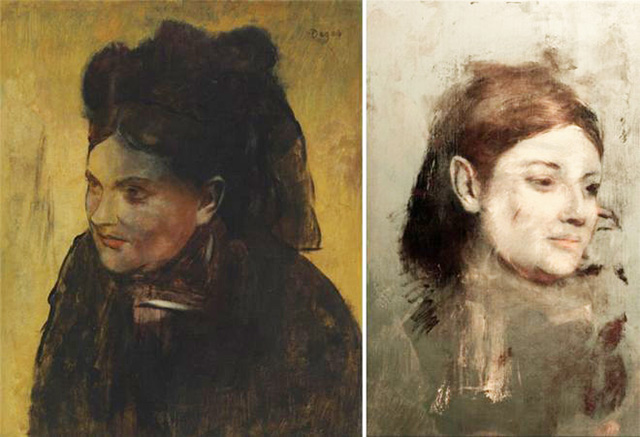
Hidden Degas portrait revealed BBC - August 4, 2016
A hidden portrait by the French Impressionist painter Edgar Degas has been revealed by scientists.
Researchers in Australia used powerful X-rays to bring to light the painting of a young woman concealed beneath a work called Portrait of a Woman. The researchers believe the subject is Emma Dobigny, who appeared in other Degas paintings. t had long been known that Degas' portrait of a woman wearing a black bonnet and dress, which he painted in the late 1870s, covered an earlier painting.
A ghostly impression of the composition appears as a dark stain on the sitter's face, and over the years has become more prominent as the oil paint thinned. Conventional X-rays revealed the outline of another image was lurking beneath, but without scraping away the outer painting, the researchers required a much more powerful technique to show any detail.
May 8, 2016 - Loving Vincent is a 2017 animated biographical drama film about the life of painter Vincent van Gogh, and in particular, the circumstances of his death. It is the first fully painted animated feature film. The film, written and directed by Dorota Kobiela and Hugh Welchman, is a Polish production, funded by the Polish Film Institute, and partially through a Kickstarter campaign. First conceived as a 7 minute short movie in 2008, Loving Vincent was idealized by Dorota Kobiela, a painter herself, after studying the techniques and the artist's story through his letters. Each of the film's 65,000 frames is an oil painting on canvas, using the same technique as Van Gogh, created by a team of 125 painters.[ The film premiered at the 2017 Annecy International Animated Film Festival. It won Best Animated Feature Film Award at the 30th European Film Awards in Berlin and was nominated for Best Animated Feature at the 90th Academy Awards.