
Earliest botanical art hints at prehistoric mathematical thinking PhysOrg - December 11, 2025
Earlier prehistoric art focused primarily on humans and animals. Halafian pottery, however, marks the moment when the plant world entered human artistic expression in a systematic and visually sophisticated way. Across 29 archaeological sites, Garfinkel and Krulwich documented hundreds of carefully rendered vegetal motifs, some naturalistic, others abstract, all reflecting conscious artistic choice. These vessels represent the first moment in history when people chose to portray the botanical world as a subject worthy of artistic attention. It reflects a cognitive shift tied to village life and a growing awareness of symmetry and aesthetics.

Stunning blue pigment on a 13,000-year-old artifact surprises scientists. The find suggests ancient people possessed deeper knowledge of minerals and colors than believed. Science Daily - December 9, 2025
It also hints at vanished forms of decoration or artistic practices. The discovery dates to roughly 13,000 years ago and opens new avenues for exploring identity and symbolism in Ice Age cultures. After applying a variety of advanced scientific techniques, the team determined that the residue came from azurite, a bright blue mineral pigment that has not previously been documented in Paleolithic art in Europe.
The World's Oldest Known Drawing Is a 73,000-Year-Old Hashtag Live Science - September 13, 2018
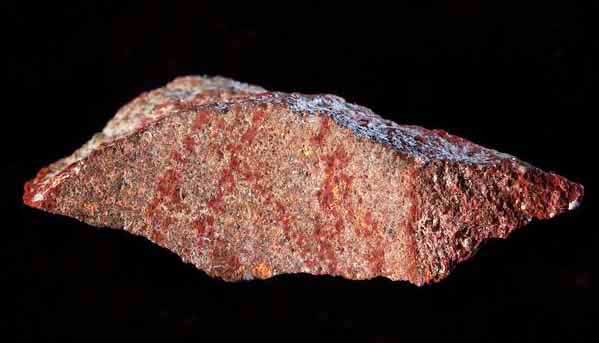
A small rock flake no larger than a house key is covered with a colossal surprise: the first known drawing ever made by a human. Some human or humans (Homo sapiens) used a red-ochre crayon to draw a hashtag-like design on a rock flake in what is now South Africa about 73,000 years ago, said the researchers who analyzed the doodle.
Drawing on a piece of silcrete found in Blombos Cave predates previous human-made drawings by at least 30,000 years PhysOrg - September 12, 2018

The drawing, which consists of three red lines cross-hatched with six separate lines, was intentionally drawn on a smooth silcrete flake about 73 000 years ago. This predates previous drawing from Africa, Europe and Southeast Asia by at least 30 000 years. The drawing on the silcrete flake was a surprising find by archaeologist Dr. Luca Pollarolo, an honorary research fellow at the University of the Witwatersrand (Wits), while he painstakingly sifted through thousands of similar flakes that were excavated from Blombos Cave at the Wits University satellite laboratory in Cape Town. Blombos The cave contains material dating from 100,000 - 70,000 years ago, a time period referred to as the Middle Stone Age. Later Stone Age material dating from 2,000-300 years ago.

Rock Art: Prehistoric, Cave Art, Rock Art: Petroglyphs, Pictograms, Geoglyphs
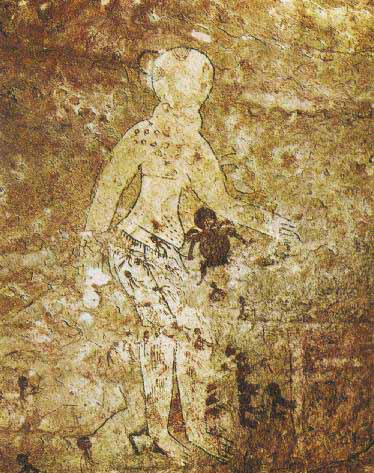
Ancient Cave Art