Physics News
Scientists freeze beam of light BBC - December 2003
 Physicists say they have brought light to a complete halt
for a fraction of a second and then sent it on its way.
Physicists say they have brought light to a complete halt
for a fraction of a second and then sent it on its way.

Molecules form new state of matter Nature - November 2003
Researchers have coaxed a group of molecules into a weird type of matter
called a Bose-Einstein condensate, or BEC. The achievement gives physicists
a powerful new tool for investigating phenomena such as superconductivity.
Batteries -
Scientists develop 'bacterial battery' BBC
A novel microbe, found in marine sediments, is able to convert sugar
into electricity with a higher efficiency that any previously known organism.
Microbatteries - thousandth of a millimetre across Nature
World's biggest battery switched on in Alaska
The world's biggest battery was plugged in yesterday to provide emergency power to one of the United States' most isolated cities.
The rechargable battery, which at 2,000 square metres is bigger than a football pitch and weighs 1,300 tonnes, was manufactured by power components specialist ABB to provide electricity to Fairbanks, Alaska's second-largest city, in the event of a blackout.
Stored in a warehouse near the city, where temperatures plunge to -51 degrees Centigrade in winter, the battery will provide 40 megawatts of power - enough for around 12,000 people - for up to seven minutes.
This is enough time, according to ABB, to start up diesel generators to restore power, an important safeguard since at such low temperatures, water pipes can freeze entirely in two hours.
With no power lines between the state and the rest of America, Alaska is often described as an "electrical island" where tough environmental conditions and a sparse population make power cuts a way of life.
ABB's battery, the first of its scale in the world, was commissioned by Golden Valley Electrical Association (GVEA) in Fairbanks, because the city suffers total blackouts every two or three years, as well as frequent swings in power supply.
The earthquake-proof contraption contains 13,760 NiCad cells - bigger versions of those used in many portable electronic appliances including laptop computers and radios. Each cell measures 16in by 21in and weighs more than 12 stone.
ABB, a Swiss company listed in London, is one of the companies set to benefit from the US's decision to spend between $50 billion and $100 billion improving its power grid after the blackouts this month. This follows a difficult year in which asbestos claims, corporate governance scandals and financial and business difficulties almost tore apart the company.
Peter Smits, head of the company's power technologies division, said: "This battery will improve power reliability in an area where it is vital. We have entered it for the Guinness Book of Records."
A spokesman from Guinness World Records said: "Well this battery certainly looks like being the biggest in the world, but of course we will have to check all the evidence when it comes in."
Molecules of life come in waves Nature - September 2003
Compounds found in cells show quantum behaviour.

The world's smallest buckets BBC - September 2003
Nano test tubes so small they hold just a few hundred atoms
Squeezed light breaks quantum barrier Physicsweb - September 2003
Map shows variations in Earth's gravitational field BBC - August 2003
Optic fibre delivers solar surgery New Scientist - August 2003
Glass pane containing liquid crystals - guide and manipulate beams of light NASA - - August 2003
World's smallest electric rotor created by physicists Nature - August 2003
Zero Point Energy Guardian - August 2003
World's smallest electric rotor created by physicists July 2003 - Nature
Solar sailing 'breaks laws of physics' July 2003 - New Scientist
A physicist is claiming that solar sailing - the idea of using sunlight to blow
spacecraft across the solar system - is at odds with the laws of thermal physics.
Accelerating Universe theory dispels dark energy Nature July 2003

Is dark energy - negative gravity - driving everything apart with increasing speed?
Behold the pentaquark BBC July 2003

Physicists have discovered a new class of subatomic particle that will
provide unexpected insights into the fundamental building blocks of matter.
Maps revealing the details of how electrical storms evolve July 2003 - Discovery
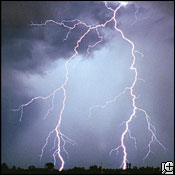
Stopping Time - Time just got shorter Discover July 2003
Nanotechnology around since 4500 BC Nature July 2003
Key sub-atomic particle slips away again July 2003 - New Scientist
Pinning down the Higgs boson, or proving that it does not exist, would
be a huge step towards understanding why our Universe has mass.
Scientists Observe Unknown Lightning Type Space.com - June 2003

Alchemy with light shocks physicists New Scientist - May 2003
Claims of "unexpected and stunning new physical phenomena"
are rare in the abstract of a reputable scientific paper.
Physicists find 'rebel' particle May 2003 - BBC
Physicists have found a new subatomic particle, named Ds (2317).
It will help them better understand the building blocks of matter.
The particle consists of an unusual combination of more fundamental particles - quarks.
Rockets Trigger Lightning, Scientists Discover X-ray BBC - February 2003

Strongest magnet in the cosmos Physics Web - January 2003
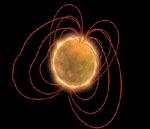
Physicist proposes deeper layer of reality Nature - January 2003
New theory takes the chance out of quantum mechanics.
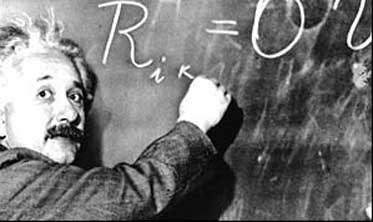
Einstein proved right on gravity BBC
First speed of gravity measurement revealed New Scientist
The speed of gravity has been measured for the first time.
The landmark experiment shows that it travels at the
speed of light, meaning that Einstein's general theory of
relativity has passed another test with flying colours.
Breakthrough Brings Laser Light To New Regions Of The Spectrum January 2003 - Science Daily
Random vibrations can generate rotation and motion August 2002 - Nature
Fusion reactor breaks duration record August 2002 - New Scientist
Second law broken July 2002 - Nature Magazine
Researchers have shown for the first time that, on the
level of thousands of atoms and molecules, fleeting energy
increases violate the second law of thermodynamics.
The First Law of Thermodynamics: Heat is work and work is heat.
The Second Law of Thermodynamics: Heat cannot of itself pass
from one body to a hotter body
PHYSICS
PHYSICAL SCIENCES
ALPHABETICAL INDEX OF ALL FILES
CRYSTALINKS MAIN PAGE