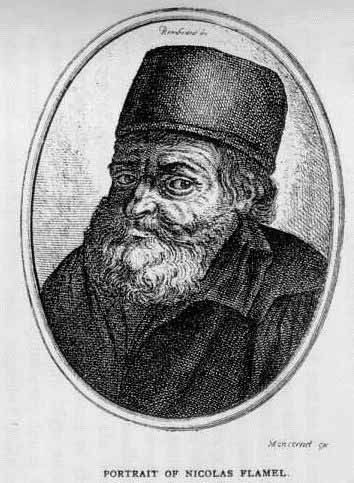
Nicolas Flamel 1330 - Paris, March 22, 1418 - was a successful French scrivener and manuscript-seller who developed a posthumous reputation as an alchemist due to his reputed work on the Philosopher's Stone.
According to the introduction to his work and additional details that have accrued since its publication, Flamel was the most accomplished of the European alchemists, and had learned his art from a Jewish converso on the road to Santiago de Compostela. As Deborah Harkness put it, "Others thought Flamel was the creation of 17th-century editors and publishers desperate to produce modern printed editions of supposedly ancient alchemical treatises then circulating in manuscript for an avid reading public."
The modern assertion that many references to him or his writings appear in alchemical texts of the 16th century, however, has not been linked to any particular source. The essence of his reputation are claims that he succeeded at the two magical goals of alchemy: that he made the Philosopher's Stone, which turns lead into gold, and that he and his wife Perenelle achieved immortality through the "Elixir of Life".
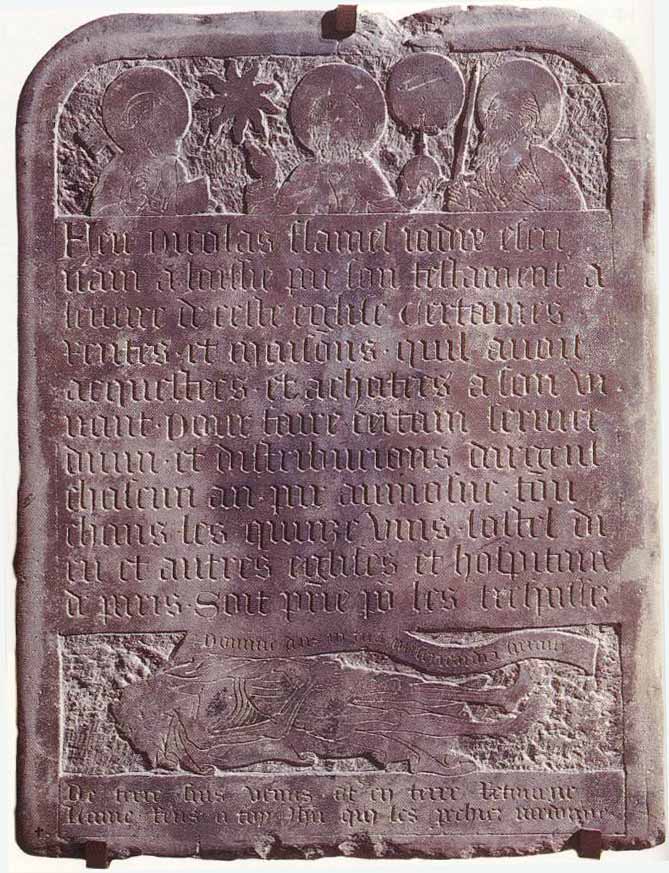
Nicolas and his wife Perenelle were Roman Catholics. Later in life they were noted for their wealth and philanthropy as well as multiple interpretations on modern day alchemy. Flamel lived into his 80s, and in 1410 designed his own tombstone, which was carved with arcane alchemical signs and symbols. The tombstone is preserved at the Musee de Cluny in Paris.
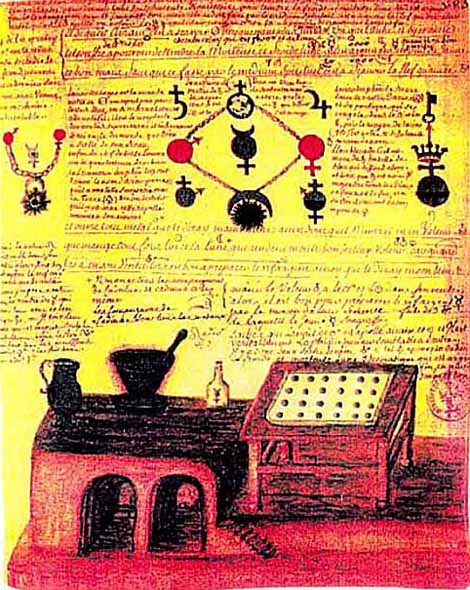
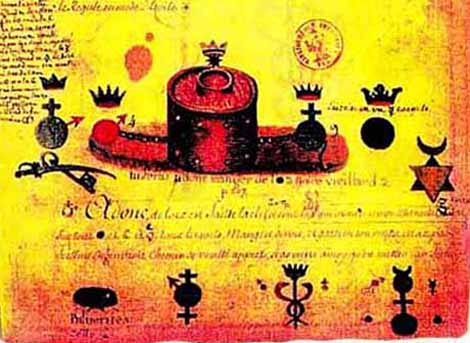
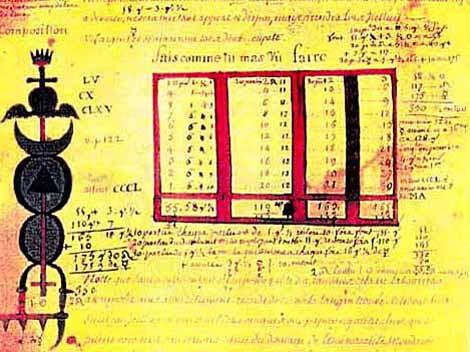
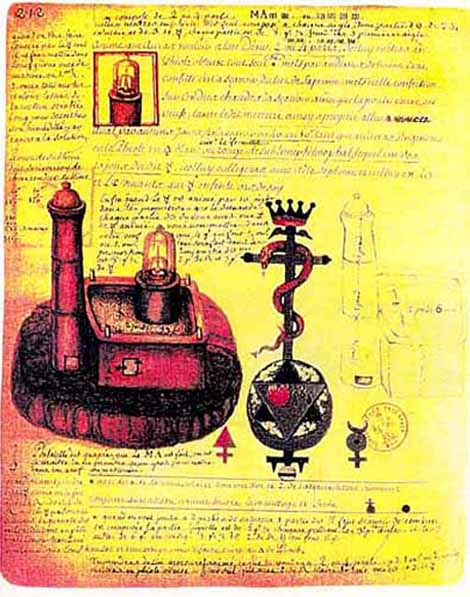
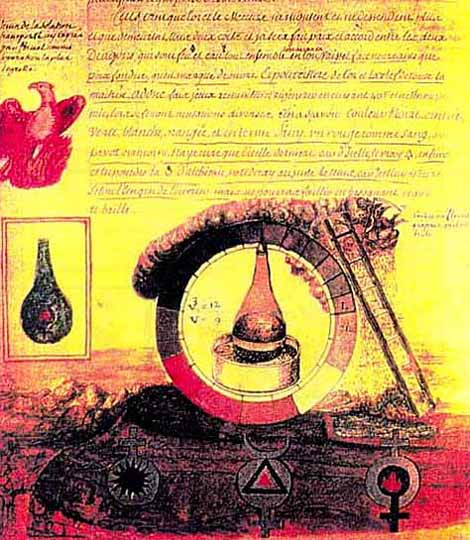
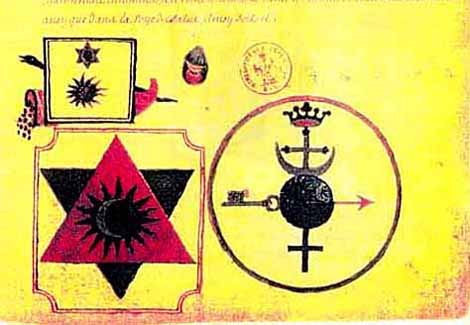
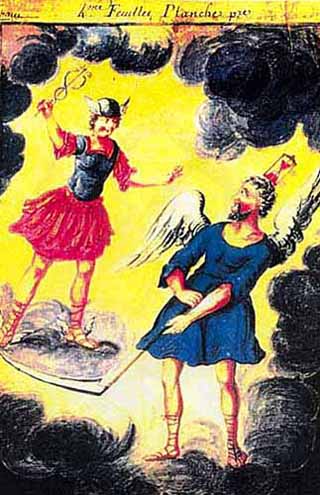
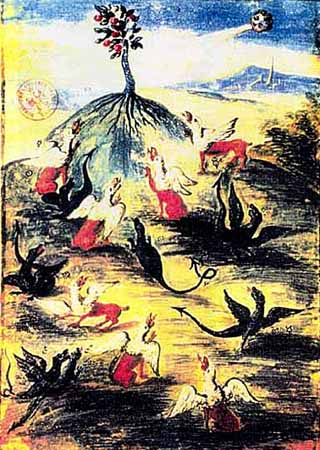
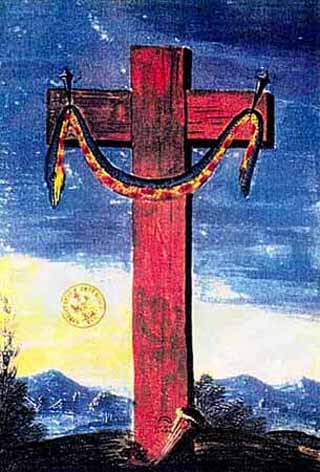
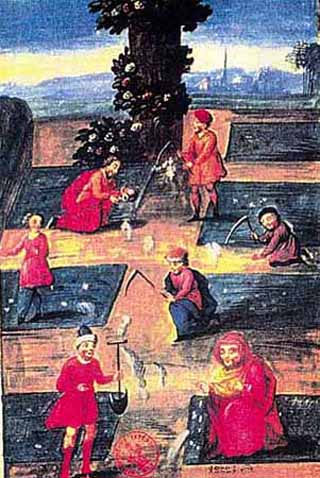
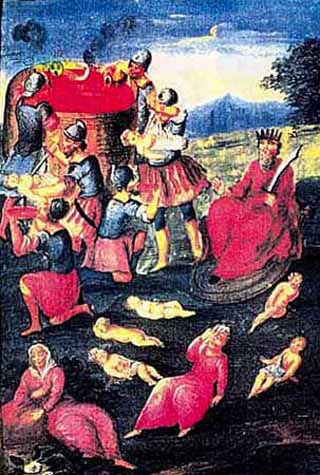
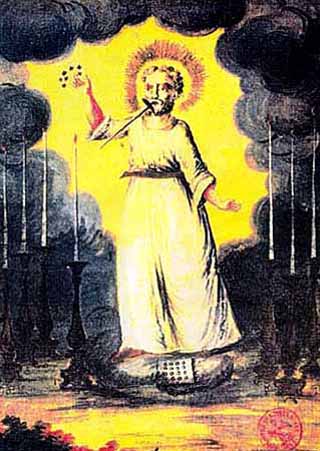
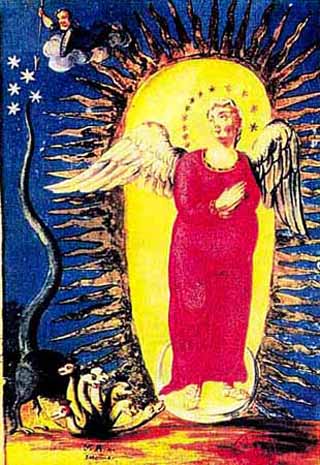
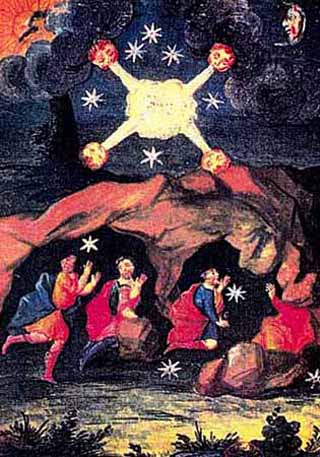
Expanded accounts of his life are legendary. An alchemical book, published in Paris in 1613 as Livre des figures hieroglypiques and in London in 1624 as Exposition of the Hieroglyphical Figures was attributed to Flamel. It is a collection of designs purportedly commissioned by Flamel for a tympanum at the Cimeti¸re des Innocents in Paris, long disappeared at the time the work was published. In the publisher's introduction Flamel's search for the philosopher's stone was described.
According to that introduction, Flamel had made it his life's work to understand the text of a mysterious 21-page book he had purchased. The introduction claims that, around 1378, he traveled to Spain for assistance with translation. On the way back, he reported that he met a sage, who identified Flamel's book as being a copy of the original Book of Abraham the Mage.
With this knowledge, over the next few years, Flamel and his wife allegedly decoded enough of the book to successfully replicate its recipe for the Philosopher's Stone, producing first silver in 1382, and then gold. In addition, Flamel is said to have studied some texts in Hebrew. Interest in Flamel revived in the 19th century, and Victor Hugo mentioned him in The Hunchback of Notre Dame. Eric Satie was intrigued by Flamel.
He had already achieved legendary status within the circles of alchemy by the mid 17th Century, with references in Isaac Newton's journals to "the Caduceus, the Dragons of Flammel". Albert Pike makes reference to Nicholas Flamel in his book Morals and Dogma of the Scottish Rite of Freemasonry.
Wisdom has various means for making its way into the heart of man. Sometimes a prophet comes forward and speaks. Or a sect of mystics receives the teaching of a philosophy, like rain on a summer evening, gathers it in and spreads it abroad with love. Or it may happen that a charlatan, performing tricks to astonish men, may produce, perhaps without knowing it himself, a ray of real light with his dice and magic mirrors. In the fourteenth century, the pure truth of the masters was transmitted by a book.
This book fell into the hands of precisely the man who was destined to receive it; and he, with the help of the text and the hieroglyphic diagrams that taught the transmutation of metals into gold, accomplished the transmutation of his soul, which is a far rarer and more wonderful operation.
Thanks to the amazing book of Abraham the Jew all the Hermetists of the following centuries had the opportunity of admiring an example of a perfect life, that of Nicolas Flamel, the man who received the book. After his death or disappearance many students and alchemists who had devoted their lives to the search for the Philosopher's Stone despaired because they had not in their possession the wonderful book that contained the secret of gold and of eternal life. But their despair was unnecessary. The secret had become alive. The magic formula had become incarnate in the actions of a man. No ingot of virgin gold melted in the crucibles could, in color or purity, attain the beauty of the wise bookseller's pious life.
There is nothing legendary about the life of Nicolas Flamel. The Bibliotheque Nationale in Paris contains works copied in his own hand and original works written by him. All the official documents relating to his life have been found: his marriage contract, his deeds of gift, his will. His history rests solidly on those substantial material proofs for which men clamor if they are to believe in obvious things. To this indisputably authentic history, legend has added a few flowers. But in every spot where the flowers of legend grow, underneath there is the solid earth of truth.
Whether Nicolas Flamel was born at Pontoise or somewhere else, a question that historians have argued and investigated with extreme attention, seems to me to be entirely without importance. It is enough to know that towards the middle of the fourteenth century, Flamel was carrying on the trade of a bookseller and had a stall backing on to the columns of Saint-Jacques la Boucherie in Paris. It was not a big stall, for it measured only two feet by two and a half. However, it grew. He bought a house in the old rue de Marivaux and used the ground floor for his business. Copyists and illuminators did their work there. He himself gave a few writing lessons and taught nobles who could only sign their names with a cross. One of the copyists or illuminators acted also as a servant to him.
Nicolas Flamel married Pernelle, a good-looking, intelligent widow, slightly older than himself and the possessor of a little property. Every man meets once in his life the woman with whom he could live in peace and harmony. For Nicolas Flamel, Pernelle was that woman. Over and above her natural qualities, she had another which is still rarer. She was a woman who was capable of keeping a secret all her life without revealing it to anybody in confidence. But the story of Nicolas Flamel is the story of a book for the most part. The secret made its appearance with the book, and neither the death of its possessors nor the lapse of centuries led to the complete discovery of the secret.
Nicolas Flamel had acquired some knowledge of the Hermetic art. The ancient alchemy of the Egyptians and the Greeks that flourished among the Arabs had, thanks to them, penetrated to Christian countries. Nicolas Flamel did not, of course, regard alchemy as a mere vulgar search for the means of making gold.
For every exalted mind the finding of the Philosopher's Stone was the finding of the essential secret of Nature, the secret of her unity and her laws, the possession of perfect wisdom. Flamel dreamed of sharing in this wisdom. His ideal was the highest that man could attain. And he knew that it could be realized through a book, for the secret of the Philosopher's Stone had already been found and transcribed in symbolic form. Somewhere it existed. It was in the hands of unknown sages who lived somewhere unknown. But how difficult it was for a small Paris bookseller to get into touch with those sages.
Nothing, really, has changed since the fourteenth century. In our day also many men strive desperately towards an ideal, the path which they know but cannot climb; and they hope to win the magic formula (which will make them new beings) from some miraculous visit or from a book written expressly for them. But for most, the visitor does not come and the book is not written.
Yet for Nicolas Flamel the book was written. Perhaps because a bookseller is better situated than other people to receive a unique book; perhaps because the strength of his desire organized events without his knowledge, so that the book came when it was time. So strong was his desire, that the coming of the book was preceded by a dream, which shows that this wise and well-balanced bookseller had a tendency to mysticism.
Nicolas Flamel dreamed one night that an angel stood before him. The angel, who was radiant and winged like all angels, held a book in his hands and uttered these words, which were to remain in the memory of the hearer: "Look well at this book, Nicholas. At first you will understand nothing in it neither you nor any other man. But one day you will see in it that which no other man will be able to see." Flamel stretched out his hand to receive the present from the angel, and the whole scene disappeared in the golden light of dreams. Sometime after that the dream was partly realized.
One day, when Nicolas Flamel was alone in his shop, an unknown man in need of money appeared with a manuscript to sell. Flamel was no doubt tempted to receive him with disdainful arrogance, as do the booksellers of our day when some poor student offers to sell them part of his library. But the moment he saw the book he recognized it as the book that the angel had held out to him, and he paid two florins for it without bargaining.
The book appeared to him indeed resplendent and instinct with divine virtue. It had a very old binding of worked copper, on which were engraved curious diagrams and certain characters, some of which were Greek and others in a language he could not decipher.
The leaves of the book were not made of parchment, like those he was accustomed to copy and bind. They were made of the bark of young trees and were covered with very clear writing done with an iron point. These leaves were divided into groups of seven and consisted of three parts separated by a page without writing, but containing a diagram that was quite unintelligible to Flamel.
On the first page were written words to the effect that the author of the manuscript was Abraham the Jew - prince, priest, Levite, astrologer, and philosopher. Then followed great curses and threats against anyone who set eyes on it unless he was either a priest or a scribe.
The mysterious word Maranatha, which was many times repeated on every page, intensified the awe-inspiring character of the text and diagrams. But most impressive of all was the patined gold of the edges of the book, and the atmosphere of hallowed antiquity that there was about it.
Nicolas Flamel considered that being a scribe he might read the book without fear. He felt that the secret of life and of death, the secret of the unity of Nature, the secret of the duty of the wise man, had been concealed behind the symbol of the diagram and formula in the text by an initiate long since dead. He was aware that it is a rigid law for initiates that they must not reveal their knowledge, because if it is good and fruitful for the intelligent, it is bad for ordinary men. As Jesus has clearly expressed it, pearls must not be given as food to swine. Was he qualified to read this book?
Nicolas Flamel considered that being a scribe he might read the book without fear. He felt that the secret of life and of death, the secret of the unity of Nature, the secret of the duty of the wise man, had been concealed behind the symbol of the diagram and formula in the text by an initiate long since dead. He was aware that it is a rigid law for initiates that they must not reveal their knowledge, because if it is good and fruitful for the intelligent, it is bad for ordinary men. As Jesus has clearly expressed it, pearls must not be given as food to swine.
He had the pearl in his hands. It was for him to rise in the scale of man in order to be worthy to understand its purity. He must have had in his heart a hymn of thanksgiving to Abraham the Jew, whose name was unknown to him, but who had thought and labored in past centuries and whose wisdom he was now inheriting.
He must have pictured him a bald old man with a hooked nose, wearing the wretched robe of his race and wilting in some dark ghetto, in order that the light of his thought might not be lost. And he must have vowed to solve the riddle, to rekindle the light, to be patient and faithful, like the Jew who had died in the flesh but lived eternally in his manuscript.
Nicolas Flamel had studied the art of transmutation. He was in touch with all the learned men of his day. Manuscripts dealing with alchemy have been found, notably that of Almasatus, which were part of his personal library.
He had knowledge of the symbols of which the alchemists made habitual use. But those that he saw in the book of Abraham the Jew remained dumb for him. In vain, he copied some of the mysterious pages and set them out in his shop, in the hope that some visitor conversant with the Kabbalah would help him to solve the problem. He met with nothing but the laughter of skeptics and the ignorance of pseudo-scholars just as he would today if he showed the book of Abraham the Jew either to pretentious occultists or to the scholars at the Academie des Inscriptions et Belles Lettres.
Nicholas Flamel's Journey For twenty-one years, he pondered the hidden meaning of the book. That is really not that long. He is favored among men for whom twenty-one years are enough to enable him to find the key of life.
At age twenty-one Nicolas Flamel had developed in himself sufficient wisdom and strength to hold out against the storm of light involved by the coming of truth to the heart of man.
Only then did events group themselves harmoniously according to his will and allow him to realize his desire. For everything good and great that happens to a man is the result of the co-ordination of his own voluntary effort and a malleable fate.
No one in Paris could help Nicolas Flamel understand the book. Now, this book had been written by a Jew, and part of its text was in ancient Hebrew. The Jews had recently been driven out of France by persecution. Nicolas Flamel knew that many of these Jews had migrated to Spain.
In towns such as Malaga and Granada, which were still under the more enlightened dominion of the Arabs, there lived prosperous communities of Jews and flourishing synagogues, in which scholars and doctors were bred. Many Jews from the Christian towns of Spain took advantage of the tolerance extended by the Moorish kings and went to Granada to learn. There they copied Plato and Aristotle forbidden texts in the rest of Europe and returned home to spread abroad the knowledge of the ancients and of the Arab masters.
Nicolas Flamel thought that in Spain he might meet some erudite Cabalist who would translate the book of Abraham for him. Travelling was difficult, and without a strong-armed escort, safe passage was nearly impossible for a solitary traveler. Flamel made therefore a vow to St James of Compostela, the patron saint of his parish, to make a pilgrimage. This was also a means of concealing from his neighbors and friends the real purpose of his journey.
The wise and faithful Pernelle was the only person who was aware of his real plans. He put on the pilgrim's attire and shell-adorned hat, took the staff, which ensured a certain measure of safety to a traveler in Christian countries, and started off for Galicia.
Since he was a prudent man and did not wish to expose the precious manuscript to the risks of travel, he contented himself with taking with him a few carefully copied pages, which he hid in his modest baggage.
Nicolas Flamel has not recounted the adventures that befell him on his journey. Possibly he had none. It may be that adventures happen only to those who want to have them. He has told us merely that he went first to fulfill his vow to St James. Then he wandered about Spain, trying to get into relations with learned Jews.
But they were suspicious of Christians, particularly of the French, who had expelled them from their country. Besides, he had not much time. He had to remember Pernelle waiting for him, and his shop, which was being managed only by his servants. To a man of over fifty on his first distant journey, the silent voice of his home makes a powerful appeal every evening.
In discouragement, he started his homeward journey. His way lay through Leon, where he stopped for the night at an inn and happened to sup at the same table as a French merchant from Boulogne, who was traveling on business.
This merchant inspired him with confidence and trust, and he whispered a few words to him of his wish to find a learned Jew. By a lucky chance the French merchant was in relations with a certain Maestro Canches, an old man who lived at Leon, immersed in his books. Nothing was easier than to introduce this Maestro Canches to Nicolas Flamel, who decided to make one more attempt before leaving Spain.
One can easily appreciate the depth of the scene when the profane merchant of Boulogne has left them, and the two men are face to face. The gates of the ghetto close. Maestro Canches' only thought is expressed by a few polite words to rid himself as quickly as he can of this French bookseller, who has deliberately dulled the light in his eye and clothed himself in mediocrity (for the prudent traveler passes unnoticed).
Flamel speaks, reticently at first. He admires the knowledge of the Jews. Thanks to his trade, he has read a great many books. At last he timidly lets fall a name, which hitherto has aroused not a spark of interest in anyone to whom he has spoken - the name of Abraham the Jew, prince, priest, Levite, astrologer and philosopher.
Suddenly Flamel sees the eyes of the feeble old man before him light up. Maestro Canches has heard of Abraham the Jew! He was a great master of the wandering race, perhaps the most venerable of all the sages who studied the mysteries of the Cabala, a higher initiate, one of those who rise the higher the better they succeed in remaining unknown.
His book existed and disappeared centuries ago. But tradition says it has never been destroyed, that it is passed from hand to hand and that it always reaches the man whose destiny it is to receive it. Maestro Canches has dreamed all his life of finding it. He is very old, close to death, and now the hope that he has almost given up is near realization. The night goes by, and there is a light over the two heads bent over their work. Maestro Canches is translating the Hebrew from the time of Moses. He is explaining symbols that originated in ancient Chaldea. How the years fall from these two men, inspired by their common belief in truth.
But the few pages that Flamel had brought are not enough to allow the secret to be revealed. Maestro Canches made up his mind at once to accompany Flamel to Paris, but his extreme age was an obstacle. Furthermore, Jews were not allowed in France. He vowed to rise above his infirmity and convert his religion! For many years now, he had been above all religions. So the two men, united by their indissoluble bond, headed off along the Spanish roads north.
The ways of Nature are mysterious. The nearer Maestro Canches came to the realization of his dream, the more precarious became his health, and the breath of life weakened in him. Oh God! he prayed, grant me the days I need, and that I may cross the threshold of death only when I possess the liberating secret by which darkness becomes light and flesh spirit!
But the prayer was not heard. The inflexible law had appointed the hour of the old man's death. He fell ill at Orleans, and in spite of all Flamel's care, died seven days later. As he had converted and Flamel did not want to be suspected of bringing a Jew into France, he had him piously buried in the church of Sante-Croix and had masses said in his honor. For he rightly thought that a soul that had striven for so pure an aim and had passed at the moment of its fruition. could not rest in the realm of disembodied spirits.
Flamel continued his journey and reached Paris, where he found Pernelle, his shop, his copyists, and his manuscripts safe and sound. He laid aside his pilgrim's staff. But now everything was changed. It was with a joyous heart that he went his daily journey from house to shop, that he gave writing lessons to illiterates and discussed Hermetic science with the educated.
From natural prudence, he continued to feign ignorance, in which he succeeded all the more easily because knowledge was within him. What Maestro Canches had already taught him in deciphering a few pages of the book of Abraham the Jew was sufficient to allow his understanding of the whole book. He spent three years more in searching and in completing his knowledge, but at the end of this period, the transmutation was accomplished.
Having learned what materials were necessary to put together beforehand, he followed strictly the method of Abraham the Jew and changed a half-pound of mercury first into silver, and then into virgin gold. And simultaneously, he accomplished the same transmutation in his soul. From his passions, mixed in an invisible crucible, the substance of the eternal spirit emerged.
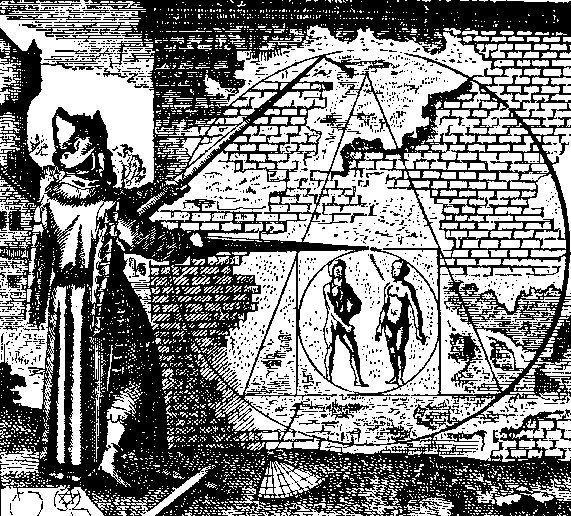
From this point, according to historical records, the little bookseller became rich. He established many low-income houses for the poor, founded free hospitals, and endowed churches. But he did not use his riches to increase his personal comfort or to satisfy his vanity. He altered nothing in his modest life.
With Pernelle, who had helped him in his search for the Philosopher's Stone, he devoted his life to helping his fellow men. "Husband and wife lavished succor on the poor, founded hospitals, built or repaired cemeteries, restored the front of Saint Genevieve des Ardents and endowed the institution of the Quinze-Vingts, the blind inmates of which, in memory of this fact, came every year to the church of Saint Jacques la Boucherie to pray for their benefactor, a practice which continued until 1789," wrote historian Louis Figuier.
At the same time that he was learning how to make gold out of any material, he acquired the wisdom of despising it in his heart. Thanks to the book of Abraham the Jew, he had risen above the satisfaction of his senses and the turmoil of his passions. He knew that man attains immortality only through the victory of spirit over matter, by essential purification, by the transmutation of the human into the divine.
He devoted the last part of his life to what Christians call the working out of personal salvation. But he attained his object without fasting or asceticism, keeping the unimportant place that destiny had assigned him, continuing to copy manuscripts, buying and selling, in his new shop in the rue Saint-Jacques la Boucherie.
For him, there was no more mystery about the Cemetery of the Innocents, which was near his house and under the arcades of which he liked to walk in the evenings. If he had the vaults and monuments restored at his own expense, it was nothing more than compliance with the custom of his time. He knew that the dead who had been laid to rest there were not concerned with stones and inscriptions and that they would return, when their hour came, in different forms, to perfect themselves and die anew.
He knew the trifling extent to which he could help them. Yet he had no temptation to divulge the secret that had been entrusted to him through the book, for he was able to measure the lowest degree of virtue necessary for the possession of it, and he knew that the revelation of the secret to an undeveloped soul only increased the imperfection of that soul.
And when he was illuminating a manuscript and putting in with a fine brush a touch of skyblue into the eye of an angel, or of white into a wing, no smile played on his grave face, for he knew that pictures are useful to children; moreover, it is possible that beautiful fantasies which are pictured with love and sincerity may become realities in the dream of death. Though he knew how to make gold, Nicolas Flamel made it only three times in the whole of his life and then, not for himself, for he never changed his way of life; he did it only to mitigate the evils that he saw around him. And this is the single touchstone that convinces that he really attained the state of adept.
This "touchstone" test can be used by everyone and at all times. To distinguish a man's superiority, there is but a single sign: a practical and not an alleged-contempt for riches. However great may be a man's active virtues or the radiant power of his intelligence, if they are accompanied by the love of money that most eminent men possess, it is certain that they are tainted with baseness. What they create under the hypocritical pretext of good will bear within it the seeds of decay. Unselfishness and innocence alone is creative, and it alone can help to raise man.
Flamel's generous gifts aroused curiosity and even jealousy. It seemed amazing that a poor bookseller should found almshouses and hospitals should build houses with low rents, churches and convents. Rumors reached the ears of the king, Charles VI, who ordered Cramoisi, a member of the Council of State, to investigate the matter. But thanks to Flamel's prudence and reticence, the result of the inquiries was favorable to him.
The rest of Flamel's life passed without special event. It was actually the life of a scholar. He went from his house in the rue de Marivaux to his shop. He walked in the Cemetery of the Innocents, for the imagination of death was pleasant to him. He handled beautiful parchments. He illuminated missals. He paid devout attention to Pernelle as she grew old, and he knew that life holds few better things than the peace of daily work and a calm affection.
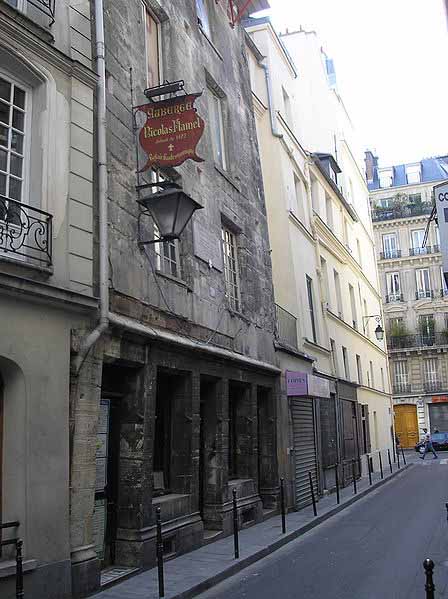
Flamel died in 1418. He was buried in Paris at the Musee de Cluny at the end of the nave of the former Church of Saint-Jacques-de-la-Boucherie.
One of Flamel's houses still stands in Paris, at 51 rue de Montmorency. It is the oldest stone house in the city. There is an old inscription on the wall : We, ploughmen and women living at the porch of this house, built in 1407, are requested to say every day an "Our Father" and an "Ave Maria" praying God that His grace forgive poor and dead sinners. The ground floor currently contains a restaurant.
A Paris street near the Louvre Museum, the rue Nicolas Flamel, has been named for him; it intersects with the rue Perenelle, named for his wife.
Pernelle died first; Nicolas Flamel reached the age of eighty. He spent the last years of his life writing books on alchemy. He carefully settled his affairs and planned how he was to be buried: at the end of the nave of Saint Jacques la Boucherie. The tombstone to be laid over his body had already been made.
On this stone, in the middle of various figures, there was carved a sun above a key and a closed book. It contains the symbols of his life and can still be seen at his gravesite in the Musee de Cluny in Paris. His death, to which he joyfully looked forward, was as circumspect and as perfect as his life.
As it is equally useful to study men's weaknesses as their finest qualities, we may mark Flamel's weakness. This sage, who attached importance only to the immortality of his soul and despised the ephemeral form of the body, was inspired as he grew old with a strange taste for the sculptural representation of his body and face. Whenever he had a church built, or even restored, he requested the sculptor to represent him, piously kneeling, in a comer of the pediment of the facade.
He had himself twice sculptured on an arch in the Cemetery of the Innocents: once as he was in his youth and once old and infirm. When he had a new house built in the rue de Montmorency, on the outskirts of Paris, eleven saints were carved on the front, but a side door was surmounted with a bust of Flamel.
The bones of sages seldom rest in peace in their grave. Perhaps Nicolas Flamel knew this and tried to protect his remains by ordering a tombstone of great weight and by having a religious service held for him twelve times a year. But these precautions were useless. Hardly was Flamel dead when the report of his alchemical powers and of his concealment somewhere of an enormous quantity of gold spread through Paris and the world. Everyone who was seeking the famous projection powder, which turns all substances into gold, came prowling round all the places where he had lived in the hope of finding a minute portion of the precious powder.
It was said also that the symbolical figures which he had had sculptured on various monuments gave, for those who could decipher it, the formula of the Philosopher's Stone. There was not a single alchemist but came in pilgrimage to study the sacred science on the, stones of Saint-Jacques- la Boucherie, or the Cemetery of the Innocents. The sculptures and inscriptions were broken off under cover of darkness and removed. The cellars of his house were searched and the walls examined.
According to author Albert Poisson, towards the middle of the sixteenth century a man who had a well-known name and good credentials, which were no doubt fictitious, presented himself before the parish board of Saint-Jacques la Boucherie. He said he wished to carry out the vow of a dead friend, a pious alchemist, who, on his deathbed, had given him a sum of money with which to repair Flamel's house.
The board accepted the offer. The unknown man had the cellars ransacked under the pretext of strengthening the foundations; wherever he saw a hieroglyph he found some reason for knocking down the wall at that point. Having found nothing, he disappeared, forgetting to pay the workmen.
Not long afterwards, a Capuchin friar and a German baron are said to have discovered in the house some stone vials full of a reddish powder allegedly the projection powder.
By the seventeenth century, the various houses which had belonged to Flamel were despoiled of their ornaments and decorations, and there was nothing of them left but the four bare walls.
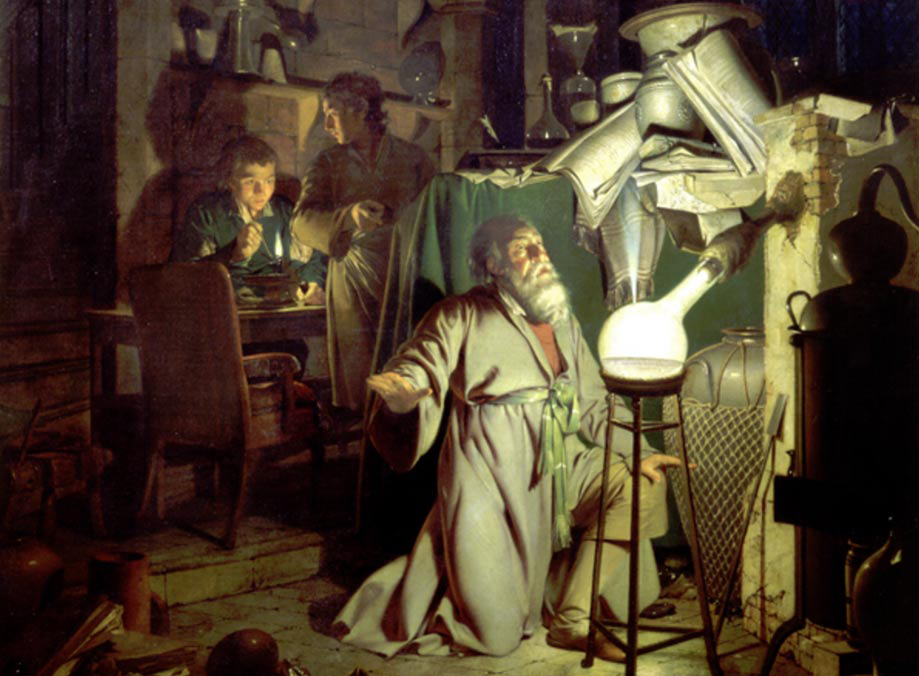
Alchemy and Immortality - The Tale of Nicolas Flammel and the Lapis Philosophorum Ancient Origins - January 14, 2016
For mankind, immortality has always been a remarkably fascinating idea. Throughout time, the quest to eliminate death in order to achieve indefinite life in the physical body has taken various forms. One of the most well-known of such attempts was alchemy. The main goal of alchemy was to produce the Lapis Philosophorum, the Philosopher's Stone, a legendary substance with the property of turning common metal into gold with a high level of purity and a substance which could help in making the elixir of long life. This prevented death, thus making the drinker immortal.
According to some accounts it was sufficient to drink from the elixir only once to prevent death indefinitely, while other accounts sustained that a regular consumption of the elixir was necessary in order to remain immortal. In alchemical engravings, the Philosopher's Stone is usually represented symbolically in the form of an egg, sometimes along with the alchemical snake. Many alchemists claimed to have found the Stone and to have made the elixir of immortality, however few have managed to prove it. In Asia, it was very common for emperors to order their subjects to go look for someone who could make the elixir and to bring it back to them so that they could enjoy the joy of everlasting life, however many were brought false elixirs which only managed to offer death instead of the much desired dream of immortality.
What had happened to the book of Abraham the Jew? Nicolas Flamel had bequeathed his papers and library to a nephew named Perrier, who was interested in alchemy and of whom he was very fond.
Absolutely nothing is known of Perrier. He no doubt benefited by his uncle's teachings and spent a sage's life in the munificent obscurity that Flamel prized so dearly, but had not been able altogether to maintain during the last years of his life.
For two centuries the precious heritage was handed down from father to son, without anything being heard of it. Traces of it are found again in the reign of Louis XIII.
A descendant of Flamel, named Dubois, who must still have possessed a supply of the projection powder, threw off the wise reserve of his ancestor and used the powder to dazzle his contemporaries. In the presence of the King, he changed leaden balls with it into gold.
As a result of this experiment, it is known he had many interviews with Cardinal de Richelieu, who wished to extract his secret.
Dubois, who possessed the powder but was unable to understand either Flamel's manuscripts or the book of Abraham the Jew, could tell him nothing and was soon imprisoned at Vincennes.
It was found that he had committed certain offences in the past, and this enabled Richelieu to get him condemned to death and confiscate his property for his own benefit.
At the same time the proctor of the Chitelet, no doubt by order of Richelieu, seized the houses that Flamel had owned and had them searched from top to bottom.
About this time, at the church of Saint-Jacques la Boucherie, robbers made their way in during the night, lifted Flamel's tombstone and broke open his coffin. It was after this incident that the rumor spread that the coffin had been found empty, and that it had never contained the body of Flamel, who was supposed to be still alive.
Through whatever means, it is believed Richelieu took possession of the book of Abraham the Jew. He built a laboratory at the Chateau of Rueil, which he often visited to read through the master's manuscripts and to try to interpret the sacred hieroglyphs.
But that which a sage like Flamel had been able to understand only after twenty-one years of meditation was not likely to be at once accessible to a politician like Richelieu. Knowledge of the mutations of matter, of life and death, is more complex than the art of planning strategies or administering a kingdom. Richelieu's search gave no good results.
On the death of the cardinal, all traces of the book were lost, or rather, all traces of the text, for the diagrams have often been reproduced. Indeed, the book must have been copied, for it is recorded in the seventeenth century that the author of the Tresor des Recherches et Antiquites Gauloises made a journey to Milan to see a copy which belonged to the Seigneur of Cabrieres. In any case, the mysterious book has now disappeared.
Perhaps a copy or the original itself rests under the dust of some provincial library. And it may be that a wise fate will send it at the proper time to a man who has the patience to ponder it, the knowledge to interpret it, the wisdom not to divulge it too soon.
Written in France in the late 1750s and published in London in 1806. The original document was written in the hand of Nicolas Flamel in a coded alphabet consisting of 96 letters. It was written in secrecy and intended only for his nephew. A Parisian scribe named Father Pernetti and a Monsieur de Saint Marc were finally able to break the code in 1758.
1. I Nicholas Flamel, a scrivener of Paris, in the year 1414, in the reign of our gracious Prince Charles VI, whom God preserve; and after the death of my faithful partner Perenelle, am seized with a desire and a delight, in remembrance of her, and in your behalf, dear nephew, to write out the whole magistery of the secret of the Powder of Projection, or the Philosophical Tincture, which God hath willed to impart to his very insignificant servant, and which I have found out, as thou also wilt find out in working as I shall declare unto you.
2. And for this cause do not forget to pray to God to bestow on thee the understanding of the reason of the truth of nature, which thou wilt see in this book, wherein I have written the secrets word for word, sheet by sheet, and also as I have done and wrought with thy dear aunt Perenelle, whom I very much regret.
3. Take heed before thou workest, to seek the right way as a man of understanding. The reason of nature is Mercury, Sun and Moon, as I have said in my book, in which are those figures which thou seest under the arches of the Innocents at Paris. But I erred greatly upwards of 23 years and a half, in laboring without being able to marry the Moon, that is quicksilver, to the Sun, and to extract from them the seminal dung, which is a deadly poison; for I was then ignorant of the agent or medium, in order to fortify the Mercury: for without this agent, Mercury is as common water.
4. Know in what manner Mercury is to be fortified by a metallic agent, without which it never can penetrate into the belly of the Sun and of the Moon; afterward it must be hardened, which cannot be affected without the sulfurous spirit of gold or silver. You must therefore first open them with a metallic agent, that is to say with royal Saturnia, and afterward you must actuate the Mercury by a philosophic means, that you may afterward by this Mercury dissolve into a liquor gold and Luna, and draw from their putrefaction the generative dung.
5. And know thou, that there is no other way nor means to work in this art, than that which I give thee word for word; an operation, unless it be taught as I now do, not at all easy to perform, but which on the contrary is very difficult to find out.
6. Believe steadfastly, that the whole philosophic industry consists in the preparation of the Mercury of the wise, for in it is the whole of what we are seeking for, and which has always been sought for by all ancient wise men; and that we, no more than they, have done nothing without this Mercury, prepared with Sun or Moon: for without these three, there is nothing in the whole world capable of accomplishing the said philosophical and medicinal tincture. It is expedient then that we learn to extract from them the living and spiritual seed.
7. Aim therefore at nothing but Sun, Moon and Mercury prepared by a philosophical industry, which wets not the hands, but the metal, and which has in itself a metallic sulfurous soul, namely, the ignited light of sulfur. And in order that you may not stray from the right path, apply yourself to metals; for there the aforesaid sulfur is found in all; but thou wilt easily find it, even almost similar to gold, in the cavern and depths of Mars, which is iron, and of Venus, which is copper, nearly as much in the one as in the other; and even if you pay attention to it, this sulfur has the power of tingeing moist and cold Luna, which is fine silver, into pure yellow and good Sun; but this ought to be done by a spiritual medium, viz. the key which opens all metals, which I am going to make known to you. Learn therefore, that among the minerals there is one which is a thief, and eats up all except Sun and Moon, who render the thief very good; for when he has them in his belly, he is good to prepare the quicksilver, as I shall presently make known to you.
8. Therefore do not stray out of the right road, but trust to my words, and then give thyself up to the practice, which I am going to bestow on thee in the name of the Father, of Son, and Holy Ghost. The Practice.
9. Take thou in the first place the eldest or first-born child of Saturn, not the vulgar, 9 parts; of the saber chalibs of the God of War, 4 parts. Put this latter into a crucible, and when it comes to a melting redness, cast therein the 9 parts of Saturn, and immediately this will redden the other. Cleanse thou carefully the filth that arises on the surface of the saturnia, with saltpetre and tartar, four or five times. The operation will be rightly done when thou seest upon the matter an astral sign like a star.
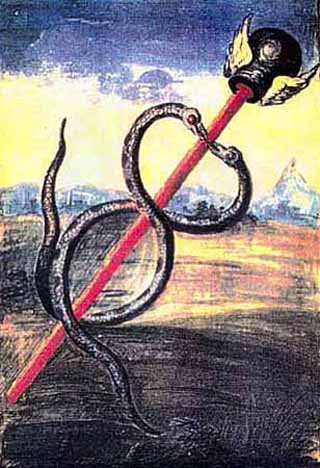
10. Then is made the key and the saber, which opens and cuts through all metals, but chiefly Sun, Moon and Venus, which it eats, devours and keeps in his belly, and by this means thou art in the right road of truth, if thou has operated properly. For this Saturnia is the royal triumphant herb, for it is a little imperfect king, whom we raise up by a philosophic artifice to the degree of the greatest glory and honor. It is also the queen, that is to say the Moon and the wife of the Sun: it is therefore both male and female, and our hermaphrodite Mercury. This Mercury or Saturnia is represented in the seven first pages of the book of Abraham the Jew, by two serpent encircling a golden rod. Take care to prepare a sufficient quantity of it, for much is required, that is to say about 12 or 13 lbs. of it, or even more, according as you wish to work on a large or a small scale.
11. Marry thou therefore the young god Mercury, that is to say quicksilver with this which is the philosophic Mercury, that you may actuate by him and fortify the said running quicksilver, seven or even ten or eleven times with the said agent, which is called the key, or a steel sharpened saber, for it cuts, scythes and penetrates all the bodies of the metals. Then wilt thou have the double and treble water represented by the rose tree in the book of Abraham the Jew, which issues out of the foot of an oak, namely our Saturnia, which is the royal key, and goes to precipitate itself into the abyss, as says the same author, that is to say, into the receiver, adapted to the neck of the retort, where the double Mercury throws itself by means of a suitable fire.
12. But here are found thorns and insuperable difficulties, unless God reveals this secret, or a master bestows it. For Mercury does not marry with royal Saturnia: it is experient to find a secret means to unite them: for unless thou knowest the artifice by which this union and peace are effected between these aforesaid argent-vives, you will do nothing to any purpose. I would not conceal any thing from thee, my dear nephew; I tell thee, therefore, that without Sun or Moon this work will profit thee nothing. Thou must therefore cause this old man, or voracious wolf, to devour gold or silver in the weight and measure as I am now about to inform thee. Listen therefore to my words, that thou mayest not err, as I have done in this work. I say, therefore, that you must give gold to our old dragon to eat. Remark how well you ought to operate. For if you give but little gold to the melted Saturnia, the gold is indeed opened, but the quicksilver will not take; and here is an incongruity, which is not at all profitable. I have a long while and greatly labored in this affliction, before I found out the means to succeed in it. If therefore you give him much gold to devour, the gold will not indeed be so much opened nor disposed, but then it will take the quicksilver, and they will both marry. Thus the means is discovered. Conceal this secret, for it is the whole, and neither trust it to paper, or to any thing else which may be seen. For we should become the cause of great mischief. I give it thee under the seal of secrecy and of thy conscience, for the love I bear thee.
13. Take thou ten ounces of the red Sun, that is to so say, very fine, clean and purified nine or ten times by means of the voracious wolf alone: two ounces of the royal Saturnia; melt this in a crucible, and when it is melted, cast into it the ten ounces of fine gold; melt these two together, and stir them with a lighted charcoal. Then will thy gold be a little opened. Pour it on a marble slab or into an iron mortar, reduce it to a powder, and grind it well with three pounds of quicksilver. Make them to curd like cheese, in the grinding and working them to and fro: wash this amalgama with pure common water until it comes out clear, and that the whole mass appears clear and white like fine Luna. The conjunction of the gold with the royal golden Saturnia is effected, when the mass is soft to the touch like butter.
14. Take this mass, which thou wilt gently dry with linen or fine cloth, with great care: this is our lead, and our mass of Sun and Moon, not the vulgar, but the philosophical. Put it into a good retort of crucible earth, but much better of steel. Place the retort in a furnace, and adapt a receiver to it: give fire by degrees. Two hours after increase your fire so that the Mercury may pass into the receiver: this Mercury is the water of the blowing rose-tree; it is also the blood of the innocents slain in the book of Abraham the Jew. You may now suppose that this Mercury has eat up a little of the body of the king, and that it will have much more strength to dissolve the other part of it hereafter, which will be more covered by the body of the Saturnia. Thou has now ascended one degree or step of the ladder of the art.
15. Take the feces out of the retort; melt them in a crucible in a strong fire: cast into it four ounces of the Saturnia, (and) nine ounces of the Sun. Then the Sun is expanded in the said feces, and much more opened that at the first time, as the Mercury has more vigor than before, it will have the strength and virtue of penetrating the gold, and of eating more of it, and of filling his belly with it by degrees. Operate therefore as at first; marry the aforesaid Mercury, stronger one degree with this new mass in grinding the whole together; they will take like butter and cheese; wash and grind them several times, until all the blackness is got out: dry it as aforesaid; put the whole into the retort, and operate as thou didst before, by giving during two hours, a weak fire, and then strong, sufficient to drive out, and cause the Mercury to fall into the receiver; then wilt thou have the Mercury still more actuated, and thou wilt have ascended to the second degree of the philosophic ladder.
16. Repeat the same work, by casting in the Saturnia in due weight, that is to say, by degrees, and operating as before, till thou hast reached the 10th step of the philosophic ladder; then take thy rest. For the aforesaid Mercury is ignited, actuated, wholly engrossed and full of the male sulfur, and fortified with the astral juice which was in the deep bowels of the gold and of our saturnine dragon. Be assured that I am now writing for thee things which by no philosopher was ever declared or written. For this Mercury is the wonderful caduceus, of which the sages have so much spoken in their books, and which they attest has the power of itself of accomplishing the philosophic work, and they say the truth, as I have done it myself by it alone, and thou wilt be enabled to do it thyself, if thou art so disposed: for it is this and none else which is the proximate matter and the root of all the metals.
17. Now is done and accomplished the preparation of the Mercury, rendered cutting and proper to dissolve into its nature gold and silver, to work out naturally and simply the Philosophic Tincture, or the powder transmuting all metals into gold and silver.
18. Some believe they have the whole magistery, when they have the heavenly Mercury prepared; but they are grossly deceived. It is for this cause they find thorns before they pluck the rose, for want of understanding. It is true indeed, that were they to understand the weight, the regimen of the fire, and the suitable way, they would not have much to do, and could not fail even if they would. But in this art there is a way to work. Learn therefore and observe well how to operate, in the manner I am about to relate to you.
19. In the name of God, thou shalt take of thy animated Mercury what quantity thou pleasest; thou wilt put it into a glass vessel by itself; or two or four parts of the Mercury with two parts of the golden Saturnia; that is to say, one of the Sun and two of the Saturnia; the whole finely conjoined like butter, washed, cleansed and dried; and thou wilt lute thy vessel with the lute of wisdom. Place it in a furnace on warm ashes at the degree of the heat of an hen sitting on her eggs. Leave this said Mercury so prepared to ascend and descend for the space of 40 or 50 days, until thou seest forming in thy vessel a white or red sulfur, called philosophic sublimate, which issues out of the reins of the said Mercury. Thou wilt collect this sulfur with a feather: it is the living Sun and the living Moon, which Mercury begets out of itself.
20. Take this white or red sulfur, triturate it in a glass or marble mortar, and pour on it, in sprinking it, a third part of its weight of the Mercury from which this sulfur has been drawn. With these two make a paste like butter: put again this mixture into an oval glass; place it in a furnace on a suitable fire of ashes, mild, and disposed with a philosophic industry. Concoct until the said Mercury is changed into sulfur, and during this coction, thou wilt see wonderful things in thy vessel, that is to say, all the colors which exist in the world, which thou canst not behold without lifting up thy heart to God in gratitude for so great a gift.
21. When thou has attained to the purple red, thou must gather it: for then the alchymical powder is made, transmuting every metal into fine pure and neat gold, which thou maist multiply by watering it as thou hast already done, grinding it with fresh Mercury, concocting it in the same vessel, furnace and fire, and the time will be much shorter, and its virtue ten times stronger.
22. This then is the whole magistry done with Mercury alone, which some do not believe to be true, because they are weak and stupid, and not at all able to comprehend this work.
23. Shouldest thou desire to operate in another way, take of fine Sun in fine powder or in very thin leaves: make a paste of it with seven parts of thy philosophic Mercury, which is our Luna: put them both into an oval glass vessel well luted; place it in a furnace; give a very strong fire, that is to say, such as will keep lead in fusion; for then thou has found out the true regimen of the fire; and let thy Mercury, which is the philosophical wind, ascend and descend on the body of the gold, which it eats up by degrees, and carries in its belly. Concoct it until the gold and Mercury do no more ascend and descend, but both remain quiet, and then will peace and union be effected between the two dragons, which are fire and water both together.
24. Then wilt thou see in thy vessel a great blackness like that of melted pitch, which is the sign of the death and putrefaction of the gold, and the key of the whole magistery. Cause it therefore to resuscitate by concocting it, and be not weary with concocting it: during this period divers changes will take place; that is to say, the matter will pass through all the colors, the black, the ash color, the blue, the green, the white, the orange, and finally the red as red as blood or the crimson poppy: aim only at this last color; for it is the true sulfur, and the alchymical powder. I say nothing precisely about the time; for that depends on the industry of the artist; but thou canst not fail, by working as I have shown.
25. If thou are disposed to multiply thy powder, take one part thereof, and water it with two parts of thy animated Mercury; make it into a soft and smooth paste; put it in a vessel as thou hast already done, in the same furnace and fire, and concoct it. This second turn of the philosophic wheel will be done in less time than the first, and thy powder will have ten times more strength. Let is wheel about again even a thousand times, and as much as thou wilt. Thou wilt then have a treasure without price, superior to all there is in the world, and thou canst desire nothing more here below, for thou hast both health and riches, if thou useth them properly.
26. Thou hast now the treasure of all worldly felicity, which I a poor country clown of Pointoise did accomplish three times in Paris, in my house, in the street des Ecrivains, near the chapel of St. Jacques de la Boucherie, and which I Flammel give thee, for the love I bear thee, to the honor of God, for His glory, for the praise of Father, Son, and Holy Spirit.