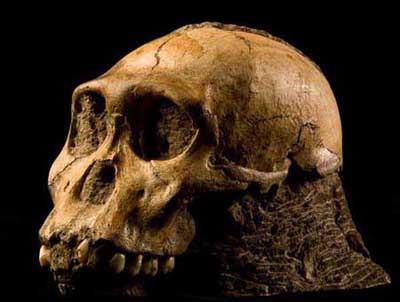
Modern Humans Retain Caveman's Survival Instincts Live Science - September 24, 2007
Odd Fossil Skeletons Show Both Apelike and Human Traits National Geographic - September 20, 2007
Georgia clues to human origins BBC - September 20, 2007 A team of scientists working in Georgia has unearthed the remains of four human-like creatures dating to 1.8 million years ago.
160,000-Year-Old Child Suggests Modern Humans Got Early Start National Geographic - March 15, 2007
First Humans: Time of Origin Pinned Down Live Science - February 24, 2007
Chimps, humans split only 4 million years ago MSNBC - February 24, 2007
Assuming orangutan divergence 18 million years ago, speciation time of human and chimpanzee is consistently around 4 million years ago, they wrote in their study, published in the Public Library of Science journal PLoS Genetics. Primate evolution is a central topic in biology, and much information can be obtained from DNA sequence data,² Dr. Asger Hobolth of North Carolina State University said in a statement.
The theory of a molecular clock is based on the premise that all DNA mutates at a certain rate. It is not always a steady rate, but it evens out over the millennia and can be used to track evolution. Experts agree that humans split off from a common ancestor with chimpanzees several million years ago and that gorillas and orangutans split off much earlier. But it is difficult to date precisely when, although most recent studies have put the date at about 5 million to 7 million years ago. Hobolth and colleagues from the University of Aarhus in Denmark and the University of Oxford in Britain looked at four regions of the human, chimpanzee and gorilla genomes. They used a statistical technique called the hidden Markov model, developed in the 1960s and originally applied to speech recognition.
What they found directly contradicts some other recent research. They found evidence that it took only 400,000 years for humans to become a separate species from the common chimp-human ancestor. Just in May, David Reich of the Broad Institute at the Massachusetts Institute of Technology and Harvard Medical Schoolıs Department of Genetics found evidence that the split probably took 4 million years to occur, although his team put the final divergence at just 5.4 million years ago. Reichıs study of chimpanzee and human DNA suggested that the early ancestors of humans and the ancestors of chimpanzees may have interbred for a long time before they separated.
Experts have long known that humans and chimpanzees share much DNA, and are in fact 96 percent identical on the genetic level. And one year ago, Soojin Yi and colleagues at the Georgia Institute of Technology said they found genetic evidence that chimpanzees may be more closely related to humans than to gorillas and orangutans. Their look at the molecular clock showed humans evolved one unique trait just a million years ago our longer life span and our long childhood, which means humans reach sexual maturity very late in life compared to other animals. Other experts in genetics were not immediately available to comment on Hobolthıs report.
CRYSTALINKS MAILING LIST, NEWSLETTER, UPDATES