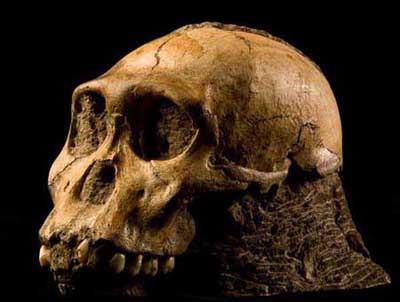
Neanderthal

The Neanderthal (Homo neanderthalensis) or Neandertal was a species of the Homo genus that inhabited Europe and parts of western Asia from about 230,000 to 29,000 years ago, during the Middle Paleolithic period.

Neanderthals were adapted to the cold, as shown by their large braincases, short but robust builds, and large noses - traits selected by nature in cold climates, as observed in modern sub-arctic populations. Their brain sizes have been estimated as larger than modern humans, but their brains may in fact have been approximately the same as those of modern humans. On average, Neanderthal males stood about 1.65m tall (just under 5' 6") and were heavily built, and muscular due to their physical activity. Females were about 1.53 to 1.57m tall (about 5'-5'2").

The characteristic style of stone tools in the Middle Paleolithic is called the Mousterian Culture, after a prominent archaeological site where the tools were first found. The Mousterian culture is typified by the wide use of the Levallois technique. Mousterian tools were often produced using soft hammer percussion, such as bones, antlers, and wood, rather than hard hammer percussion, using stone. Near the end of the time of the Neanderthals, they created the Châtelperronian tool style, considered more "advanced" than that of the Mousterian. They either invented the Chatelperronian themselves or "borrowed" elements from the incoming modern humans who are thought to have created the Aurignacian.

Continued


In the News ...


Modern Behavior of Early Humans Found Half-Million Years Earlier Than Thought   Science Daily - December 22, 2009

Top 10 Mysteries of the First Humans   Live Science - October 28, 2009

Humans Walked After Tree-Climbing Era, Study Indicates   Live Science - August 10, 2009

Extinct Walking Bat Found; Upends Evolutionary Theory   National Geographic - August 10, 2009

When did humans return after last Ice Age?   PhysOrg - July 27, 2009

Early Humans Were Poor Climbers   Live Science - April 13, 2009

Early Human Babies Had Big Brains, Fossil Pelvis Shows   National Geographic - November 13, 2008

6-Million-Year-Old Human Ancestor 1st to Walk Upright? National Geographic - March 20, 2008

Oldest Embracing Lovers Found in Turkey? National Geographic - October 17, 2007

Odd Fossil Skeletons Show Both Apelike and Human Traits National Geographic - September 20, 2007

Georgia clues to human origins BBC - September 20, 2007
A team of scientists working in Georgia has unearthed the remains of four human-like creatures dating to 1.8 million years ago.

Human Ancestor had Lime-Size Brain National Geographic - May 15, 2007

Ancient human unearthed in China Cave BBC - April 3, 2007

160,000-Year-Old Child Suggests Modern Humans Got Early Start National Geographic - March 15, 2007

Neanderthal yields nuclear DNA BBC - May 16, 2006

Fossils fill gap in human lineage BBC - April 13, 2006

Fossil hunters have found remains of a probable direct ancestor of humans that lived more than four million years ago. The specimens of this ancient creature are helping bridge a long gap during a crucial phase of human evolution.

Robotics show Lucy walked upright BBC - July 20, 2005
'Australopithecus afarensis', the early human who lived about 3.2 million years ago, walked upright, according to an "evolutionary robotics" model.

Early hominid from the Caucasus may have 'cared for elderly' BBC - April 2005

Flesh on bones of 'first ape-man' BBC- April 2005

Experts are a step closer to answering whether an ancient skull from Africa belonged to a possible human ancestor or was closer to apes,

Oldest Fossil Protein Sequenced From Neanderthal Science Daily - April 2005

Neandertal Advance: First Fully Jointed Skeleton Built National Geographic - March 2005

-

Scientists in Ethiopia unearth early skeleton - 4 million years old BBC - March 2005


Older Than Lucy

Age of ancient humans reassessed BBC - February 2005

Two skulls originally found in 1967 have been shown to be about 195,000 years old, making them the oldest modern human remains known to science

The icy truth behind Neanderthals BBC - February 2005

In 1848, a strange skull was discovered on the military outpost of Gibraltar. It was undoubtedly human, but also had some of the heavy features of an ape - distinct brow ridges, and a forward projecting face

The Mysterious end of Essex Man Guardian - January 2005
Archaeologists now believe two groups of early humans fought for dominance in ancient Britain - and the axe-wielders won.

Amazing hominid haul in Ethiopia BBC - January 2005
Fossil hunters unearthed remains of at least nine primitive hominids that are between 4.5 million and 4.3 million years old.

Skull fuels Homo erectus debate Story 1 - BBC - July 2004
Was pre-human a failed experiment? Story 2 - MSNBC - July 2004

A tiny pre-human who lived more than 900,00 years ago in what is now Kenya, may have been a 'short experiment' in evolution that never quite made it.

Neanderthals were 'adults by 15' BBC - April 2004

Early human marks are 'symbols' BBC - March 2004

A series of parallel lines engraved in an animal bone between 1.4 and 1.2 million years ago may be the earliest example of human symbolic behavior.

A New Branch Of Primitive Humans Reported Found In Ethiopia Space Daily - March 2004

Earliest British cemetery dated - in a cave BBC - September 2003

Between 10,200 and10,400 years old

Human fossils set European record September 2003 - BBC

Fossils picked up in a Romanian bear cave are the oldest specimens yet found of modern humans in Europe, scientists say.

Looking for the caveman inside us BBC - March 19, 2003

Evidence of earliest human burial BBC - March 26, 2003


Researchers claim to have found the earliest deliberate human burial - and therefore the first evidence of symbolic thought - at a 350,000-year-old site in northern Spain.

First humans 'small brained'' BBC - July 2002

Early hominids - the ancestors of humans -- Larger brain size was probably not the only driving force behind the exodus of early humans from Africa. A third skull found at the camp of some of the the first humans to leave the continent is much smaller than the others.

Flat-faced man is puzzle BBC - March 21, 2001

Scientists have unearthed the remains of what they say is yet another new hominid, or human-like creature, in Kenya.

Walking in our footsteps BBC - November 15, 2001

Genetic 'Adam never met Eve' BBC - October 30, 2001

DNA clues to Neanderthals BBC - October 11, 2000

Tiny bones tell evolution story BBC - March 17, 2000


3.4 Million-Year-Old Skeleton Found in Ethiopia

January 18, 2001 - Reuters

An Ethiopian scientist has discovered the well-preserved 3.4 million-year-old partial skeleton of a child hominid, which experts say should provide valuable information in the study of human evolution. Dr. Zeresenay Alemseged, a palaeoanthropologist, told reporters in Addis Ababa Saturday they had found a fragment of a lower jaw and an exceptionally well-preserved partial skeleton, including the skull, of a child early hominid. They were discovered in the Busidina-Dikika sector of the Afar region, in an area bordering the Republic of Djibouti. Busidina-Dukika lies south of Hadar, where numerous fossils of Austrolopithecus Afarensis, including the famous Lucy, have been discovered.

``This is probably the earliest well-preserved young hominid so far known,'' he said, adding that the discovery would help in filling a gap between the earliest known hominids and those from later periods. ``The new hominid is an important addition which may fill in the gap between Lucy, which is dated to 3.2 million years, and a similar hominid species from Laetoli, Tanzania, and dated at 3.7 million years,'' he said. Alemseged, a post-doctoral research associate at the Institute of Human Origins at Arizona State University, led a mission to prehistoric sites in Busidina and Dikika in 1999 and 2000.


DNA Study Traces European Ancestors to 10 Men

November 10, 2000 - AP

About 80 percent of Europeans arose from primitive hunters who arrived about 40,000 years ago, endured the long ice age and then expanded rapidly to dominate the continent, a new study shows.

Researchers analyzing the Y chromosome taken from 1,007 men from 25 different locations in Europe found a pattern that suggests four out of five of the men shared a common male ancestor about 40,000 years ago. Peter A. Underhill, a senior researcher at the Stanford Genome Technology Center in Palo Alto, Calif., and co-author of the study, said the research supports conclusions from archaeological, linguistic and other DNA evidence about the settlement of Europe by ancient peoples. ``When we can get different lines of evidence that tell the same story, then we feel we are telling the true history of the species,'' said Underhill. The study, which involved more than a dozen researchers from Stanford and Europe, appears Friday in the journal Science. Underhill said the researchers used the Y chromosome in the study because its rare changes establish a pattern that can be traced back hundreds of generations, thus helping to plot the movement of ancient humans.

The Y chromosome is inherited only by sons from their fathers. When sperm carrying the Y chromosome fertilizes an egg it directs the resulting baby to be a male. An X chromosome from the father allows a fertilized egg to be female. The Y chromosome has about 60 million DNA base pairs. Changes in those base pairs happen infrequently, said Underhill, but they occur often enough to establish patterns that can be used to trace the ancestry of people. He said researchers looking at the 1,007 chromosome samples from Europe identified 22 specific markers that formed a specific pattern of change. Underhill said the researchers found that about 80 percent of all European males shared a single pattern, suggesting they had a common ancestor thousands of generations ago.

The basic pattern had some changes that apparently developed among people who once shared a common ancestor and then were isolated for many generations, Underhill said. This scenario, he said, supports other studies about the Paleolithic European groups. Those studies suggest that a primitive, stone-age human came to Europe, probably from Central Asia and the Middle East, in two waves of migration beginning about 40,000 years ago. Their numbers were small and they lived by hunting animals and gathering plant food. They used crudely sharpened stones and fire.

About 24,000 years ago, the last ice age began, with mountain-sized glaciers moving across most of Europe. Underhill said the Paleolithic Europeans retreated before the ice, finding refuge for hundreds of generations in three areas: what is now Spain, the Balkans and the Ukraine. When the glaciers melted, about 16,000 years ago, the Paleolithic tribes resettled the rest of Europe. Y chromosome mutations occurred among people in each of the ice age refuges, said Underhill. He said the research shows a pattern that developed in Spain is now most common in northwest Europe, while the Ukraine pattern is mostly in Eastern Europe and the Balkan pattern is most common in Central Europe.

About 8,000 years ago, said Underhill, a more advanced people, the Neolithic, migrated to Europe from the Middle East, bringing with them a new Y chromosome pattern and a new way of life: agriculture. About 20 percent of Europeans now have the Y chromosome pattern from this migration, he said. Archaeological digs in European caves clearly show that before 8,000 years ago, most humans lived by gathering and hunting, he noted. After that, there are traces of grains and other agricultural products.

Earlier studies had traced European migration patterns using the DNA contained in the mitochondria, a key part of each cell. This type is DNA is passed down from mother to daughter. Antonio Torroni, a researcher at the University of Urbino, Italy, who first proposed that early humans retreated to Spain during the ice age, said in a separate Science report that the Y chromosome study ``fits completely'' with the mitochondria studies. Underhill said the Y chromosome studies are also consistent with genetic studies showing a broader picture of human migration.

In general, studies show that modern humans first arose in Africa about 100,000 years ago and thousands of years later began a long series of migrations, he said. Some groups migrated eastward and humans are known to have existed in Australia about 60,000 years ago. Other groups crossed the land bridge into the Middle East. Humans appeared in Central Asia about 50,000 years ago. From there, the theory goes, some migrated west, arriving in Europe about 40,000 years ago. Later, some migrated east, across the Bering Straits, to the Americas.


Scientist Makes Dramatic Apeman Find

April 25, 2000 - Reuters - Johannesburg

South African scientists are set to reveal details about the most complete apeman skull ever excavated and scientifically described, shedding light on humanity's distant origins. The 1.5 million to two million-year-old skull was found in a previously unreported site a few miles from the renowned Sterkfontein Caves north of Johannesburg, where the most complete arm and hand of an apeman dating back 3.3 million years was recently unearthed.``The teeth have been almost perfectly preserved -- they are a marvelous set of choppers,'' Dr Graham Baker, editor of the South African Journal of Science (SAJS), told Reuters in a telephone interview Tuesday.

An article on the skull will be published later this month in the SAJS. Dr Andre Keyser, the retired geologist who made the previously unannounced find, will outline details Wednesday at the University of Witwatersrand, where the skull will be placed on public display for the first time. Keyser will reveal the hominid's scientific name and the exact location of the discovery. Baker said scientists believe the skull did not belong to a direct ancestor of modern humans but to a line of hominids that eventually became extinct. Scientists hope its similarities to and differences from humanity's ancestors, and the reasons for its extinction, will provide clues to humanity's march up the evolutionary ladder. The reasons for hominid extinctions are a matter of debate in the scientific community. Some speculate that modern man at a very early stage may have shown his dark side by eliminating potential rivals.

The Sterkfontein Caves and the surrounding areas -- declared a World Heritage Site by UNESCO -- have a rich history in the search for human roots and bolster Africa's claim to being the ''cradle of humanity.'' The first fossil of an adult apeman ever discovered was found at Sterkfontein in 1936 by Dr Robert Bloom. The recent discovery of the complete 3.3 million-year-old arm and hand greatly excited the scientific community, as the primate's skull is very ape-like but the hand bones have more in common with modern man. It is from discoveries such as those in and around Sterkfontein -- where dolomite caves preserve bones through calcification -- that scientists hope to eventually piece together when and why humans and apes parted company on the evolutionary tree.


Skulls Point to First Emigration 'Out of Africa'

May 12, 2000 - Reuters

Three skulls dug from under a medieval Georgian town and dating back 1.7 million years may represent the first pre-humans who migrated out of Africa and into Europe, researchers said on Thursday. The skulls look like those of early humans who lived in East Africa at the same time, and a wealth of tools found at the site look like tools made by the African pre-humans. This is surprising because archeologists had believed the species of hominid, called Homo ergaster, was too primitive to have made the long and difficult journey from African savanna to the challenging terrain of Europe.

``These constitute the first well-documented humans that came out of Africa,'' Reid Ferring, a geologist and archeologist at the University of North Texas at Denton who worked on the study, said in a telephone interview. 'We suggest that these hominids may represent the same species that initially dispersed from Africa and from which the Asian branch of H. erectus was derived,'' the team of U.S., Georgian, French and German scientists wrote in their report, published in the journal Science. "We are dealing with people who are very closely related to folks in East Africa at the time,'' Ferring said.

The finding suggests the hominids moved quickly out of Africa across the Levant, what is now Syria and Lebanon, into Turkey and up into Georgia. Ferring said Homo ergaster falls in between the more primitive Homo habilis and Homo erectus, a robust creature with advanced stone tools that just about everyone thought was the first to move out of Africa to populate Asia and Europe. Hominids Ready To Make The Jump Out Of Africa

It had been assumed that hominids had to develop more physically and technologically to make the jump out of Africa into the strange and extreme terrain of Eurasia.``It appears that people were ready to get out of Africa earlier than we thought,'' Ferring said.``In my mind, also, they were advanced in ways that don't show up in their stone tools,'' he added. This would include the use of wood, but also social development. The hominids would have had to be organized to survive at 3,000 feet (1,000 meters) elevation, where it snows heavily in winter. ``We are not in Africa at all,'' Ferring said. And there would have been lots of them. ``It looks like this was a pretty substantial occupation. These people made a lot of tools,'' Ferring said. ``It raises the issue of were these people hunters.''

Susan Anton of the University of Florida in Gainesville thinks it is probable. ``The argument that we're making is that during that time in Africa, the savanna is expanding and there is a greater availability of 'protein on the hoof','' she said in a statement. ``With the appearance of Homo, we see bigger bodies that require more energy to run, and therefore need these higher quality sources of protein as fuel.'' The researchers had a run of luck, first in finding that the site, at Dmanisi, about 50 miles southwest of Tblisi, was so intact.

Magnetic Flip-Flop Provides Clues

And the site, under a medieval town built on layers of basalt laid down during volcanic activity 1.85 million years ago, offered many clues as to its age. One was provided by the periodic flip-flopping of the Earth's magnetic poles, which leaves a record in the rock. "We know that 1.78 million years ago the poles shifted from normal to reverse,'' Ferring said.

The basalt is ``normal'' but the deposits on top which contain the artifacts and remains, are reversed. This geomagnetic evidence helped them check the other evidence provided by traditional dating of layers and by radiographic dating. The dates alone would make the hominids the first in Europe. ``I don't think anyone, pushed into a corner, would say these are the first, because someone will always come along next week and find something even older,'' Ferring stressed. ``We don't want to get into a 'first' game.''


Scientist Makes Dramatic Apeman Find

April 25, 2000 - Reuters - Johannesburg

South African scientists are set to reveal details about the most complete apeman skull ever excavated and scientifically described, shedding light on humanity's distant origins. The 1.5 million to two million-year-old skull was found in a previously unreported site a few miles from the renowned Sterkfontein Caves north of Johannesburg, where the most complete arm and hand of an apeman dating back 3.3 million years was recently unearthed.``The teeth have been almost perfectly preserved -- they are a marvelous set of choppers,'' Dr Graham Baker, editor of the South African Journal of Science (SAJS), told Reuters in a telephone interview Tuesday.

An article on the skull will be published later this month in the SAJS. Dr Andre Keyser, the retired geologist who made the previously unannounced find, will outline details Wednesday at the University of Witwatersrand, where the skull will be placed on public display for the first time. Keyser will reveal the hominid's scientific name and the exact location of the discovery. Baker said scientists believe the skull did not belong to a direct ancestor of modern humans but to a line of hominids that eventually became extinct. Scientists hope its similarities to and differences from humanity's ancestors, and the reasons for its extinction, will provide clues to humanity's march up the evolutionary ladder.

The reasons for hominid extinctions are a matter of debate in the scientific community. Some speculate that modern man at a very early stage may have shown his dark side by eliminating potential rivals. The Sterkfontein Caves and the surrounding areas -- declared a World Heritage Site by UNESCO -- have a rich history in the search for human roots and bolster Africa's claim to being the ''cradle of humanity.'' The first fossil of an adult apeman ever discovered was found at Sterkfontein in 1936 by Dr Robert Bloom. The recent discovery of the complete 3.3 million-year-old arm and hand greatly excited the scientific community, as the primate's skull is very ape-like but the hand bones have more in common with modern man. It is from discoveries such as those in and around Sterkfontein -- where dolomite caves preserve bones through calcification -- that scientists hope to eventually piece together when and why humans and apes parted company on the evolutionary tree.


Stone Age Man Wasn't So Dumb

BBC - February 14, 2000 - BBC

Archaeologists are rethinking our cultural origins in the light of new discoveries in South Africa.

In a cramped cave that looks out across the swell of the Indian Ocean, South African archaeologists are unearthing evidence of Middle Stone Age people well ahead of their time. The prehistoric occupants were painting their bodies red for rituals and carving abstract symbols. They were fishing and using bone awls, perhaps for leather working.

Body art: Masai warriors wearing ochre body paint in use as far back as the Middle Stone Age

This is a South African team's interpretation of life in Blombos Cave some time between 80,000 and 100,000 years ago. If correct, many prehistorians will be inclined to change their views about the origins of modern human culture and mind. Our ancestors should not have been doing these sophisticated things for another 40,000 years at least.

The cave is high in a limestone cliff on a wild stretch of the Southern Cape coast of South Africa. The first hints of something extraordinary came in 1993 with the discovery, by Dr Chris Henshilwood of the South African Museum, of stone artefacts known as bifacial points. They look like spear tips and some are symmetrical, shaped like leaves. Their most remarkable aspect is that they've been made in a style that has only been seen before in Europe, dated at 19,000 years old.

Further excavations highlighted the Blombos people's sophistication - implements of ground and polished animal bone. At 80,000 to 100,000 years old, these are among the oldest bone tools in Africa, and much older than shaped tools discovered elsewhere. Although our ancestors worked stone 2.5 million years ago, they learnt relatively late that bone could be fashioned into something useful. But, as with stone technology, it looks as though the idea started in sub-Saharan Africa.

Fishing is another activity humans invented late in prehistory, and Blombos has the earliest evidence for that, too. Dr Judy Sealy of the University of Cape Town says the Middle Stone Age cave floor layers contain fish bones. Fishing is thought to be a much later innovation, so the question at Blombos is whether these fish were caught, or scavenged. If people picked up dead fish from the shore, different species should be represented. The fish in the cave have been identified by Cedric Poggenpoel as the remains of only a few species, so are likely to have been caught.

At Blombos, we have African hunter-gatherers at 80,000 years ago doing many things associated with the Late Stone Age "cultural explosion" 40,000 to 30,000 years ago - when Homo sapiens arrived in Europe for the first time. In fact, the notion of a recent origin of cultural modernity has been under attack anyway. American researchers have found barbed bone harpoons and catfish remains at another, albeit controversial, site dated 80,000 to 100,000 years old in the Democratic Republic of Congo. There are other sites in Africa of similar age with some elements of the Blombos cultural package.

Further afield, it looks as though Homo sapiens was smart enough to travel by sea from Indonesia to Australia about 60,000 years ago. The fossil remains, and genetic analyses of living people, point to an origin for our species somewhere in sub-Saharan Africa about 150,000 years ago, and the first dispersals of Homo sapiens out of Africa perhaps 50,000 years later. However, the archaeological record in the near East indicates that the earliest migrants weren't behaving any more fancily than the Neanderthal people who had already been in the Levant and Europe for about 200,000 years. Consequently, there is much debate about when and where anatomically modern bodies started acting and thinking in modern ways.

For archaeologists, symbolic behaviour - manifest in art and body decoration - is the great hallmark of modern behaviour and mind. Some even argue that the appearance of symbolism correlates with the origin of syntactical language in our ancestors. The most obvious examples of symbolism are the carved figurines and cave paintings of Upper Palaeolithic Europe (African Later Stone Age). But there is evidence of symbolic behaviour much earlier at Blombos. Ochre, and lots of it.

Ochre is natural red iron oxide, and is used by hunter-gatherers today as a pigment for body paint. Dr Henshilwood believes the occupants of the Blombos cave used it for the same purpose. The ochre here is not the oldest on record. Small amounts show up at African sites as old as 300,000 years, but its occurrence is sporadic until about 120,000 years ago. Thereafter, in southern Africa, it appears more regularly and seems to have played a more important role in Stone Age life.

At Blombos, the archaeologists have found hundreds of lumps, as well as powder traces on stone and bone tools. Many pieces have been ground and worked. "The most intensively ground pieces take the form of crayons," says Ian Watts, a British archaeologist studying Blombos ochre. "Some are beautiful and the implication of such honed points is that they were used for design."

There is even one piece with a carved cross-hatched design - three straight lines with another set of three at a diagonal to them. "This," says Dr Henshilwood, "is undoubtedly a symbolic act - the earliest evidence in the world for that kind of symbolism." It reinforces the South African team's belief that the ochre was for symbolic body decoration. Dr Henshilwood imagines the Middle Stone Agers would have ground powder from the raw chunks and then mixed it with animal fat. They would have smeared the bright red mixture on their bodies for rituals.

Explanations for why our ancestors took to painting their bodies are speculative. Dr Geoffrey Miller, an evolutionary psychologist at University College, London, and author of a forthcoming book, The Mating Mind, believes the custom began as a way of attracting sexual partners. "In many traditional societies today," he says, "people only start to paint their bodies once they've reached adolescence." The practice tails off once they have passed the peak of their sexual lives and settled down to family life.

Dr Miller believes it makes evolutionary sense to pick the best body decorator. As well as choosing someone who looks good, you're also selecting valuable genetic endowments for any children you have; genes for assets such as dexterity, creativity, conscientiousness and resourcefulness, because ochre can be hard to find. These are traits for survival as well as for artistry. A competing hypothesis gives women the credit for inventing body painting. It proposes they did so as a method of birth control about 300,000 years ago, when ochre first appears in the archaeological record. At this time, the brain size of our ancestors was rising steeply towards modern levels and there was a prolonged period of childhood dependency.

Modern human babies take much longer than other infant species to develop to the point when they can look after themselves. As brains became large, it would have been advantageous for a mother to have some means of limiting the number of dependant children on her hands at any one time. That would bolster the survival chances of her family and, therefore, her genes. Camilla Power of University College London proposed that related women smeared themselves with red ochre to mimic menstrual blood and make it difficult for men to distinguish cycling from non-cycling females. An extra zap of girl power is added to this hypothesis at 100,000-120,000 years ago, according to Ian Watts, when ochre use was more frequent and widespread in southern Africa. At this time, all the women in a group painted themselves red for regular sex strikes: the message to the men being not to hang around, expecting sex, but to go and do something useful such as hunting, fishing or collecting ochre.


NEANDERTHAL MAN


PALEONTOLOGY INDEX


ANCIENT AND LOST CIVILIZATIONS


PHYSICAL SCIENCES INDEX


ALPHABETICAL INDEX OF ALL FILES


CRYSTALINKS MAIN PAGE


PSYCHIC READING WITH ELLIE


2012 THE ALCHEMY OF TIME


Google